Goans are widely celebrated for their exceptional talent, particularly in music and football, among many other fields. It is often joked that Goans possess an extra “24th pair of chromosomes” that codes for these innate abilities. As Goans, it is important that we remain conscious of this extraordinary inheritance, take pride in our rich cultural legacy, and carry it forward with dignity and grace for generations yet to come.
The intangible heritage of Goa, its music, songs, dances, and oral narratives cannot be preserved behind glass in a museum. These traditions are living, breathing antiquities. Their survival depends not on preservation as objects, but on continued practice, performance, and lived experience. Music education in Goa has deep historical roots: as early as 1545, music schools teaching Western notation were already present in the region. In 1551, Jesuit missionary Fr. Gaspar Barzeu, an associate of Saint Francis Xavier, introduced choir masters, organ-accompanied chants, and sung Masses, laying a strong foundation for Goa’s structured musical tradition.

Goan song forms an integral part of Konkani musical culture. Its themes revolve around life, expressed through three broad dimensions: first, the ultimate meaning of life, encompassing religious compositions; second, the pivotal moments of life such as birth, death, and the transitions of adulthood; and third, the celebratory and festive occasions that punctuate human existence. Within these themes, Goan song manifests in numerous forms. These include popular art songs without a fixed theme; religious songs such as the Fugrhi; theatrical compositions like Tiatr and Zagor songs; children’s songs such as Palnnã; caste-based songs like the Dhalo; occupational songs sung during work, including those of toddy tappers; miscellaneous folk songs celebrating everyday moments; dirges associated with death; and marriage-related songs such as Ovi and Shobhane. Dance songs like the Deknni also belong to this tradition, as does the Mando, a distinctive 19th-century Goan song form classified under dance music.

Until the mid-19th century, the Ovi (or Vovi), a traditional wedding song was the most prominent form of musical expression in Goa. Although banned in 1736 by the Portuguese Inquisition, the Ovi continued to be sung until the mid-20th century. It is believed that the Mando evolved from this form. Like the Ovi, early Mandos consisted of four-line stanzas. Later, under the influence of Portuguese Fado, a chorus was added to the traditional structure. The affinity between the two genres is evident; while Fado is marked by melancholy, the Mando is equally impactful but carries an added intensity. As a dance song, the Mando likely emerged after the introduction of ballroom dancing in Goa during the 1830s.
One of the earliest known Mando composers, the late Frederico de Melo (1804–1888) from Raia, noted that during the 1840s the Mando was still danced by a single couple. Today, the Mando is often regarded as India’s most noble ballroom dance, fit for royalty. It represents a rare and anachronistic fusion of 18th-century European dances such as the Minuet and the Contredanse, and is perhaps the last dance form created in accordance with that classical ideal of perfection. Beyond its aesthetic appeal, the Mando served as a powerful vehicle for expressing emotions of love and also functioned as a chronicle of contemporary political and social events.
The period between roughly 1840 and 1950 marked the birth, flourishing, and eventual decline of the Mando. It originated primarily in South Goa among Kshatriya (Chardo) and Brahmin Catholic families from villages such as Curtorim, Margão, Loutolim, and Raia. The origin of the word “Mando” remains uncertain. It may derive from “Maand,” meaning a gathering place or temple stage, or from “mandavoll,” referring to the arrangement of dancers and singers observed during a Mando performance.
The Mando traditionally revolves around four thematic categories: utrike (yearning for union), ekvott (union attained), villap (lament arising from despair over separation), and fobro (narratives of domestic, political, or local events). Its musical accompaniment originally included the violin and guitar, with the piano used occasionally. Interestingly, contemporary performances consider the Mando incomplete without the Gumott, a percussion instrument made from a terracotta pot with two openings, the wider one covered with monitor lizard skin. While the Mando was historically performed by elite communities, the Gumott is a tribal instrument traditionally used by the Gawda community. Its inclusion likely resulted from cultural exchange, as members of the Gawda community who assisted with household chores in elite homes would have observed Mando performances and eventually contributed this instrument to its musical ensemble.

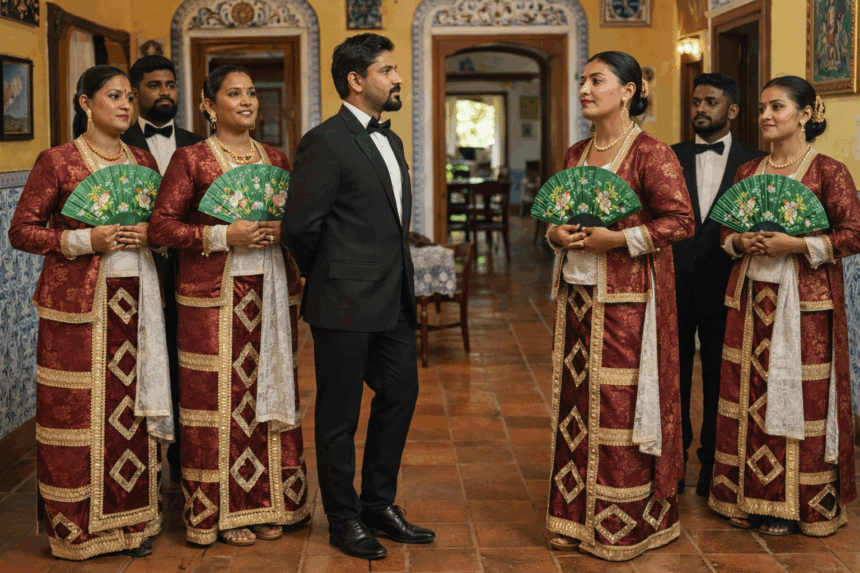
An examination of the attire worn during Mando performances offers further insight into cultural transitions of the 19th century. Men gradually adopted European-style formal clothing, reluctantly abandoning traditional garments such as the Cabaia, a long tunic with wide sleeves introduced during Muslim rule, and the Kaxtti, a waist-supported kerchief covering the genitals. Their new attire typically consisted of a tailored suit, with either a tailed or untailed coat and a collar bow. Women wore the Torhop-baz (also known as Pano baju), comprising a wraparound skirt (Torhop), a blouse (baz), a shawl (tuvalo), and velvet shoes embroidered with gold or silver thread known as Chinelo. The Torhop itself was a stylized adaptation of the traditional Indian loincloth, measuring approximately 90 by 150 cm and distinguished by horizontal and vertical borders.
Two types of Torhops existed, one for festive occasions and ceremonies, and another for mourning. Mourning Torhops were black and white with red or black borders; red signified the death of a close relative or parent, while black indicated the loss of a husband. Widows wore black Torhops until the first death anniversary, after which a black Torhop with a blue border was worn for life. Married women wore Torhops with red borders and avoided black entirely in their attire. Festive Torhops were typically made of velvet or silk in shades of red, blue, or green, embroidered predominantly with gold thread. Shawls were white, blue, or pale yellow and worn over the left shoulder. Jewelry included Pedro Vitorine or Pedro Verde (malachite lantern earrings), Cordão (multi-strand gold beaded necklaces), Chãfim (gold floral hair ornaments), bangles, and Pedra Verde necklaces. Everyday Torhops were stitched in cotton. Variants such as Mudo de Tisso (damask silk Torhops without gold gallon), Fotá quimão (highly ornate Torhops with gold work), and Asquin quimão (home attire for spinsters) are documented, with details provided by Joyce Carvalho e Aguiar.
During Mando performances, it was customary in certain regions of Goa for a man to present a woman with a card bearing the name of the dance he wished to perform with her. Upon acceptance, women formed a line on one side of the ballroom and men on the opposite side. In complete silence, the solemn strains of the Mando guided the dancers through a sequence of slow, graceful movements, advancing right, forward, left, and into a three-quarter turn. When nearing each other at the center, the couples would separate and retreat, followed by another advance culminating in crossings and exchanges of positions. Men employed expressive gestures throughout the dance, flicking handkerchiefs, offering military-style salutes, folding arms across the chest, or adjusting hats theatrically. By the dance’s conclusion, the woman was often visibly exhausted, while the triumphant man wiped his brow and escorted her back to her seat.
Despite its cultural richness, the Mando today faces an uncertain future, Pé. Mansueto Fernandes, a musician and capelão da Capela do Menino Jesus, Muda Cuncolim, observes that very few young people appreciate or engage with the Mando. He attributes this decline primarily to a lack of early exposure, warning that the future of the form appears bleak due to minimal youth participation. Mando enthusiast Mr. Ivo Gonçalves from Moira echoes these concerns, noting that the younger generation often lacks the emotional depth required to breathe life into the lyrics.
Antoneta Piedade de Moraes, from Margão recalls that in earlier times, it was mandatory for brides to sing the Mando and for couples to dance to it. Mando festivals during the 1960s and 1970s, she says, were marked by elegance and high artistic standards, with celebrated groups such as that of Ranchi Viega Coutinho from Margão achieving prominence. Over time, both the number of performing groups and the quality of performances have declined sharply.
Now is the moment to revive this quintessentially Goan 19th-century secular musical form and ensure that the Mando continues to resonate through the generations yet to come.