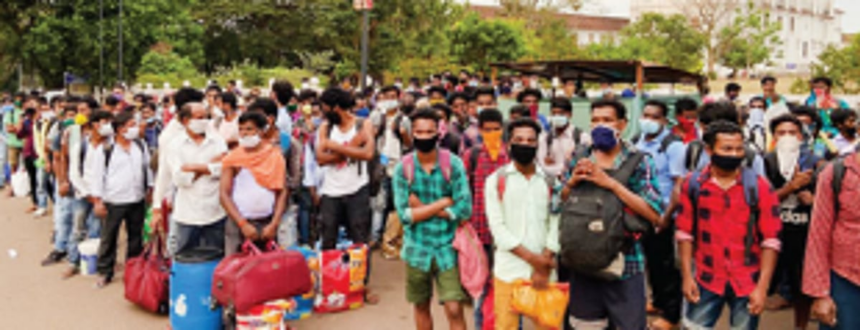
As we observe International Workers Day on May 1, the labour scenario appears grim with loss of jobs, closure of industrial units and the plight of migrant and informal workers remains vulnerable with many of them returning to their native places by available mode of transport due to financial hardship, that follows a lockdown.
During the lockdown last year, an estimated 200 migrant workers including their children reportedly died on their way back home. It was pathetic to watch women with babies in arms trudging their way in the scorching sun. Each day’s economic productivity decides the wages of the migrant workers. Since they became economically unproductive during the lockdown, they do not receive any payment. With little or no savings at hand, a massive exodus of migrant workers took place last year.

After the crisis was highlighted the Union government-organized special “Shramik trains” and temporary ration supplies for migrant workers. However social protection continued to dodge them. This year too the same scenario is being repeated with long queues of migrant workers outside railway stations in Mumbai, New Delhi and Gujarat, and other places.
The migrant workers comprise those handling menial jobs, construction workers and others. They are people employed by contractors for piecemeal work which neither guarantees a job continuation nor social security benefits. They also include roadside hawkers. These migrants live in slums or live in the open without access to water and sanitation.
Although the Inter-State Migrant Workmen (Regulation of Employment and Conditions of Service) Act, 1979, existed earlier, its provisions were largely overlooked by most states with no records of workers maintained. Now the provisions of this act have been subsumed into the Occupational Safety, Health and Working Conditions Act (OSHWCA), under the Industrial Relations Code, 2020 passed in September last year. Earlier there was also the Unorganised Worker Social Security Act 2008 which made the registration of migrant workers compulsory for employers. But by and large, this act was also not implemented in letter and spirit.
New Labour Code
Chapter XI, Part II of the OSHWCA, pertains to migrant workers. But it is silent about the migrants who move within state borders or intra-state migrants. Besides, there is no provision to make companies file annual reports with the labour departments on migrant workers employed and allowances paid to them.
The Act provides for a jail term of up to one year and a fine of Rs 1,000 for violating any contained provisions. It also says that the owner of the establishment employing migrant workers can be prosecuted for violations. Under the Act, the labour inspector is the principal implementer, which gives him powers to conduct inspections and take testimonies of the workers at any time. It also provides for 2 years of jail for obstructing his work.
The OSHWA covers any worker who has migrated to another state, including self-employed workers. It also calls for their registration on a portal that the Central government and the state governments have been mandated to set up. However, the exact mechanism through which this will be done and how the responsibilities related to registration would be fixed is not clear.
The migrants
As per the Census 2011, there are over 45 crore migrants in the country. According to reports of the state labour bureaus, not more than 5% of the migrant workers are enrolled with any state government agency with the only exception of Odisha, which has a helpline and facilities for children of migrant workers. Besides, the Goa government has become a first state to set up a dedicated cell to resolve the issues being faced by migrants labourers.
There are over 11 lakh migrants in Goa. By and large the country needs a “Protection of Immigrants” like the “Protector of Emigrants” (POE) under which intending emigrants are given clearance, to protect and aid them during their stay abroad.