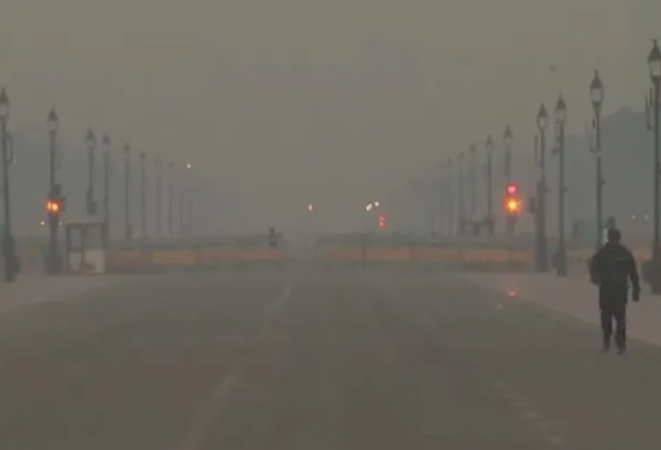
After a brief two-day improvement, Delhi’s air quality once again dipped into the ‘very poor’ category on Thursday, registering a 24-hour average Air Quality Index (AQI) of 307.
Data from the Central Pollution Control Board’s (CPCB) Sameer app showed that 25 out of 40 monitoring stations across the national capital recorded air quality in the ‘very poor’ range. Rohini reported the most toxic air, with an AQI reading of 372.

The Decision Support System (DSS) for Air Quality Management identified transport as the highest contributor to Delhi’s pollution levels at 16.6%. This was followed by emissions from industries in Delhi and its surrounding areas (8.3%), residential sources (4%), and construction activities (2.2%).
Neighbouring NCR districts also added significantly to Delhi’s pollution load. Jhajjar was the top external contributor at 18%, followed by Rohtak (5.8%), Bhiwani (3.9%), Sonipat (2.7%), and Gurgaon (1.9%).
As per CPCB classifications, an AQI of 0–50 is ‘good’, 51–100 ‘satisfactory’, 101–200 ‘moderate’, 201–300 ‘poor’, 301–400 ‘very poor’, and 401–500 ‘severe’.
The city began the morning in the ‘poor’ category with an AQI of 288. Forecasts from the Air Quality Early Warning System suggest that Delhi’s air is likely to remain in the ‘very poor’ zone until Saturday.
(This story is published from a syndicated feed)