AUGUSTO RODRIGUES
For years, despite clear High Court orders, illegalities along Goa’s coast flour-ished with open impu-nity. It has taken a man-made tragedy to force a pause a catastrophe that has momentarily stalled an ecosystem of bra-zen lawlessness the government allowed to metastasize unchecked.

Today, in what residents grim-ly describe as a ‘welcome lull’, the Anjuna-Vagator belt is quieter than it has been in years though that silence has come at the cost of 25 innocent lives. The calm is uneasy and heavy with the knowledge that it exists not because authorities acted, but because disaster struck.
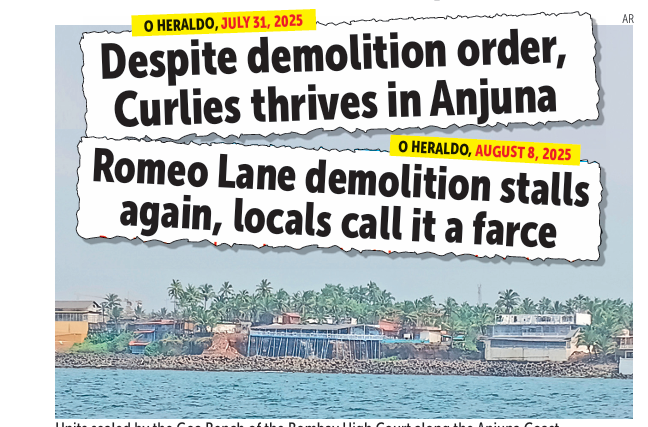
In Public Interest Litigation (SuoMotu) No 2 of 2022, the Goa Bench of the Bombay High Court had ordered 175 structures to be sealed. Yet three years later, the ground re ality reads like an indictment: Curlies in Anjuna — the only unit to lose its appeal against GCZMA’s demolition order — still stands (see ‘Despite demolition order, Curlies thrives in Anjuna’, O Heraldo dated July 31, 2025). 117 units con tinue to operate; 14 are closed; 19 are temporary shacks and 25 cannot even be located. Not only has Curlies remained untouched since June 5, 2024, but the path leading to it — rugged and symbolic of neglect — mirrors the government’s unwillingness to en force its own mandates. Deputy Collector (North Goa) VarshaParab said, “I know Curlies needs to be demolished. I have sent the file to GCZ MA. They (GCZMA) are supposed to conduct an inspection but I am not aware of the details. Once I get the report, work on demolition will begin.” But Goa has heard such assurances before. GCZMA Secretary Sachin Dessai admitted that mapping was ‘supposed to be underway’. “I am aware of the order and my staff is supposed to be doing a mapping of the place. I am not sure of how far they have reached. But I shall get back to you by five pm,” he stated. Till the time of going to press, Dessai did not revert. The judiciary had long sensed something amiss. Justice M S Sonak and Justice Valmiki SA Menezes had come down heavily on the secretaries of the Village Panchayat during the hearings stating, “at least prima facie, we think that false statements were made, particularly by DharmendraGoven kar before this Court, about the sixteen demolitions that were informed had already been carried out. Jitendra Naik has also to explain his role since October 2023.” Along the coast, the figures were damning. From the 117 units that escaped the High Court seal, 19 were temporary shacks and hence could not be indentified on the coast and 10 were units – resting on CRZ-II areas – run by the family of two individuals from the village alleg edly arrested for murder and now on bail. 62 units were part of two hotels, located on what were mountain tops of the village which were ordered to be sealed. They were rooms built on CRZ areas that the own ers managed to later get permission from GCZMA. “Upon written verification by the GCZMA that the eight huts with 12 rooms are indeed temporary and in accord ance with GCZMA plans, the Panchayat is authorised to de-seal them,” read an order by the two justices of the Goa Bench of the Bombay High Court in possession of O Her aldo. Evidence on GCZMA’s failures is not controversial but has left the locals in the village wanting to distance them selves from the authority with local Maxcy D’Souza won dering, “how are permanent structures being described as temporary.” A former sarpanch of the village has nine units function ing despite the same being sealed because they are on CRZ land. At the time of sealing, none of the units had any per mission from GCZMA. Most units were operating based on copies of Village Panchayat resolutions; report from Collec tor and copies of Panchayat Trade license. According to CRZ Notification 2011, only traditional coastal communities are allowed to reconstruct houses in CRZ III to carry out their traditional livelihoods as per GCZ MA rules. Local Alfredo Dias believes a majority of the one hundred and seventeen structures that have been de-sealed have done so, “by putting wool in the eyes of the authorities.” As one sailed through a canoe to get a closer look of the truth , the words of Dias came closest to the truth when he said, “Our entire coastal belt has disappeared with out siders coming and building clubs that blast music all night right on the shoreline. Were those our traditional huts?” “The High Court took SuoMotu action because the viola tions were too blatant but somehow the Panchayat man aged to profit off the case. Action was taken on the mar ginalised and the moneyed not only managed to get their places de-sealed but built more,” claimed Annie D’Costa who runs a small establishment in a field. The village Panchayat of Anjuna, in its status report to the Goa Bench of the Bombay High Court, admitted that from the thirty eight structures to be demolished only ten had and the remaining could not as the respective parties were granted stays by the Additional Director of Panchayats. One unit, belonging to a member of the ruling political dispensation, which was sealed, also managed to be de sealed despite not having any permission from the GCZMA prior to being sealed as per records sourced. “The Courts are our last bastion for justice and this is be ing demonstrated so often that unless the Courts force the hand of the government or any tragedy strikes , the gov ernment does not awaken from its slumber with respect to blatant illegalities,’ said advocate MelwinViegas. “Unless Goans unite, come on the roads for simple issues, it appears that the government is giving permanency to its nelson’s eyes to rampant corruption leading to the slow destruction of our little amazing Goem,” added Advocate Viegas.