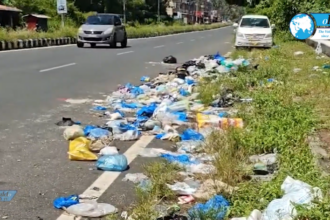
Reason: close vicinity of septic tanks
PORVORIM, JAN 26
Believe it or not, 90% of the wells in Panjim are contaminated, mainly because the distance between septic tank and wells or ground water tanks are less than the minimum 20 mtrs.
“The Public Health Act states that the distance between septic tank and wells or ground water tanks should be minimum 20 mtrs. However, this is not being observed by the citizens, due to which 90% of the wells in Panjim have become contaminated,” said Mapusa Health Officer Dr Pradeep Korgaonkar, who previously served as health officer of Panjim Health Centre.
He was speaking at a programme organized by Goa Institute of Rural Development and Administration (GIRDA) in association with Public Works Department to create awareness about Natural Rural Drinking Water Quality Monitoring and Surveillance programme of Central government at Guirim Panchayat hall on Tuesday.
“In Mapusa, the hutment dwellers residing on the hills do not have septic tanks and as such the entire sewage flows down the Mapusa town through the nullahs. The solution to this type of problem is the sewage line. It is sad that in most of the towns in Goa, there is no separate sewage line,” said Dr Korgaonkar.
Dr Korgaonkar further said no water, whether it is received from treatment plants or wells or tube wells, is safe for drinking.
“The water must be boiled and then consumed. As per the Natural Rural Drinking Water Quality Monitoring and Surveillance programme, every ward of municipal council must have Ward Health and Sanitation Committee. Mapusa Municipal council is yet to form these committees,” said Dr Korgaonkar.
Aldona Primary Health Centre Health Officer Dr Pradeep Dhavjekar stated that 80% of the diseases are generated through water.
“The Town and Country Planning should make it compulsory for builders of houses or buildings to indicate the distance between the septic tank and ground water tank in blue print while submitting the projects for approval,” said Dr Dhavjekar.
“It has been observed that in most of the buildings and houses, there is hardly any distance between septic tank and water tank. The chemical composition of the water should also be checked,” added Dr Dhavjekar.
“The water, if it contains chemicals like lead, chlorides and heavy metal, may affect kidneys. The panchayat should not encourage illegal constructions as these constructions are built in haphazard manners violating health rules,” said Dr Dhavjekar.
Candolim PHC Health Officer Dr Sachin Govekar said as per the Public Health Act, every panchayat is required to form a Village Health Sanitation Committee, but most of the panchayats have still not formed such committees.
“Sanitation and health go hand in hand and hence it is necessary that panchayats take interest in maintaining cleanliness in the village. As per Section 40 of the Public Health Act, those who commit nuisance can be penalized,” added Dr Govekar.
Siolim PHC Health Officer Dr Chandrakant Parab, Colvale Health Officer Shetaoker, GOACAN Convener Roland Martins, PWD Superintendent Engineer V Santanam, Assistant Engineer P Surlikar and Guirim Sarpanch Ankush Menezes also spoke on the occasion.
Earlier, GRIDA Assistant Director Rekha Joshi welcomed the gathering, while Shambavi Kamat compered the programme.