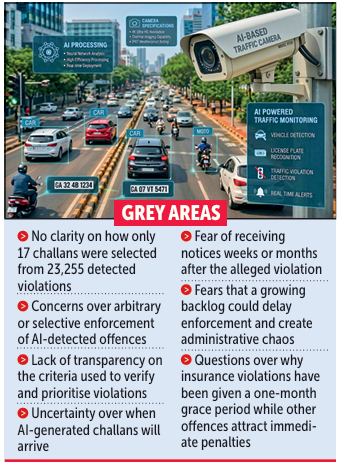
Goa’s ambitious rollout of AI-powered traf fic surveillance has begun with an eye-catching sta tistic — and an even bigger question mark. Within the first 24 hours of PANJIM: Goa’s ambitious rollout of AI-powered traf fic surveillance has begun with an eye-catching sta tistic — and an even bigger question mark. Within the first 24 hours of becoming operational, the state’s AI-enabled traffic cameras detected a stagger ing 23,255 traffic violations across 26 locations. Yet, despite the massive haul of offences, only 17 challans were issued, triggering con cerns over the transparency, consistency and the arbi trary enforcement.
The Transport Depart ment said 16 challans were issued to two-wheeler rid ers for riding without hel mets and one for a seatbelt violation. Officials main tained that the remaining violations are undergoing verification before notices are generated to ensure le gal compliance. However, the sharp dis parity between the number of violations detected and the number of penalties issued has left motorists questioning how the first 17 cases were selected from a pool of more than 23,000 of fences. The government has becoming operational, the state’s AI-enabled traffic cameras detected a stagger ing 23,255 traffic violations across 26 locations.

Yet, despite the massive haul of offences, only 17 challans were issued, triggering con cerns over the transparency, consistency and the arbi trary enforcement. The Transport Depart ment said 16 challans were issued to two-wheeler rid ers for riding without hel mets and one for a seatbelt violation. Officials main tained that the remaining violations are undergoing verification before notices are generated to ensure le gal compliance. However, the sharp dis parity between the number of violations detected and the number of penalties issued has left motorists questioning how the first 17 cases were selected from a pool of more than 23,000 of fences. The government has not explained whether the challans were issued ran domly, based on the order in which violations were re corded, or according to any other criteria.
The unanswered ques tions have fuelled fears that motorists could receive The unanswered ques tions have fuelled fears that motorists could receive challans weeks or even months after the alleged offence, by which time re calling the circumstances or contesting the violation could become significantly more difficult The scale of the task has also raised doubts over wheth er the Transport Department possesses the infrastructure required to scrutinise and process such a massive volume of cases. If more than 23,000 violations can be detected in a single day, the backlog could swell into several lakh pending cases within weeks unless the verification process keeps pace. The AI cameras are capable of automatically detecting a range of violations, including riding without helmets, driv ing without seatbelts, using mobile phones while driving, over speeding, unauthorised parking and operating vehi cles without valid insurance.
While the government has described the system as a tool to improve road safety rather than maximise revenue, its phased implementation has prompted questions over con sistency in enforcement. Transport Minister Mauvin Godinho announced a one month grace period during which motorists driving with out valid insurance will not be fined, despite the AI system detecting such violations from day one. No detailed expla nation has been provided on why insurance violations — which can carry serious legal and financial consequences in the event of an accident — have been temporarily ex empted while offences such as riding without helmets, failing to wear seatbelts, over speeding and using mobile phones while driving continue to attract immediate en forcement. Defending the initiative, Godinho said its objective was to improve road discipline rather than penalise motorists indiscriminately. “The cameras have been installed to ensure discipline on our roads. Traffic rules have to be followed to prevent ac cidents and protect both yourself and others,” the minister said.
Expressing concern over the large number of uninsured vehicles detected by the AI system, he warned motorists of the consequences of driving without valid insurance and urged them to regularise their documents. “Most accidents occur due to over speeding. Those who do not commit offences will not have to pay fines,” he said. The government has appealed to motorists to wear hel mets and seatbelts, avoid using mobile phones while driv ing, obey speed limits and ensure that vehicle documents, including insurance, remain valid. Yet the first day’s figures have shifted attention from the technology’s ability to detect violations to the State’s abil ity to enforce them fairly and efficiently.