SHASHWAT GUPTA RAY
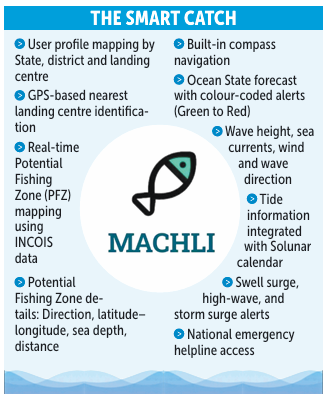
A new digital tool promising to trans form the way India’s fishing community navi gates the seas was unveiled this week, blending ocean science, artificial intelligence and grass roots feedback into a single, multilingual mobile platform — Machli. Developed by the Indian National Centre for Ocean Information Services (INCOIS), an auton omous organisation under the Ministry of Earth Sciences, in association with Reliance Founda tion, ‘Machli’ app is designed to make fishing saf er, smarter and more sustainable. The app was launched at the Marine Fishermen Meet held as part of the ongoing World Ocean Science Con gress 2026 (WOSC 2026). The app is accessible in 10 Indian languages and offers both text and audio formats to ensure accessibility even for users with limited literacy. “The Machli marine advisory app is a multilin gual, AI-enabled marine advisory platform designed to strengthen fisher safety, navigation and livelihood decision-making across India’s coastal States,” Di rector of INCOIS, T M Balakrishnan Nair said.

“The app can be accessed in 10 different Indian languages. Our fisher men in Goa can avail of the services in Marathi. It has both text and audio facilities. One can listen to whatever information is sought on the app,” Nair told O Heraldo after launching the app. Beyond weather alerts, the platform integrates predictive intelligence and oceanographic data to guide fishermen towards areas with higher fish aggregation. Nair explained that the app identifies zones with high concen trations of commercially valuable species such as tuna and mackerel, while also providing critical inputs on wave heights, ocean currents and wind conditions — key variables that influence both catch potential and safety. “This is part of one of the major MoUs signed between Goa University and INCOIS, where we want to focus on providing all kinds of information for fishermen, the tourism department and also the shipping sector,” he said. According to S Senthil Kumar, Head, Platforms and Applications at Re liance Foundation, the application was developed after extensive consul tations with fishing communities across peninsular India to ensure it is intuitive and practical in real-world conditions. “This app doesn’t just give information; it provides predictive intelli gence. For example, when there is a cyclone, it’s not just about its speed and distance. It can provide information about the exact path. If it is going to strike a low-lying area, then villagers may want to move their livestock to a higher location,” he said. The emphasis on usability was echoed by S Prasanna Kumar, former act ing director of NIO Goa and Coordinator, WOSC-2026 (Students Outreach and Fishermen Meet), who underscored the simplicity of the interface. “It is very simple to use. There are graphics that provide all kinds of in formation a fisherman would need by just tapping on the visuals,” he said. Director of Fisheries, Government of Goa, Chandrakant Velip, pointed out that access to Potential Fishing Zone (PFZ) advisories can significantly reduce the time spent searching for fish and cut down on fuel consumption — a major operational cost for small-scale fishermen. “Additionally, there is a helpline for fishermen in distress on the high seas due to rough weather or any other emergency. They can send messages to the nearest control room or fellow fishermen, and their lives could be saved. As Director of Fisheries, I would request all my fishermen to install this app on their mobile phones, as it will definitely help them,” Velip added.