Aviation project sparks outcry in Betul
MARGAO: The State government’s decision to clear an integrated aero-sports and aviation hub at Quitol-Betul has ignited sharp ecological and political backlash, with wildlife experts warning that the plateau hosts newly listed “Near Threatened” bird species, even as residents accuse authorities of pushing yet another mega project without public consultation.

Earlier this week, the Goa Investment Promotion and Facilitation Board (IPB) granted in-principle approval for the project on 2,45,459 sqm of land at the Quitol Industrial Estate. The proposed hub is expected to include skydiving, paragliding, hot air balloon rides, microlight operations, drone testing, aviation training and related facilities.
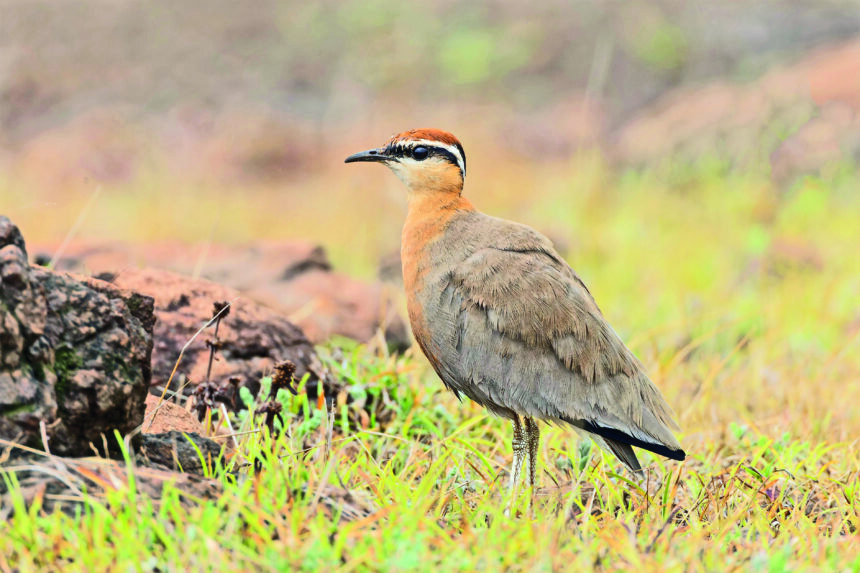
The approval has renewed focus on plateau ecosystems following the recent decision of the International Union for Conservation of Nature (IUCN) to uplist four bird species to the “Near Threatened” category. Three of these species are open grassland and plateau-dependent birds found in Goa.
Wildlife expert and author Parag Rangnekar described the development as deeply troubling. “I am not sure which direction we are heading in,” he said. “Wildlife and ecology, which should be at the centre of our discourse, have been reduced to something ornamental — celebrated through days and festivals — but they do not seem to matter or feature in developmental planning.”
Rangnekar directly linked the Quitol proposal to the recent conservation update. “The IUCN has recently uplisted four birds to the ‘Near Threatened’ category, three of which — all found in Goa — are open grassland and plateau-dependent birds,” he said. “The Indian Courser, one of the uplisted species, was recorded at the Quitol Plateau on February 11, 2026. It is a new record for the State.”
He said the timing of the project was particularly distressing in light of that sighting.
“That the plateau is now earmarked for an aerospace and aviation hub, with nearly 2.50 lakh sqm of land set to be converted, distresses me immensely. We have lost Mopa; all our industrial estates are on plateaus; the last remaining open areas in Verna are being built over; and the majority of our housing projects are on plateaus.”
Questioning the broader planning approach, Rangnekar added: “Why do we undermine the importance of this ecosystem when many senior scientists have spoken about its ecological significance? I hope better sense prevails and decision-makers factor ecological knowledge into developmental planning. And please spare me the sermon that these areas are devoid of trees.”
Aam Aadmi Party (AAP) Goa President Valmiki Naik drew attention to Rangnekar’s statement by noting that his book Wild Goa was released by Chief Minister Pramod Sawant, praised by Prime Minister Narendra Modi, and presented to visiting dignitaries as an official memento of the State. By foregrounding Rangnekar’s credentials and official recognition, Naik appeared to question how the government could celebrate his conservation work while proceeding with a project he has strongly opposed.
While ecological concerns have dominated the immediate debate, resistance on the ground in Betul has also begun to gather momentum.
Residents of Betul and adjoining areas told the media they were disappointed with the government’s decision and recalled that they had not been taken into confidence, even as they continue to await the promised food park for the area. Villagers said the repurposing of the site marks a departure from earlier development projections and sought clarity on how aviation-related activities would affect the locality.
The food park proposal had previously been positioned as an initiative expected to generate local economic activity. Residents now argue that converting the site into an aviation and aero-sports facility alters both the character and intended use of the area.
Local leader Dagley Fernandes also questioned the decision, pointing to what he described as a growing list of major interventions in Betul. “There is already a port project, ONGC-related hill cutting and a proposed university campus in Betul. Successive large-scale projects seem to move forward without clearly benefiting Goans. Now, with the addition of an aviation hub, there are serious concerns about the cumulative impact of multiple developments on the coastal belt,” he said.
With ecological warnings, political scrutiny and grassroots opposition emerging soon after the IPB clearance, the Quitol-Betul proposal has evolved into a broader test of whether major development initiatives can proceed without adequately addressing environmental science and public sentiment.