Santosh Naik

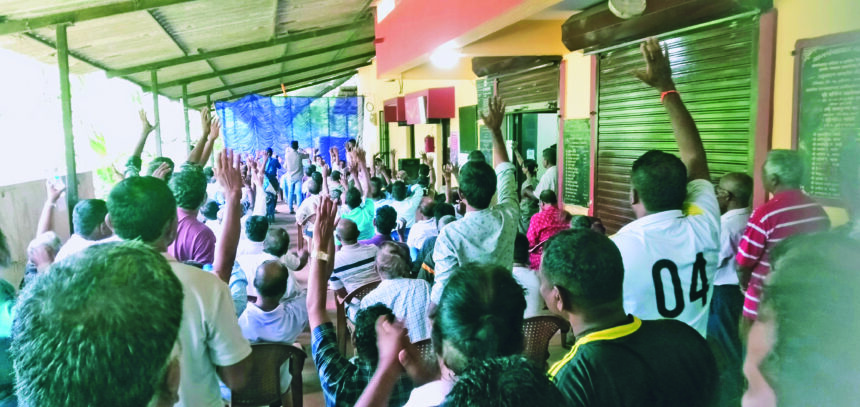
PONDA: The proposed Indian Institute of Technology (IIT) at the Farmagudi GEC Plateau ran into a wall of opposition on Sunday, with Bandora villagers unanimously rejecting the project and warning that construction on the plateau could destroy a critical water-recharge system and leave communities at its foothills facing an acute water crisis.
The villagers told the Gram Sabha that the issue was not merely about constructing another institution on government-acquired land, but about the fate of a plateau that sustains the water systems, agricultural lands and biodiversity of several surrounding villages.
They warned that an IIT campus accommodating thousands of students, staff and workers would place enormous pressure on the plateau’s water resources. With the plateau situated above the surrounding villages, villagers fear that the drilling of borewells and large-scale construction could disrupt the natural flow of water into wells, springs, temple lakes, tollens, kulagars and bagayats below.
Sarpanch Chitra Fadte, who chaired the Gram Sabha, said the Panchayat would stand with the villagers in opposing the project.
“If the villagers don’t want the IIT, then the Panchayat is also opposed to it. The Panchayat will stand with the villagers,” she said.
The Gram Sabha also demanded that the Katamagal Dada Plateau, on which the GEC is located, be declared a heritage site. Villagers said the plateau, named after the Katamagal Dada deity, has been worshipped since Portuguese times and should be protected from further development.
Gurudas Naik opposed the proposed IIT and demanded that the shrine, referred to as 160/0, be declared a protected site, with no development permitted in the area. The resolution adopted by the Gram Sabha will be forwarded to the Director of Technical Education.
Advocate Surel Tilve, chairman of the Bandora Biodiversity Committee, said the Farmagudi plateau was far more than a piece of land available for construction.
“It is not just a plateau, but a rainwater harvesting system. Villagers from the surrounding Panchayats of Bandora, as well as Veling-Priol-Cuncoliem, depend on the GEC plateau for water and for the irrigation of bagayats and kulagars,” he said.
“The plateau is exactly at the top of the villages. When the IIT comes, it will definitely exploit water through borewells and also destroy the rich biodiversity. The Tollem (lake) at Donshi, Bandora, has already dried up due to a borewell constructed at the Farmagudi plateau,” Tilve said.
His warning comes amid growing opposition to unchecked development on the plateau and its slopes. Tilve said villagers had also opposed land conversions under Section 39A on sloping land at Farmagudi, alleging that such conversions threatened water sources, bagayats and agricultural fields.
He said a plotting project involving infrastructure work for around 400 plots had already begun at Farmagudi, including the construction of retaining walls stretching nearly 100 metres.
“Due to increasing construction and the drilling of borewells at the top of the plateau, villagers residing at the bottom will face a major water crisis,” he said.
Tilve said the Biodiversity Committee would submit a letter to the Water Resources Department seeking an inspection of the number of borewells dug on the plateau and demanding action to prevent further exploitation of groundwater.
Villager Dinesh Gaunkear questioned whether the government had conducted an environmental impact assessment before pushing the IIT proposal.
“It is not only about religious activities, but also about the environment. Has the government conducted an environmental impact assessment before pushing the IIT proposal?” he asked, questioning Chief Minister Pramod Sawant.
Gaunkear also raised questions over the management of sewage from a campus expected to house thousands of students, employees and workers.
“How will the sewage be handled at the top of the plateau when thousands of students, staff and workers are expected to stay there? If sewage penetrates the water resources, people living at the bottom of the plateau will face polluted water in their wells,” he said.
He said the plateau was rich in biodiversity and warned that the surrounding tollens and temple lakes could eventually dry up if the natural water-recharge system was disrupted.
Gaunkear said the plateau’s present ecological importance was the result of deliberate efforts by earlier generations.
“The plateau was earlier rocky land, but our forefathers were visionary. For the sake of future generations, they protected the plateau and converted the rocky land into soft soil by carrying waste mud from paddy fields in bullock carts. This allowed water to penetrate the top of the plateau and recharge the wells, springs and lakes used by people living below,” he said.
The opposition comes after villagers in several other parts of Goa rejected proposals to locate the IIT in their areas. The Veling-Priol-Cuncoliem Panchayat had also opposed the proposed IIT at its Gram Sabha last week, citing fears over future water scarcity and environmental damage, with residents pointing out that they too depend on the Farmagudi plateau.