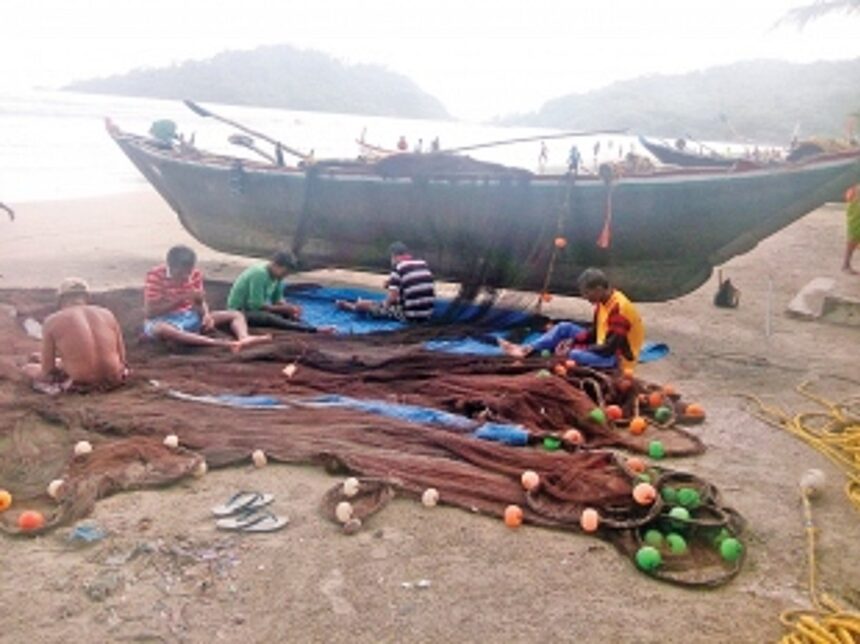
CANACONA: Canacona’s traditional fishermen are gearing up for the fishing season that recommences on August 1. Since the last week, many ramponkars have been repairing their fishing nets on the beaches.
According to Dilhon Pagui, many generations have earned a living by fishing with nylon fishing nets and non-motorized canoes. He said, “Fishing ban or no fishing ban, we fish round the year. We venture out in the sea even during bad weather because we are good swimmers.”
“We use the oars, our hands and a little food and water to last for a day. We are off duty only during festivals, and thanks to our efforts, the people get fish all round the year,” said Ram Pagui from Palolem. He added that unlike trawlers, the fishermen weren’t dependent on diesel, engines or drivers.
Ram also lamented that it was difficult to mend or patch defective nets. In olden times, suitable knots were devised to make the nets. The net size was determined by the availability of materials and they were mended by hand.
“Around 10,000 to 12,000 Canconcars depend on fishing for a livelihood. Most of them work in wooden out-riggers or small fiber-glass boats. Despite the introduction of outboard motors, their methods remain traditional and low-tech,” said Dilip Mokhardkar, former president of Akhil Goa Kshatriya Pagui Samaj.
Mokhardkar also said the tourism industry had affected not only their traditional business, but also the coastal areas by extracting sand for erecting shacks, tents and huts every season.
Former Chairperson of Canacona Municipal Council Dayanand Pagui, who is also a traditional fisherman, informed that the fishermen in Palolem were happy presently as they get a good catch of small fish (Kormott) in their nets every day.
The catch is divided according to each family’s stake in the net. If fish is found after markets close, they are salted and dried, while fish that has no market value is used as manure for plants and coconut trees.
Yields from this kind of fishing are only available at the Palolem, Patnem, Agonda and Colomb beaches
“The yield is also affected because most of the space used by the fishermen is being occupied by tourist and government shacks,” added Gomati Pagui.
From the last many years, the fishing businesses has shrunk considerably due to competition from larger, more modern and better-equipped trawlers.