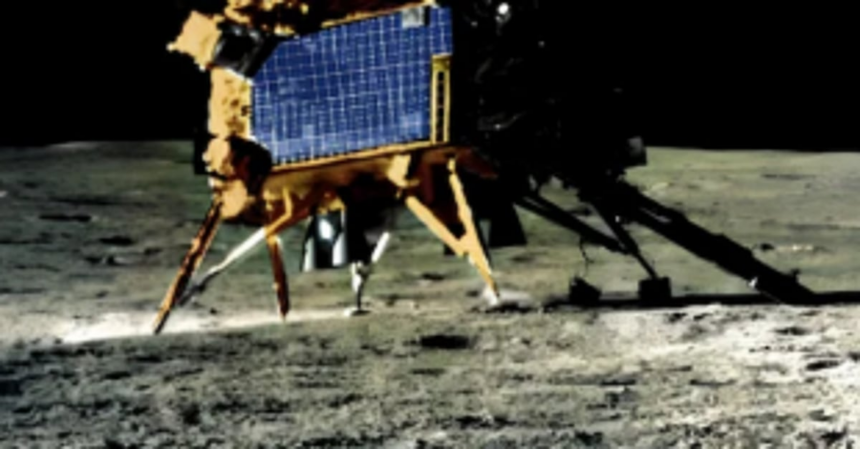
The reactivation of Chandrayaan-3’s Pragyan rover and Vikram
lander, initially scheduled for Friday evening, has been rescheduled for
Saturday, as announced by Nilesh Desai, Director of Space Applications Centre.
The Indian Space Research Organisation (ISRO) had planned to
rouse the lander and rover from their ‘sleep mode,’ a state they had been in
for approximately 16 Earth days, before the lunar night descended over the
Moon’s south pole.

Desai explained, “Earlier we planned to reactivate the
rover and lander on the evening of 22nd September, but due to some reasons we
will now do it tomorrow on 23rd September. We have a plan to take out the
lander and rover from the sleep mode and reactivate it.”
The primary objective behind reactivating the rover and
lander is to facilitate the rover’s movement on the lunar surface. Desai
further elaborated, “We had a plan to move the rover to almost 300-350
meters. But due to some reasons we couldn’t. The rover has moved 105 meters
till now. Last time, we moved it for 10 days on the surface of the moon.”
Notably, both modules of Chandrayaan-3 had functioned efficiently
for about 10 Earth days, accomplishing their designated tasks. The rover
entered ‘sleep mode’ on September 2, followed by the lander on September 4.
The Chandrayaan-3 mission achieved a significant milestone
when the Vikram lander executed a successful ‘soft-landing’ on the Moon’s
surface on August 24, making India the first nation to land on the Moon’s south
pole. Subsequently, the Pragyaan rover conducted in-situ experiments and
successfully detected various elements, including Sulphur (S), Aluminium,
Calcium, Ferrous (Iron), Chromium, Titanium, Manganese, Silicon, and Oxygen.
However, it’s crucial to acknowledge that the extreme
conditions at the Moon’s south pole present formidable challenges, with
nighttime temperatures plummeting as low as -200° Celsius.