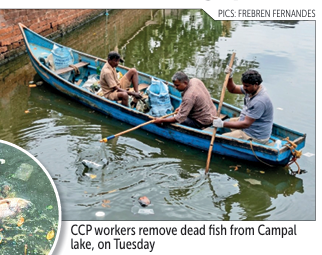
Just weeks after mass fish deaths at Mala Lake shook Panjim’s civic and environmental agen cies into issuing assurances and launching inspections, a fresh wave of dead fish has now surfaced at Lake View Colony, Campal — exposing a continu ing pattern of ecological neglect rather than an isolated incident. On Tuesday, a large number of dead fish were found floating in Cam pal lake, triggering a foul stench across the surround ing residential area and forcing the Corporation of the City of Panaji (CCP) to deploy workers and boats to remove the carcasses. While cleanup operations were initiated, authori ties offered no immediate explanation for the sudden mortality event. The lake, linked to the St Inez Creek system, is widely believed to be high ly vulnerable to urban discharge pressures, in cluding untreated sewage inflows, toxic runoff and reduced tidal exchange. Residents and environ mental observers say these stressors, long flagged in earlier incidents, continue unchecked despite repeat ed episodes of fish mortal ity across interconnected water bodies.
What makes the latest incident particularly alarming is its proximity to the Mala Lake fish kill in mid-April, where decomposing fish and a persistent stench prompted judi cial intervention and a subsequent crackdown on illegal sewage outlets. Even then, preliminary assessments had pointed to a sharp fall in dissolved oxygen levels — possi bly triggered by industrial effluents or abrupt changes in water flow — as a likely cause. At Campal Lake, residents now fear a similar ecological failure may be unfolding again, suggesting that corrective measures announced after the earlier incident have failed to prevent recurrence. “We are deeply concerned by the large number of dead fish found in the lake. Authorities must immediately inves tigate the cause of this incident, whether it is due to pollu tion, sewage inflow, or a drop in oxygen levels. Water qual ity tests should be conducted without delay to determine the source of the problem and prevent further damage to the lake’s ecosystem,” said a resident of Campal Lakeview Colony. Environmentalists have been more direct in their crit icism of institutional inaction and lack of preventive monitoring. Highlighting the unusually harsh summer conditions and absence of proactive intervention, envi ronmentalist and Convenor of Goa Green Brigade, Aver tino Miranda, said, “Considering the unusually High heat, the government should have taken measures to prevent these preventable mass fish deaths. However, the local civic body the CCP and the Department of Environment have miserably failed to take simple measures to monitor the PH level of the water and inject fresh water. No steps have been taken to prevent dumping of garbage and sew age in these eco-sensitive water bodies.

The Goa Govern ment must fix responsibility of the respective government agencies to prevent any future mass deaths of fishes in the water bodies and initiate urgent measures on a war footing to prevent future disasters of the marine life in our water bodies.” Despite previous interventions, including aerator in stallations after a similar fish kill in 2022, Campal Lake ap pears to be reverting to a cycle of contamination and oxy gen depletion — raising questions about the effectiveness of long-term monitoring and enforcement mechanisms. Dr Mohan Girap, Scientist-C at Goa State Pollution Con trol Board (GSPCB) official said that the Board has col lected samples from the water-body for further analysis. Authorities have yet to release any scientific assessment of the latest incident. Residents, meanwhile, are demand ing immediate water testing, identification of pollution sources, and accountability for what they describe as a preventable ecological failure repeating itself in Panjim’s urban water system.