Many a time, the acts of genuine Goan activists, fighting for their motherland have been met with rebukes, mainly from those close to the ruling class. Their protests, their statements, their street agitations have been termed “against national interest” and sections of the ruling government have termed many ‘anti-people projects’ like the railway double-tracking, the highway expansion and the power transmission lines through Mollem as “national interest” projects. But the people of Goa have protested when they felt that this so-called national interest is not in people’s interest.
The Delhi High Court has articulated the inner voice of what most of you feel. Activists are neither terrorists nor anti-national. And the right to protest, even if it sometimes “pushes the limits” and leads to strong street protests, chakka jams etc when there is widespread opposition to government or parliamentary action is within the law.
In a judgment which is a huge boost to democracy and the right to protest, already enshrined in the Constitution, the court order granting bail to three student activists –JNU students Natasha Narwal and Devangana Kalita and Jamia Millia Islamia student Asif Iqbal Tanha – for their alleged role in the North East Delhi riots, in the aftermath of the anti CAA protests, has said – and this tells it all – “(The) State has blurred the line between the Constitutionally guaranteed ‘right to protest’ and ‘terrorist activity’. If such blurring gains traction, democracy will be in peril,” the bench said in the judgment granting bail to Kalita, one of the students.
The Bench comprising Justices Siddharth Mridul and Anup J Bhambhani held that the foundations of this nation stood on surer footing than those likely to be shaken by a protest, however vicious, organised by college students who operated from the confines of a university.
These words of the court bear huge significance. It underlines that protests, even if it pushes the line between peaceful and what is permissible in the law, even if not strictly peaceful is legitimate. “Though such protests are expected to be peaceful and non-violent, it is not uncommon for protesters to push the limits permissible in law. The making of inflammatory speeches, chakka jams and such like actions are not uncommon.”
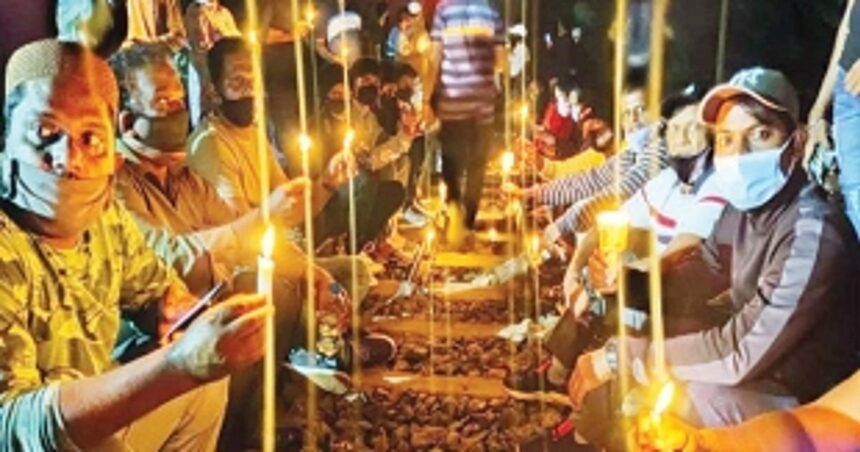
On the intervening night of November 1-2, over 3,000 Goans had come out to protest the double-tracking of the railway line off Chandor. The Goa Police have filed an FIR and booked convenors of two NGOs — Goyant Kolso Naka and Goencho Ekvott. The FIR also includes a section on rioting. There were peaceful Goans marching and sitting with lit candles and shouting slogans, including elderly ladies and gentlemen who would never even harm a fly. Did the police see rioters here? In the light of observations made by the Delhi High court in the bail order for three student activists, the FIR lodged for the November 1/2 anti-double tracking protests also blurs the line between the right to protest and rioting.
Goans have a right to demand the quashing of a knee-jerk police action and withdrawing the FIR.
Whenever there are injustices, be it against coal pollution, the skewed Coastal Zone Management Plan, or any other social and civic issue, standing up to the government is a right of every Goan and it is guaranteed by law. These are protests by the people, for the people and of the people. Unless there is irrefutable evidence that these were violently against the State (not to be confused with the ruling party), there cannot be any coercive action by the State to suppress genuine dissent.
For the last word, let’s go back to the court order, “the right to protest is not outlawed and cannot be termed as a ‘terrorist act’.”