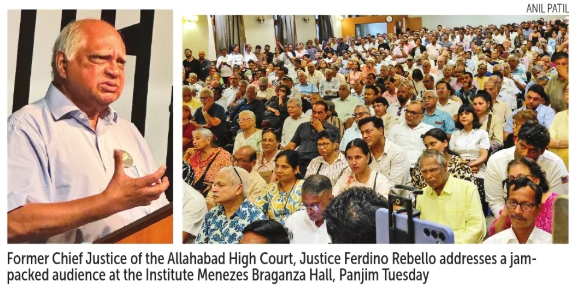
A strong call for the immediate repeal of Sections 17(2) and 39A of the Town and Country Planning (TCP) Act, along with other relat-ed legislations permitting change of zoning, land use and Floor Area Ratio (FAR), dominated a much-anticipat-ed public meeting held on Tuesday at the Institute Me-nezes Braganza Hall, Panjim. The meeting was organised by former Chief Justice of the Allahabad High Court, Justice Ferdino Rebello.
The hall was packed to capacity, with every seat oc-cupied and many attendees standing. To accommodate the overflowing crowd, the organisers installed a giant screen at Azad Maidan, allowing those who could not be accommodated inside the hall to follow the proceed ings.

All seven Opposition MLAs and two former MLAs were present in the front rows. Speakers at the meeting included activist Rajdeep Naik, architect Tahir Noronha, influencer Usman Khan Pathan, trib al leader Ravindra Velip and Goa Freedom Fighters Association president Ro-hidas ‘Dad’ Dessai. Veteran freedom fighter Libia Lobo Sardesai was also present on the dais.
A slogan displayed on the stage read “Enough is Enough” in English and “Ani Sonsu Nejo” (We can’t
take anymore) in Konkani, setting a defiant tone for the gathering.
Justice Rebello declared, “Section 17(2) of the TCP Act must go, Section 39A must go, and the Goa Land Revenue Code must be amended to prevent the sale of land to non-agricul-turists and non-residents. These two sections insert ed into the TCP Act have become a source of mon-ey-making and must be repealed.”
Stressing the importance of collective action, he said, “How can there be an ac-tion plan without organisa-tion? We must start struc-turing an organisation. The core leadership must
consist of activists and not office-bearers of political parties. We seek the sup-port of all political parties, but the 10-point charter is non-negotiable. It is not against the government; it is for the people and the youth, who are our future.”
Describing hills and for-ests as the heritage of the people, Justice Rebello de-manded an immediate halt to all development and hill cutting. He urged the gov-ernment to promulgate an Ordinance or introduce a Bill to amend the law or relevant regulations to stop such activities forth-with. He further demanded that until the contentious laws are repealed, all permissions granted under the amended pro-visions be put on hold. “In plots where development has not commenced or is only partially completed, work must be suspended,” he said.
Clarifying that the movement was not politically moti-vated, Justice Rebello stated, “This is not a movement of political parties. I have no aspiration to contest elections. I am satisfied with my position as former Chief Justice of the Allahabad High Court. We must restore morality among our youngsters and uphold integrity. The government must know that we are fighting for our values”
Referring to protests across the State, he added, “I said to myself, if others don’t speak, then I will raise my voice to bring a coalition of all activists. Nothing will succeed if we don’t come together. I believed that with intelligent Goans we can turn Goa into one of the best States in the coun-try. But I was deeply troubled. People are revolting and are succeeding. In my vocabulary, nothing is impossible. I was surprised by the media coverage and I am indebted to them for creating an awakening.”
Pointing out that women constitute 50 per cent of the pop-ulation, Justice Rebello urged them to express their views and assert their right to be heard. “The Almighty created nature not to be destroyed. Natural resources must be protected. Why are you keeping quiet against injustice?” he asked. Referring to the 10-point charter placed before the peo-ple of Goa, he asked. “Are we going to become outsiders in our own lands? Unless there is adequate infrastructure like water, electricity, roads and sewerage, why are plots being developed in villages and for whom? Our villagers must be protected and the identity of Goa preserved. Even non-Goans living in the State, and even a judge once told me, Goa is worth fighting for. Our mankulem (tiny) Goa is worth fighting for.”
Senior advocate and activist Norma Alvares said the Re-gional Plan 2021 is a vital document for good governance and must be protected. She said that since 2018, efforts have been made by those in power to unofficially under-mine the plan by amending the TCP Act, thereby diluting Eco-Sensitive Zones 1 and 11. According to her, the introduc-tion of Sections 168, 17(2) and 39A was designed to allow wealthy individuals and real estate interests to encroach upon eco-sensitive areas of the State.
Architect Tahir Noronha said that Goa was the first State in the country to enact a law to protect hill slopes in 1997, followed by Kerala in 2022 after the Wayanad tragedy. He expressed concern that the law has since been diluted and demanded that all development activities and hill cutting be stopped forthwith.
Tribal leader Rupendra Velip said people should visit villages to understand how they have been preserved over generations. He noted that since Goa’s land mass is scarce, people are agitating against the sale of land. He further de-manded that out of the total 334 villages in the State, as many as 63 villages be notified as Scheduled Areas.
The copies of the 10-point charter will be submitted to the offices of President of India, the Prime Minister, the State Governor, the Chief Minister and leaders of all the po-litical parties.