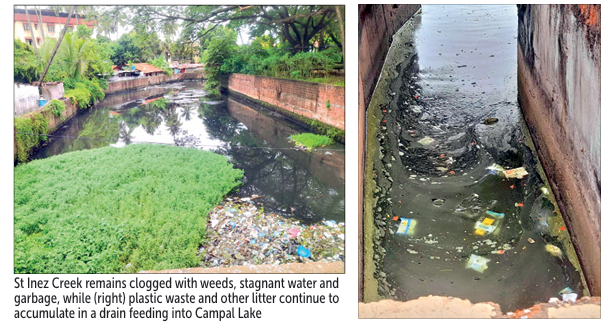
As Panjim’s Smart City makeover nears com pletion at a cost of nearly Rs 1,500 crore, the capital’s wa ter bodies are telling a very different story — one of ne glect and pollution. Back-to-back incidents of mass fish mortality at Mala Lake and Campal Lake have cast a spotlight on the deteri orating condition of Panjim’s lakes, creeks and waterways, raising concerns that authori ties have prioritised cosmetic infrastructure upgrades while allowing critical ecological as sets to decay. After dead fish were found floating in Campal Lake on June 2, O Heraldo revisited the site on Sunday and found plastic bottles, food contain ers, disposable cups and oth er waste still littering the lake within its retaining walls.
En vironmental observers suspect deteriorating water quality and depleted dissolved oxygen lev els may have contributed to the fish mortality. For local residents, the re curring ecological crises are symptomatic of years of neglect. “It should have been a place thronged by people and tour ists. But look at its condition,” said a resident living near Mala Lake, pointing to the steady de cline of one of Panjim’s most visible water bodies. The concerns extend beyond the city’s lakes. St Inez Creek, one of Panjim’s principal drainage channels, today bears the appearance of an urban waterway in distress. Large stretches are choked with dense aquatic weeds, while floating plastic waste and de bris have accumulated along its banks.

The dark, stagnant wa ter has raised concerns about sewage contamination and poor water quality. Environmentalists warn that unchecked weed growth and waste accumulation are re stricting water flow, increasing the risk of flooding during the monsoon and creating condi tions favourable for mosqui to breeding and water-borne diseases. For environmental activist and Goa Green Brigade founder Avertino Miranda, the deteri oration of Panjim’s waterways reflects a deeper failure of governance. “The water bodies have been neglected due to the indifferent attitude and lethargy that have crept in among top officials, who are being protected by their political mas ters,” Miranda said. He accused both the State government and the Corporation of the City of Panaji (CCP) of ignoring repeated warning signs. “There’s a complete lack of accounta bility, and the Goa Government and the CCP have failed to make any meaningful attempt to protect these water bodies de spite several disasters and repeated warn ing signs,” he said, warning that citizens and environmental groups may eventually be forced to undertake restoration efforts themselves if authorities continue to re main inactive.
Opposition parties have also seized on the issue, questioning how Panjim’s water ways were left in such a condition despite years of Smart City spending. Aam Aadmi Party Goa president Valmi ki Naik said the state of St Inez Creek ex posed a huge gap between official claims and ground reality. “The BJP Government has spent approx imately Rs 1,500 crore in the name of the Smart City project, but it looks like not a single rupee has reached St Inez Creek,” Naik said. He recalled that former chief minister Manohar Parrikar had directed that the creek’s rejuvenation be included in Smart City plans and noted that a detailed project report had already been prepared under the Jawaharlal Nehru National Urban Re newal Mission. “Today, St Inez Creek has become an open sewage and garbage channel, so it is no surprise that this polluted water body is killing aquatic life wherever it is connect ed,” Naik alleged. Similar criticism came from Goa for Giving founder Armando Gonsalves, who questioned the priorities of the Smart City project itself. “What was the Smart City project meant to achieve?” Gonsalves asked. “Was it only to cut down trees, build pavements, paint road markings that serve little purpose, and lay drainage lines? Why were the wa terways not restored?” He argued that Panjim’s waterways could have become major tourism assets if properly maintained. “If the Campal and Rua de Ourem wa terways were properly cleaned and main tained, they could support world-class tourism. The area has the potential to be like Amsterdam,” he said. Gonsalves further alleged that sewage discharge into the creek amounted to more than administrative negligence. “The neglect of these waterways is not merely a civic issue — it is criminal.
Sew age from the Sewage Treatment Plant is being discharged into the creek. If that is not a criminal act, then what is?” he asked. As authorities investigate the latest fish mortality incidents, environmentalists say the dead fish floating in Panjim’s lakes should not be viewed as isolated events. Critics are questioning how many warning signs authorities intend to ignore before the city’s waterways reach a point of irre versible decline.