ANIL KUMAR MISHRA & MARCOS GONSALVES
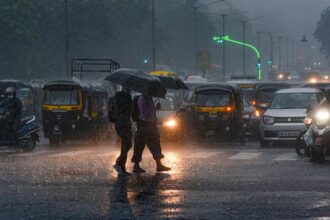
Goa’s monsoon deficit has wid ened into a growing concern for paddy farmers, with the State receiving 30.3 per cent less rainfall than normal be tween June 1 and September 7, even as the impact on the standing crop remains une ven across farming areas. The State received 1,944.7 mm of rainfall during the period against the normal 2,788.4 mm. North Goa has recorded an even sharper deficit of 35.3 per cent, with 1,849 mm against the nor mal 2,856.1 mm, while South Goa has received 2,029.3 mm against the normal 2,728.5 mm, a deficit of 25.6 per cent. The rainfall shortfall has been accompanied by sharp variations in rainfall distri bution. While some interior stations have received more than 2,500 mm, Panjim has recorded only 1,263 mm, with Mapusa at 1,523.5 mm, Dabolim at 1,356.3 mm and Mormugao at 1,354.4 mm.

Meteorologist and former National Institute of Oceanography chief scientist Dr M R Ramesh Kumar described the season as one of the more deficient monsoons Goa has experienced in re cent decades and attributed the rainfall pattern to the prevailing El Niño conditions. He said two depressions in August provided some relief after a poor June and July. “Rainfall this year was deficit, perhaps among the lowest of the past few decades. However, August provided some relief because of the two depressions,” Kumar said. The improvement in August, however, has not erased the accumulated deficit. Kumar said June and July were marked by prolonged non-rainy spells, while August was different as rainfall was more consistent, even though the intensity was generally lower. The effect of the delayed and uneven mon soon is now being felt most directly in the paddy fields, with farmers divided over whether the crop will withstand the season’s rainfall deficit. In Mapusa, farmer Paul Fernandes said the regular light showers in recent weeks had pre vented the situation from becoming worse, but the delayed onset of the monsoon had pushed cultivation back by nearly a month. “Though there has been a deficit in rainfall this year, there has been a consistency in light showers almost every day which has helped the paddy crop. The farmers who have cultivated will most likely not suffer too much on account of the deficit. The only thing is the crop has been delayed by almost a month due to the erratic and dry start of the monsoon,” Fernandes said. Farmers in other parts of the State are less op timistic.
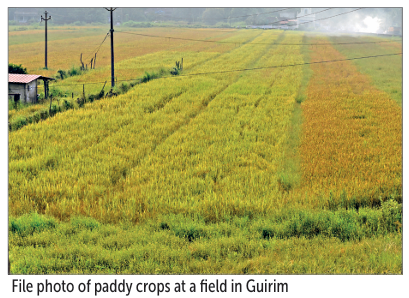
Vindo Patekar of Salvador do Mundo expects a sharp fall in production, citing inadequate rain fall as well as the rising cost of cultivation. “Because of the rainfall deficit, we do not think the yield is going to be good this year. I expect production to decline by at least 50 per cent. We may not even be able to recover what we have invested in cultivation,” Patekar said. He said the cost of labour and machinery had already placed an additional burden on cultiva tors, with older harvesters taking longer to com plete operations. “The harvesters being provided in our area are old and take more time to complete the work. This further increases our expenses. We may not be able to recover what we have spent on machinery and labour,” he said. Patekar said the condition of the crop itself was worrying. “Look at the plants; most of them are yellow instead of green. We have to consider how much we have invested and how much we are going to recover,” he said. In Sangolda, farmer Rajendra Kerkar said the delayed rains had pushed back sowing, but the crop had now reached the flowering stage, when continued showers could still help. “The rains were delayed and that is why the sowing operations were delayed. The rice is now at the flowering stage. At this stage, even if there is rain, it helps. If there is a shower almost every day, it is beneficial. We hope the rainfall contin ues, though the maturity of the crop may be de layed,” Kerkar said. The uncertainty is also reflected among farm ers in South Goa. Manuel Barbosa of Raia said the next few weeks would be critical, particular ly because the crop is entering a stage when ad equate moisture is important for development. “Initially, we faced problems due to the late arrival of the rains. However, the situation im proved later. At present, the rainfall should have been more intense, but that is missing. Consider ing the current rainfall pattern, there are doubts about whether the crops will yield a good har vest. A few days of continuous rainfall could improve the situation.
The next 15 days will be crucial in determining the fate of the crops,” Bar bosa said. Francisco Fernandes of Nuvem said the crop remained manageable but needed more rain to develop properly. “This is the stage when the crops need more rainfall to ensure a good harvest. At the moment, the situation is manageable, but the rainfall is not sufficient for the crops to develop properly and produce a better yield,” he said. Rosario Dias of Chinchinim said farmers were hoping for a further improvement in rainfall. “We are expecting more rainfall in the coming days so that the crops get the required strength. The present rainfall is not enough for the crops, and we are hoping for better rains in the days ahead,” he said. The Agriculture Department, however, has played down fears of widespread crop losses. Agriculture Director Chandrahas Naik Dessai said the rainfall deficit had not so far translated into significant crop damage and that the overall impact on paddy production was expected to be limited. “There is a rain deficit, but there is nothing to worry about.
There is not much difference. How ever, some yield of paddy may be less, though we cannot say how much at this stage,” Naik Dessai said. He said there had been no reported cases of widespread crop damage and that horticultural crops had also not been significantly affected. “Definitely, there will be some reduction in crop yield, but there will not be much impact on the entire crop,” he said. Former Zonal Agriculture Officer and farmer Joaquim D’Souza was similarly less concerned, saying the subsequent rainfall had helped com pensate for the poor start. “There is no need to worry. Although there was a shortage of rainfall initially, the subse quent rains made up for the deficit. At present, there is no significant impact of the earlier rain fall shortage on the paddy crop,” he said. The contrasting assessments underline the uneven impact of this year’s monsoon. Interior areas such as Valpoi and Dharbandora have re ceived more than 2,700 mm of rain, while sev eral coastal and urban locations have recorded substantially less. Valpoi has received 2,714.7 mm and Dharbandora 2,733.3 mm, compared with just 1,263 mm in Panjim. The State’s cumulative deficit had stood at 32.1 per cent as of August 12, when Goa had received 1,585.8 mm against the normal 2,334 mm. Subsequent rainfall, particularly during August, narrowed the gap, but the State remains substantially below normal for the season. Kumar said the remaining monsoon period could still bring useful rainfall, noting that Sep tember and October have produced significant rainfall in Goa in previous years. The final impact on agriculture, however, will depend on how the rainfall pattern evolves during the remaining weeks of the season.