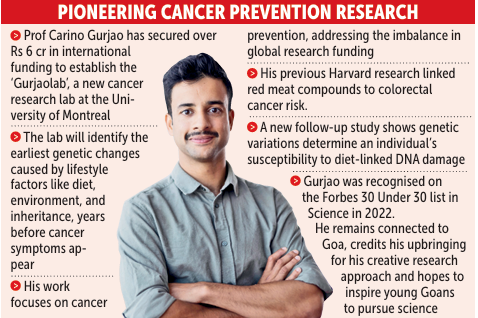
Goan-origin cancer researcher Professor Carino Gurjao has secured more than Rs 6 crore in competitive in ternational funding to estab lish his own cancer research laboratory at the University of Montreal, marking a significant milestone for the young Goan who has already drawn inter national attention for his work on diet-linked cancer risk. The funding, obtained ear lier this year after he joined the university as a Profes sor of Medicine, has enabled him to launch the Gurjaolab, a research group focused on identifying the earliest genet ic changes that lead to cancer. Gurjao said the new labo ratory, which currently has four researchers, is expand ing and actively recruiting PhD students and research analysts as it builds a long term programme of work into DNA damage caused by lifestyle factors. He described the step as the beginning of independent scientific leader ship aimed at understanding cancer before it develops into disease. “Cancer starts silent ly in DNA years before we see symptoms,” he said. “If we can detect the earliest signals, we have the best chance of stop ping it.
Gurjao first came to prominence for research conducted during his time at Harvard, where his team provided some of the strongest genetic evidence linking compounds found in red meat to colorectal cancer. The findings were widely covered in national and Goan media and received interna tional attention from outlets including CNN and Le Monde. He also appeared on French national television to explain the science behind the discovery. The study contributed to his inclusion in the Forbes 30 Under 30 list in Science in 2022, which he received for work that helped shift global discussions on how diet interacts with DNA damage to in fluence long-term cancer risk. The Harvard research also led to deeper questions about why cancer develops in some individuals and not in others despite similar dietary habits. Gurjao said his team has at tempted to address this in a follow-up study, accepted last week for publication in a peer-reviewed journal, showing that people vary genetically in how susceptible their DNA is to damage caused by compounds in red meat. “This helps explain why two people with the same diet can have com pletely different cancer outcomes,” he said. According to him, these genetic differences may clarify long-observed variations in cancer risk among individuals with compa rable lifestyles, and the findings provide new grounds for developing personalised prevention strategies rather than one-size-fits-all dietary guidelines. As he begins this next phase through the Gurjaolab, Gurjao stressed that his work focuses on a long-neglected area of global cancer research. Although medical evidence suggests that more than 70 per cent of cancer cases could be prevented through lifestyle changes, less than 5 per cent of global cancer research funding is directed towards prevention. “There is a massive mismatch between what causes cancer and where money is invested,” he said. He noted that most investment continues to flow into treat ment and drug development, which, while necessary, does not address the root causes of disease. His lab’s mandate is therefore centered on examining how everyday exposures trigger DNA changes years before cancer appears. Identi fying the earliest signals, he said, could help shape strong er public health guidelines and targeted interventions for those most at risk. Internal documents from the University of Montreal show that the grants awarded to him fall within the in stitution’s broader push into precision medicine — an approach that combines genetics, laboratory science and data analytics to tailor healthcare to individual needs. With rising global cancer incidence, the university views early-stage DNA research as critical to developing future prevention strategies. Gurjao’s group is expected to con tribute to this effort by mapping DNA damage signatures linked to diet, environment and inherited factors. While early-stage projects will focus on diet-related DNA chang es, he said the lab plans to expand into other preventable risk factors as the team grows. International collabora tions, including potential links with institutions in India, are also under consideration. Despite the growing international scope of his work, Gurjao has stayed deeply connected to Goa. In recent years, he delivered a TEDx talk advocating for the preservation of the Konkani language and later spoke at Goa Universi ty about the global decline of indigenous languages. Last year, he addressed scholars at the Rachol Seminary, where he explored how cultural identity shapes scientific think ing, personal motivation and community engagement. He said these interactions reinforced the idea that his Goan upbringing continues to influence his research approach. Growing up in a small, tightly knit community, he said, taught him to look at problems from multiple angles and encouraged creative thinking — a habit he believes is es sential in fields like cancer research where long-standing scientific questions demand fresh perspectives. Gurjao added that he hopes his career progress encour ages more young Goans to consider scientific research as a viable and fulfilling path, particularly in fields like genetics, molecular biology and cancer prevention where Goans re main underrepresented. He said that while he did not see many Goan role models in international science when he was growing up, he hopes his work helps widen the hori zons of students in Goa who may not have considered such paths. His journey, he said, reflects both his scientific am bitions and his desire to see more Goans enter global re search spaces. With new recruitment underway and several projects beginning simultaneously, the Gurjaolab is expected to broaden its contributions to global cancer studies over the coming year. As the group expands its focus from diet-re lated DNA changes to a wider range of preventable risk fac tors, the research is likely to feed into international efforts to understand how cancer begins long before symptoms emerge. For Goa, the work represents the growing global imprint of a young scientist whose research remains an chored in the values and community that shaped him.