SHASHWAT GUPTA RAY

PANJIM: A growing mismatch between willing parents and actual adoptions is exposing structural and social fault lines in Goa’s child adoption system — a gap that officials defend as procedural reality, but which stakeholders say reflects deeper inefficiencies.
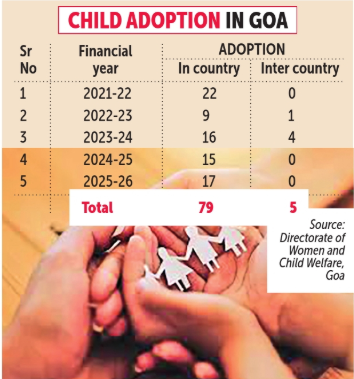
Official data shows that while 265 Prospective Adoptive Parents (PAPs) have been approved in the State, only 84 children were adopted between April 1, 2021 and March 31, 2026 — a gap that NGOs say is not merely about numbers, but about a system weighed down by rigid processes, digital barriers, and persistent social stigma.
“There is a long list of formalities that needs to be completed as part of the child adoption process. But there are also other issues, such as a lack of awareness regarding procedures. For example, prospective parents must apply online for adoption, and all details must be uploaded digitally. However, many couples are not tech-savvy. They can’t keep track of their application status and end up missing out,” said Fr Maverick Fernandes, Director of Caritas Goa, the official social welfare agency of the Archdiocese of Goa and Daman.
Another issue is the lack of proper marriage documents, especially among couples in interfaith marriages.
“Among the various documents needed for processing an adoption application is a valid marriage certificate. In many cases, couples do not have one, which creates a hurdle in the adoption process,” Fr Fernandes said.
He added that there are also instances of post-adoption disruptions, where children are unable to continue living with their adoptive parents if bonding does not occur.
“It occurs when an adopted child is removed from the adoptive home or returned to care before the adoption is legally finalised, usually due to severe behavioural challenges, unmet emotional needs, or a lack of support,” the Director of Caritas Goa said.
Fr Fernandes said the application process should be decentralised and that, instead of being entirely online, it should adopt a hybrid model.
“A hybrid model, offering both offline and online processes, is ideal. Even today, many people are not comfortable with the online system. This will help prospective parents who wish to adopt a child,” he said.
Anup Priolkar, veteran social reformer and chairman of Lokvishwas Prathishthan, Ponda, said that greater awareness is needed in society regarding adoption.
“Acceptance of adopted children is still low in society. We see many instances where adopted children are looked down upon. We continue to discriminate between an adopted and a biological child. This kind of behaviour is unacceptable,” Priolkar said.
Jyoti Desai, Director of the Directorate of Women and Child Welfare, Goa, denied that the adoption numbers were low.
“While 84 adoptions have taken place in the last five years, a total of 265 Prospective Adoptive Parents (PAPs) have been approved in the State of Goa to date, reflecting growing awareness and willingness among families to provide a nurturing environment for children,” Desai said.
She noted that adoption depends on the number of children available with the authorities. Children fall into three categories: those abandoned by their parents, those surrendered by their parents, and orphans. They are placed for adoption based on availability.
Addressing concerns about the centralised online application and tracking system, she said these policies are determined by CARA (Central Adoption Resource Authority), but added that assistance is provided to parents who are not tech-savvy.
“The Directorate of Women and Child Development, Government of Goa, through the State Adoption Resource Agency (SARA), continues to uphold its commitment to the care, protection, and rehabilitation of children in need of care and protection. In accordance with the Adoption Regulations, 2022, the State ensures a transparent, ethical, and child-centric adoption process, prioritising the best interests and overall well-being of every child,” she said.