SHASHWAT GUPTA RAY
Managing 16 lakh residents and nearly one crore annual tourists has placed Goa’s emer gency healthcare system under intense scrutiny. Significant advances have undoubtedly been made in recent years. Experts point out that the average response time of the 108 ambulance service has dropped to nine minutes from 15 minutes over the last seven years, while the number of ambulances in both the public and pri vate healthcare systems has increased. However, doctors say only half the battle has been won. They stress the need for not only more ambulances but also an urgent overhaul of pre-hospital care, citing a severe shortage of trained Emergency Medical Tech nicians (EMTs) capable of handling trauma cases and carrying out proper clinical handovers. Frontline practitioners insist that faster response times alone cannot pre vent “dead on arrival” cases without specialised mobile infrastructure. Experts also emphasised that the State must reconsider its rigid policy of barring patient transport to private hospi tals and instead adopt stra tegic ambulance deploy ment at accident hotspots to save lives during the critical “golden hour”.

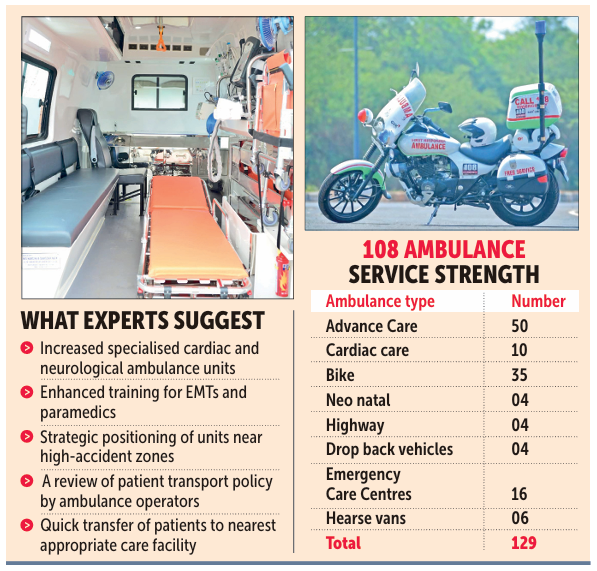
Dr Omkar Churi, consulting neurosurgeon, said, “While Goa’s elderly population enjoys a high quality of life, they are also prone to fractures and head injuries. There are a lot of road accidents in the State. Hence, there is an increas ing need for specialised ambulances.” He also advocated mobile CT scan facilities and im proved paramedic training to enhance outcomes for stroke and trauma patients. From a cardiac care perspective, Dr Sabyasachi Muk hopadhyay, consultant cardiologist, noted that while Basic Life Support (BLS) coverage is generally accessible, there is a critical shortage of Advanced Life Support (ALS) cardiac ambulances and trained EMTs. “Hospitals should recruit trained EMTs and provide ad vanced life support training to existing paramedic person nel,” he said. Veteran orthopaedic surgeon Dr Dipchand Bhandare offered another perspective, suggesting that although the number of ambulances has increased significantly over the last decade, the key issue is strategic deployment. “Given the high rate of road traffic accidents in Goa, traf fic police should identify accident hotspots so ambulanc es can be stationed nearby to reduce response times,” Dr Bhandare said. He also raised concerns over the current 108 policy of transporting patients exclusively to government medical colleges, suggesting that patients should have the option of being taken to the nearest private facility if requested. Dr Sonia Pawaskar, Resident Medical Officer at a private hospital, said ambulances require trained EMTs or nurses ca pable of trauma management using cervical collars and spine boards, controlling bleeding and positioning patients correct ly — such as propping up patients experiencing breathless ness or elevating the head in cases of head injuries. “Staff must also be trained to resist bystander pressure regarding IV fluids, particularly for patients with heart or kidney failure. Continuous maintenance of essential drugs and equipment is equally vital,” Dr Pawaskar said. She added that preventing “dead on arrival” cases re quires ambulance staff to provide hospitals with prior no tification and detailed clinical handovers, including patient history, vital signs and current condition. “If a patient’s condition worsens or a facility is non-func tional, paramedics must be empowered to redirect the pa tient to the nearest appropriate hospital,” she said. Sushma Saini, State Head of EMRI Green Health Services, said the response time for Goa’s 108 ambulance service has improved significantly, with the average response time falling from 15 minutes to nine minutes over the past seven years. She attributed the improvement to fleet expansion and the digitisation of the service’s response system. “Our Health Minister has ensured state-of-the-art healthcare facilities for Goa. We currently operate around 50 advanced care ambulances and 10 cardiac units — with two more provided by the South Goa MP — to support the STEMI project. We also have four neonatal ambulances equipped with specialised incubators for babies up to one month old. In addition, we have introduced 35 bike ambu lances to provide immediate care during the critical ‘plat inum minutes’ and four dedicated highway trauma ambu lances, with four more expected soon,” Saini said. She said the State’s 108 ambulance service is now fully digital, optimising emergency response operations. “We have implemented auto-assignment technology that dispatches the nearest ambulance within a 10-km radius, geo-fencing for staff attendance, and voice-to-text digital Patient Care Report (PCR) forms, allowing paramedics to focus entirely on patient care instead of manually record ing vital parameters on paper,” Saini said. She added that ambulances are equipped with GPS-ena bled resource tracking systems. When an emergency call is received, the automated system identifies the caller’s exact location and dispatches the nearest available ambulance without requiring manual operator intervention. “We continue to operate 16 Emergency Care Centres (mobile ICUs). These are ALS 108 ambulances equipped with ventilators, defibrillators and multi-parameter moni tors to stabilise patients during transport to hospitals,” the EMRI State Head said. Apart from these services, EMRI also operates free hearse vans for people in Goa. To ensure seamless coverage in remote areas, 108 ambu lances have been stationed at Community Health Centres and Primary Health Centres in regions such as Sattari and Canacona. “Our GPS tracking and digital landmark systems help drivers navigate effectively, even in forested areas. The sys tem also ensures vehicles do not deviate from designated routes. This tracking minimises costs and reduces transit times while helping us monitor and maintain the quality of pre-hospital care during patient transport,” Saini said. She added that the EMRI team continuously monitors ac cident hotspots to reposition ambulances strategically and advocated the creation of emergency “green corridors” to ensure patients reach hospitals within the “golden hour”. “A first responder training project is also being conduct ed in Goa to empower communities to act during the criti cal minutes before an ambulance arrives,” she said. “Furthermore, we maintain high standards for our staff through mandatory refresher training every six months for all paramedics and drivers. This ensures our team remains prepared to provide the best possible care during every emergency,” Saini added.