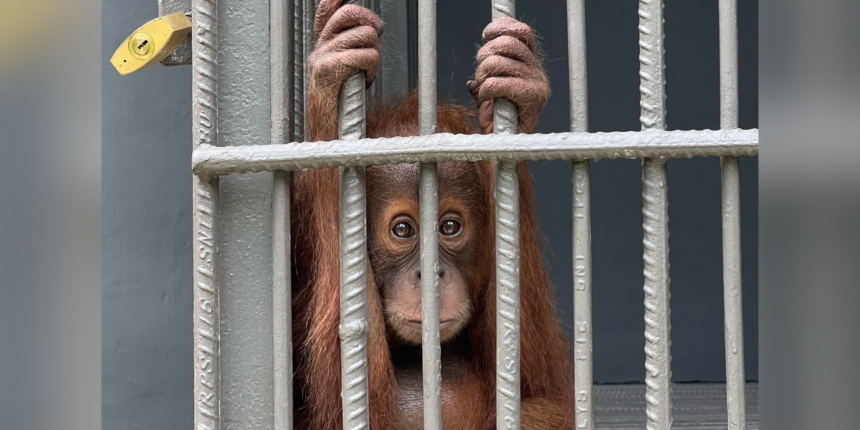
Five infant orangutans rescued from a forest in Odisha have raised serious questions about illegal wildlife trafficking and India’s growing demand for exotic animals as pets. The animals, aged between six and eight months, were found by villagers in the Ranakantha reserve forest in Balasore district on September 8 and were subsequently rescued by state authorities.
Conservationists say the orangutans could not have reached Odisha naturally. Orangutans are native only to the rainforests of Indonesia and Malaysia, and all three species — Bornean, Sumatran and Tapanuli — are classified as Critically Endangered.

Wildlife Trust of India CEO Jose Louies said there was little doubt that the animals had been illegally trafficked into India. Conservation scientist Sinan Serhadli said one possible route was by sea from Aceh in northern Indonesia, an area known for orangutan trafficking and wildlife seizures.
The circumstances surrounding the animals’ origins are also deeply concerning. If they were taken from the wild, conservation researchers say their mothers were likely killed while the infants were captured. Orangutans reproduce extremely slowly, with females typically having offspring only once every seven to nine years. Infants can also remain dependent on their mothers for eight to nine years.
This makes the removal of even a small number of animals particularly damaging to already declining populations.
There is also a possibility that the five orangutans were born in captivity. However, conservation researcher Uttara Mendiratta noted that there are no legal captive-breeding facilities for orangutans in India. Even if the animals came from captivity, she said, it would therefore point towards an illegal operation.
The incident has also highlighted India’s growing role in the international exotic-pet trade. Experts say India is no longer merely a transit route for endangered wildlife but has become an important destination market.
Five infant orangutans rescued from a forest in Odisha have raised serious questions about illegal wildlife trafficking and India’s growing demand for exotic animals as pets. The animals, aged between six and eight months, were found by villagers in the Ranakantha reserve forest in Balasore district on September 8 and were subsequently rescued by state authorities.
Conservationists say the orangutans could not have reached Odisha naturally. Orangutans are native only to the rainforests of Indonesia and Malaysia, and all three species — Bornean, Sumatran and Tapanuli — are classified as Critically Endangered.
Wildlife Trust of India CEO Jose Louies said there was little doubt that the animals had been illegally trafficked into India. Conservation scientist Sinan Serhadli said one possible route was by sea from Aceh in northern Indonesia, an area known for orangutan trafficking and wildlife seizures.
The circumstances surrounding the animals’ origins are also deeply concerning. If they were taken from the wild, conservation researchers say their mothers were likely killed while the infants were captured. Orangutans reproduce extremely slowly, with females typically having offspring only once every seven to nine years. Infants can also remain dependent on their mothers for eight to nine years.
This makes the removal of even a small number of animals particularly damaging to already declining populations.
There is also a possibility that the five orangutans were born in captivity. However, conservation researcher Uttara Mendiratta noted that there are no legal captive-breeding facilities for orangutans in India. Even if the animals came from captivity, she said, it would therefore point towards an illegal operation.
The incident has also highlighted India’s growing role in the international exotic-pet trade. Experts say India is no longer merely a transit route for endangered wildlife but has become an important destination market.
Recent cases involving gibbons and other exotic animals have added to these concerns. Conservationists have pointed to increasing demand for apes and other unusual species among wealthy private collectors. They argue that social media images and videos of celebrities with exotic animals can further fuel demand by turning rare wildlife into status symbols.
Wildlife trafficking also comes with a severe human and environmental cost. Conservationists say infant orangutans taken from the wild can suffer extreme trauma, while mothers are often killed during the capture process. Some rescued animals remain psychologically damaged for life and may never be suitable for release.
The five orangutans from Balasore — three females and two males — are currently housed at Nandankanan Zoological Park near Bhubaneswar. They have been quarantined and placed under medical supervision. Odisha has also formed a five-member technical committee to oversee their care, while police and the Wildlife Crime Control Bureau are investigating possible links to an animal-smuggling network.
The Odisha government has sought permission from the Central Zoo Authority to retain the animals at Nandankanan, with the state forest minister saying they could attract visitors and tourists.
Conservationists, however, strongly oppose keeping the animals in India permanently. They argue that the infants should eventually be returned to their country of origin, subject to DNA testing and other assessments.
Researchers believe the animals may be Sumatran orangutans, although their exact species and origin will need to be established scientifically. Indonesia has established rescue and rehabilitation programmes capable of preparing rescued orangutans for release into the wild.
Experts say returning the five animals could therefore give them a chance to contribute to declining wild populations. Indonesia has already successfully rehabilitated and released hundreds of rescued orangutans, with new populations established in parts of Sumatra.
The Odisha case has consequently become much larger than a question of where five young orangutans should live. Conservationists say it exposes India’s growing demand for exotic wildlife and the need for stronger laws, enforcement and public awareness.
For them, the central lesson is clear: without a market for illegally acquired exotic animals, trafficking networks would have far less incentive to operate.