Namrata Ninan, 16, who travelled to Jantar Mantar, recalls terrifying stampede & lathicharge
PRAVEENA SHARMA

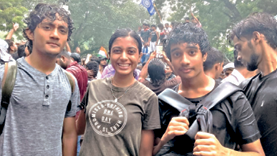
That is one point where I got a huge fright,” recalls 16-year-old Namrata Ninan. “I think they thought the police were definitely going to start beating them.” Namrata, a Class 11 student at Sharada Mandir School, trav elled all the way from Goa to New Delhi to join the Cockroach Janata Party’s (CJP) ‘Sansad Chalo’ protest march on July 20. She had been following the CJP close ly since its launch in May, fuelled by a deep-seated belief that India’s education system is in desperate need of reform Namrata booked her flight to Delhi using money she earned from cat-sitting. Upon landing, she stayed with her aunt, Cheryl D’Souza—a lawyer who has worked with Supreme Court advocate Prashant Bhushan—and her politically ac tive cousins. On Monday morning, July 20, Namrata, her aunt, and her cousins Yuval (15) and Jehan (13) arrived at Jantar Mantar by 6:15 am. Early on, the atmosphere was upbeat. “I didn’t know before going there that it’s not just activists, but all types of people,” Namrata shares. The crowd was incredibly diverse, spanning the All India Youth Federation, communist youth groups, elderly citizens, families, and members of the LGBTQ+ community. Protesters carried flags, books, and pictures of B R Ambedkar, while some wore T-shirts printed with phrases from the Constitution.
Many brought instruments like drums and guitars, chanting slogans in a welcoming, respectful environment. Namrata particularly noticed how respectful the male protesters were, ensuring women were given mosquito nets in shared tents to protect their privacy. By 9:30 am, the crowd swelled to over 5,000 people. As rain began to fall near the police barricades, the security apparatus grew visibly stricter. Twenty Rapid Action Force (RAF) officers stood positioned behind two massive water cannons. When the police tried using megaphones to con trol the crowd, protesters drowned out the sound by whis tling, yelling, and banging on plates. Around 10:30 am, the tension escalated. Protesters on the front lines began banging on the barriers, prompting the police to bring in welders to fuse the structures shut.
Though a woman coordinator urged the crowd to remain strictly non-violent, the sheer pressure of the massive crowd eventually forced a barricade down. Standing just 20 feet away while recording a video, Nam rata was caught in a sudden, terrifying surge. “Suddenly, everybody in front of me started pushing backwards. A whole group of people had started knocking over the barri ers and everyone was stamping backwards in panic to get away. That is when I got a huge fright.” The RAF had carefully planned their maneuvers. As one barrier fell, they retreated to the next line of defence, wait ing to intercept anyone who crossed. Sitting atop a barri cade at a safer distance, Namrata witnessed the State’s re taliation firsthand. “That’s when I first saw the police lathicharge people,” she says. “They would take the baton up and just bring it down on people. Until that point, I’d only seen reels of this on Instagram. I was under this illusion that the police help people—that there’s no way they would actually harm their own citizens. I literally felt like sobbing because it was so disillusioning.” As Namrata tried to update her friends, she realised the mobile network was completely dead due to phone jam mers. The police then deployed tactical crowd separation: they opened the barriers to let small batches of protest ers through, shut them abruptly, and lathicharged those trapped inside.
Namrata watched in horror as young peo ple emerged from the zone with heavily bandaged legs or being carried by others. Despite the chaos, Namrata emphasises that the students remained peaceful. “There was no violence or provocation from the protesters’ side. They did not harm police officers; they were just making hearts with their hands.” The experience has transformed her. “After being at the protest, it feels so realistic. It’s tough relating to something that’s just virtual. Now I feel so much more passionately about what happened to them. Even though both my par ents are doctors, I want to be a lawyer. In India, we need good lawyers. I would definitely like to be part of such a protest again.