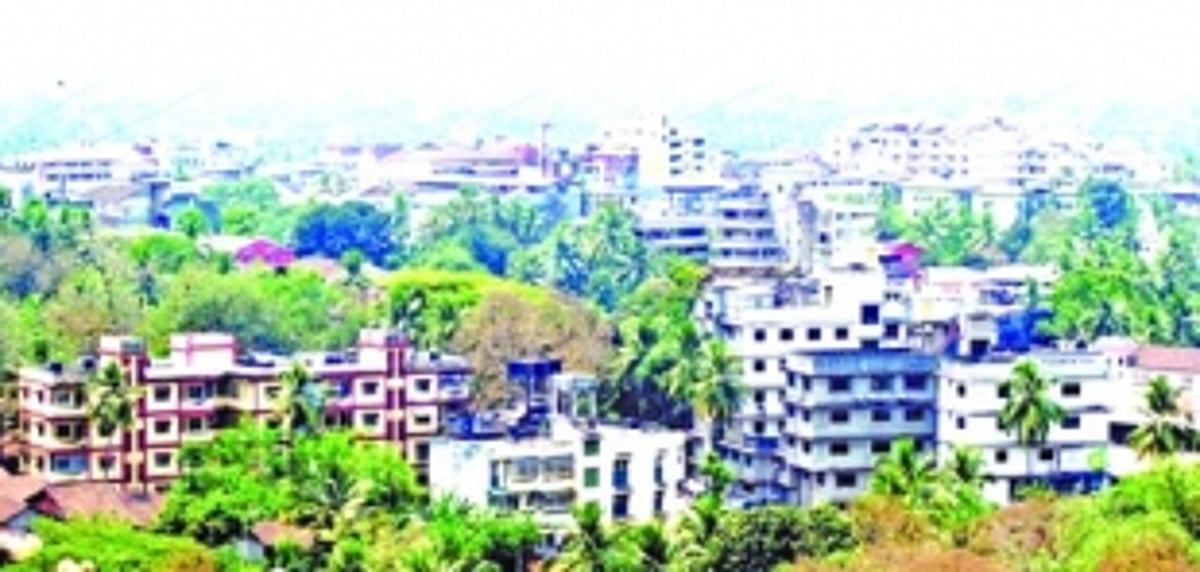
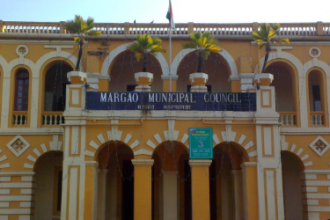
At 5pm when the entire city of Margao is at its maximum chaos, up on the quiet and steep road of Pajifond, lie the dead of the Muslim brethren in complete silence. The desolate Sunni Muslim Kabrastan, which is 160 years old, is manned by Mohammed Ghos, an old man who’s been there since his parents were hired at the Kabrastan.
“I remember when there was a small winding road to this Kabrastan on the North wall of Adarsh School and when we would struggle our way up with the dead for burial, but then the road was made and it’s easy to drive here,” explains Mohammed who takes a break from the grass cutting as he clears graves and cleans the burial grounds.
Mohammad shows the Herald Team around the Kabrastan which is on three levels and faces an issue of landslides and broken pathways since the burial grounds are on a hill and the mud is giving away.
“80 years ago my parents worked here and today I work here for small amounts but people whose graves of family I clean and dig always are generous to me. This cemetery is really huge but small for its purpose. I hope in my lifetime we move to Sonsoddo and I can serve the dead there too,” says Mohammed as he looks into the sky and remembers it’s time for his prayers as the sun sets.
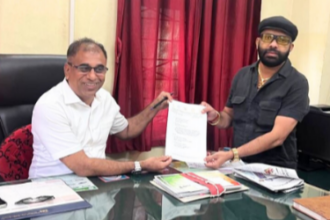
The entire Salcete has just one cemetery and the next nearest ones are at Vasco and Sanvordem besides a tiny old Kabrastan at the Monte Hill for Shias. The cemetery is spread over 9,000 square meters but is very little for the entire 60,000 odd Muslim population in Salcete, asserts Sheikh Jina, BJP’s political leader and Haj Committee of Goa chairman.
“It’s 28 years that we demanded for a new place to meet our increasing demands of burial. At Pajifond family members are fighting because we open graves before time or because we sometimes tell them there is no space and ask them go to Vasco or Sanvordem. Or we’re delayed in digging graves because of no space. I wish the government also visits this Kabrastan and understand our plight,” asserted the Kabrastan Committee member and a businessman in Margao Sayed Ahmed.
Mohammed tells us that in the Muslim practice a grave has to be kept for six years and hence there is an acute shortage of graves. Also the increasing stray dogs and existing snakes and reptiles at the Pajifond kabrastan is very difficult for people and he has been working very hard to maintain the premises. Also Ahmed explains that increasing Muslim migrants and labourers are putting a strain on the small burial grounds and he hopes the government works faster in getting forest clearance and allotting the land with all formalities complete before January 2017.
“At this Kabrastan there is no place and the gradient of the hill makes it impossible to bring a crane or excavator to break into the rock and stone to carve out more graves. Also there are 60 graves here of old Muslim priests or purchased by family members that lay in a dilapidated conditions for over 7 decades and families neither use them nor allow them to be used by others which has increased the strain on the Pajifond Kabrastan, stated Ajai Malik, a mason rebuilding excavated spaces at the top level of the Pajifond kabrastan, hoping to create an additional five graves for burial.