GUIRDOLIM: The battle against double-tracking has ramifications beyond coal dust and the damage to homes in the coastal belt. It is affecting day to day lives in traditional villages in the hinterland in a manner not always visible to the world beyond.
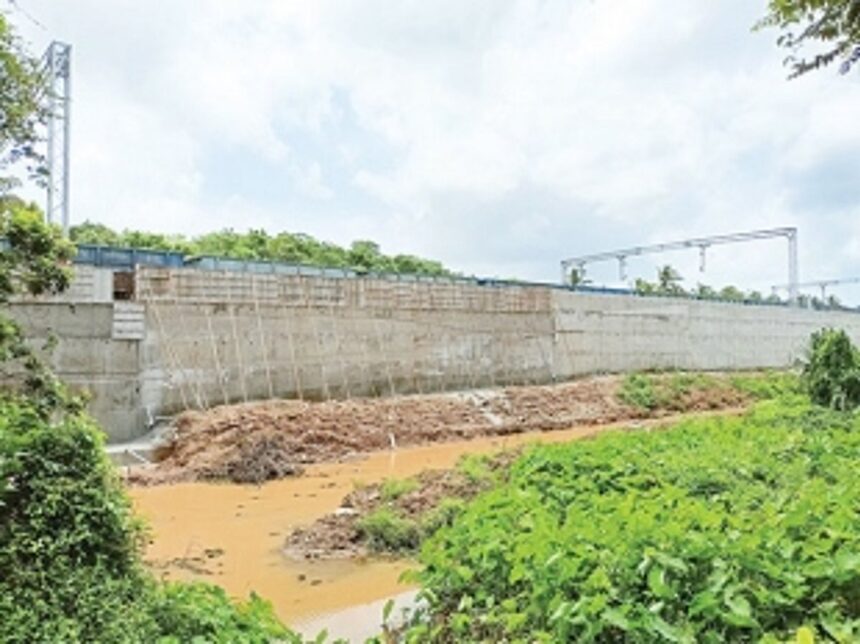
In the year 2019, residents of Folli ward in Guirdolim were shocked to discover that the railways had dumped mud in low-lying areas near the railway tracks. Since then, the locals have been fighting to protect these areas, which include the Nogozan Lake and its sluice gate, which is an outlet for the water that flows into the Kushavati River. Besides this, the locals have also protested the dumping of mud on the other side of the tracks which is blocking the flow of water into the Zuari River. All of this has damaged crops and coconut plantations in the surrounding areas, blocked traditional pathways that farmers would use to access their fields, and mud houses of those living in the vicinity were also affected.

However, the locals rue the fact that they have limited options going forward as the majority of the land has already been acquired by the railways. While they allege that some of these lands have been acquired by the railways using fraudulent means, they said a proper inquiry into such transactions has to be carried out as it could prevent additional land acquisition.
Herald met these locals who were behind this agitation and walked with them through the age-old mud path that has been used by the villagers to keep a vigil on the work the railways has been doing on this side of the track.
Standing in the middle of this path, which has fields on either side, the locals first describe what this ward was like in the past to offer perspective on why this issue means so much to them.
Jose Peixoto recalls how the water from the lake would have so many uses for the locals, be it for washing clothes or for the crops, and laments that the place will never be the same anymore. Nonetheless, the locals made it their quest to do whatever they can to save the area from further destruction.
Agostine Antao, the chairman of the Guirdolim village’s Biodiversity Management Committee (BMC) said, “The locals had to gherao the secretary of the village panchayat for initially refusing to be part of such inspections.”
Antao added that finally, there were two major agreements. The first was that the sluice gate at the lake would not be broken down or shifted and would remain where it was. The second decision was that the WRD builds a retaining wall to save the fields from inundation and stop the intrusion of saline water. He also pointed out that they are still pursuing these matters to ensure that this lake and biodiversity are preserved for the future generation too.
As of now, while a portion of the mud near the sluice gate is being removed by the railways, the locals say the mud that has been dumped on the other side of the track is lying as it is and there has been no sign of that being removed either.
Francis Peixoto, another senior citizen, questioned what happened to the other assurances given by the railways such as the construction of an overbridge, which would have helped the locals.
Marcelino Fernandes, who was one of the first persons to spot the trucks carrying mud, said, “When mud was first being dumped into these low-lying areas it was only the locals who had rushed forward to question the Railways. The locals have frequently stopped these trucks from dumping any more mud.”
“At that time even the panchayat and MLA were asking us about what the need for us was to raise these objections. But we stood firm and continued our agitation,” Fernandes added.
He added that an underpass near the railway tracks was built hurriedly by the government and MLA to allow these trucks to move easily to the site.
Regina Viegas, a senior citizen, who was holding a walking stick, pointed out that the young and old had all gotten together to put forward a united stand.
What followed since that time were multiple meetings with the authorities such as the District Collector, Water Resources Department (WRD), and even the police that led to numerous inspections at the site to assess the grievances of the locals.
Enozinha Da Silva, whose house is near the lake and is one of those that would get affected in the monsoons when water would enter their home emphasised that it was vital that a solution was found immediately as they were also at risk.
These locals were part of the famous Chandor protest in November 2020 and fear that the railway expansion will cause greater hardships to them in the future irrespective of the concerns that they have about how their lives and village will be impacted.