AUGUSTO RODRIGUES
MORJIM/ALTINHO: Olive Ridley turtle arrivals on North Goa’s beaches plummeted by more than 50 per cent during the 2025-2026 nesting season compared to the 2024-2025 season, leaving turtle lovers deeply worried even as forest officials downplayed the decline.

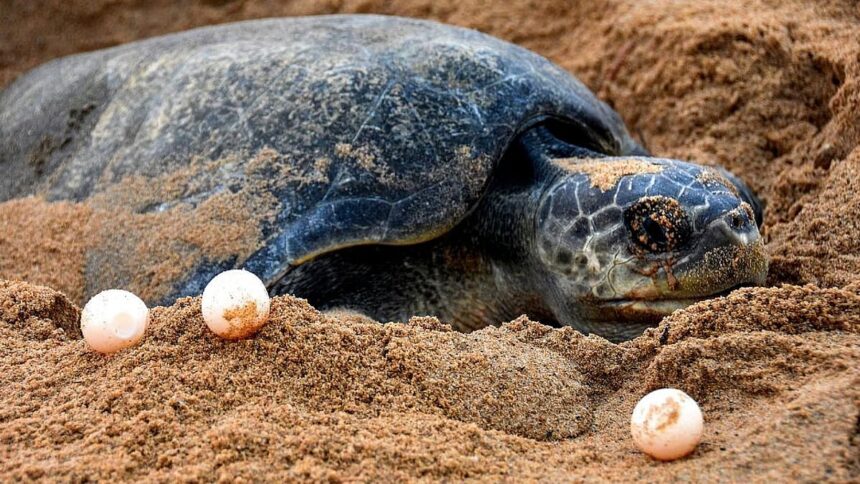
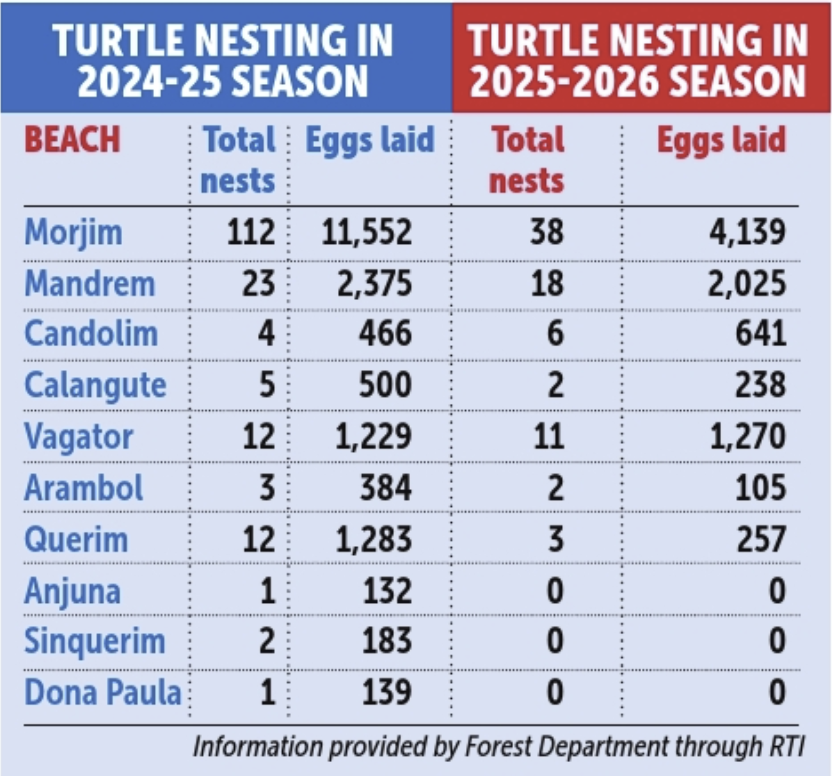
Eighty-three Olive Ridley turtles which are declared an endangered species-walked ashore eight beaches in North Goa and laid 8,991 eggs during the concluded 2025-2026 season in comparison to 175 Olive Ridley turtles that walked ashore 10 beaches in North Goa and laid a total of 18,243 eggs the previous season. The huge decrease in the number of turtles walking ashore to lay eggs is worrying the Non-Government Organisations (NGOs) with many attributing it to loud music and bright lights on beaches during their nesting time. Forest Department Officials, however, perceive the decline as “a normal trend.”
“The curve of turtles arriving at beaches will not be the same every year. It might have increased last year and it might come down this year. The short-fall of numbers cannot be termed as decrease,” explained Sujeet Kumar Dongre, Advisor to the Forest Ministry.
“There could be multiple reasons why fewer turtles might have come this season but just because they are fewer, you cannot say there is a decrease,” added Dongre.
From the 18,243 eggs laid last season, only 11,005 hatchlings were released according to an RTI from the Forest Department (Read: Low hatching rate of Olive Ridley eggs at Morjim cause for concern O Heraldo dated June 8, 2025), while the figures of hatchlings released this year were not provided despite being sought in the RTI.
The mystery of the 7,238 missing hatchlings is still unsolved, while the non-disclosure of hatch lings released this year
darkens the mystery. Dongre’s assertion that the decline in numbers cannot be termed as decrease is contested by Javish Moniz from Vagator who has been fighting for a hatchery to be built at Mahiri beach in Vagator.
The RTI indicates that 11 Olive Ridley turtles visited Mahiri beach in comparison to 12 the previous year. Despite one turtle less visiting this year, the number of eggs laid this year was higher by 41. Twelve turtles laid 1,229 eggs last year compared to 1,270 eggs laid this year by 11 turtles. “There have been complaints filed by officers of the Forest Department themselves with the police that loud music was played and weddings were held on the beach during the peak of the turtle nesting season and on two occasions turtles walked back without laying eggs,” alleged Moniz.
Information sourced from the Goa Coastal zone Manage-ment Authority (GCZMA) indicates that no permission was given for any wedding or event at turtle nesting sites so far. “Our staff cannot sleep on the beach to check if weddings are being held illegally. That is the job of the police and the tourism department,” asserted a senior member of GCZMA on condition of anonymity.
Compared to the 2024-2025 season where only one Olive Ridley turtle walked ashore and laid eggs in Dona Paula beach, there were no such incidents this season. Candolim was the only beach that saw an increase- six turtles laid 641 eggs in comparison to four turtles that had laid 466 eggs the previous year- in number of turtles and eggs laid.
“It is difficult to say fewer turtles came this year because of noise because there needs to be a scientific study to establish the conclusion. So far, there is no scientific study and hence it is something I cannot comment on,” stated Dongre when confronted with figures of noise pollution in areas declared as turtle nesting sites.
Retired Captain Gerald Fernandes, the first Goan to have won a State award for his role in Olive Ridley Turtle conservation in Goa, believes the government is not transparent when it comes to turtle nesting. “Why is it that for the first time the number of eggs laid in each nest were not specified at the hatchery in Morjim? It was done every year and only this year, the number was missing. Was it to hide some detail?” wondered Fernandes.
“Most marine turtles,” says a study by Annette C Broderick, Fiona Glen, Brendan J Godley and Graeme C Hays from the marine turtle research group, School of Biological Sciences, University of Wales, Swansea, “are non-annual breeders and show variation in both the number of eggs laid per clutch and the number of clutches laid in a season.” “Most species of marine turtle do not nest annually, but typically deposit two to four clutches of 50-150 eggs every two to four years,” reads the study. The numbers this season though, irrespective of the claims by forest officials and others has left turtle lovers worried.