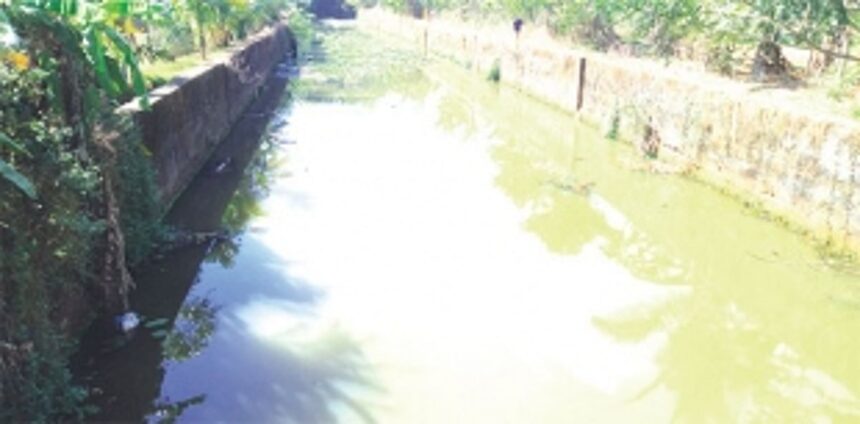
PONDA: The villagers of Kavlem, Bandora, who have been agriculturists for several generations, are now forced to leave their land fallow because they do not have clean water to irrigate their fields. Contaminated with sewage and industrial effluents, the main nullah at Ponda runs black and putrid, leaving the paddy farmers afraid and unwilling to use this water for cultivation as it poses a health hazard to the farmers as well as the consumers.
Two decades ago, Ponda’s main nullah located in the heart of the town, was considered the lifeline of agriculture in Kavlem and Bandora villages. It was the main source of irrigation for the paddy crop.

Today, the nullah lies in a highly contaminated state, choked with domestic waste and garbage. The farmers allege that untreated industrial effluents are also released into it at Bethora, making the water unfit for agriculture.
“When we used the polluted nullah water to irrigate our paddy crop, we developed rashes and other skin issues, and it also caused various health problems, and because of this, many farmers here gave up their traditional occupation and kept their land fallow,” said Durgadas Gavade, a local farmer. “The local MLA and Power Minister provided some help but only a few farmers take the risk to cultivate their fields using this water, while a majority of them are afraid to take up traditional paddy cultivation,” he said, adding that the contamination of the nullah has forced farmers to give up agricultural activity in the area for the last two decades.
The nullah originates in the Bethora village panchayat and flows down a distance of 12 km, passing through Bethora ,Curti, Ponda town, Kavlem, Undir- Bandora and then flows into River Zuari. All internal nullahs and storm water drains in these villages flow into this main nullah, but most of them bring contaminated water and garbage with them, resulting in the pollution of the main nullah.
Around three hundred farmers in Kavlem and Bandora used to cultivate around two lakh sq metres of farmland, using water from the Ponda nullah to irrigate their crop. The contamination of the nullah has resulted in 60 percent of the farmers giving up agriculture. Besides this, the government provides ration rice at subsidised rates, and this has also affected paddy cultivation in the area.
Ponda Municipal Council (PMC) Chief Officer Yogiraj Gosavi said that the PMC issues notices to people involved in releasing sewage and domestic waste into the nullah. He added that the PMC also developed the ‘Swachata App’ where people can complain against anyone found polluting the water body. “Before giving trade licenses, we also obtain an NOC from the Health Department to ensure that their waste is not released into the nullah,” he said.
Marcaim MLA and Power Minister Ramakrishna Dhavalikar said that Ponda locals will soon be connected with the Ponda Sewerage Treatment Plant. “By the end of May, households here will get sewerage connections. After that, 70 percent of the pollution of the nullah will be reduced. For the other 30 percent, which is industrial pollution, the local panchayat can take action,” he said.