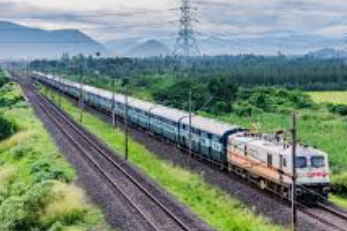
A fresh land ac quisition notification issued by the Ministry of Railways for the Vasco–Kulem dou ble-tracking project has trig gered renewed opposition in Mormugao taluka, with activ ists alleging that authorities are attempting to expand the controversial project through densely populated areas without mandatory environ mental and social studies. The notification dated February 16, 2026, issued through the South Western Railway (Construction Or ganisation), seeks to acquire an additional 5,477 square metres of land in the villag es of Cansaulim, Issorcim and Sancoale for what is de scribed as a “Special Project.” The development assumes significance as it marks yet another phase of acquisition in villages that have wit nessed sustained resistance to the double-tracking works in the past. Reacting sharply, Goencho Ekvott (GE) founder Orville Dourado Rodrigues said, “This is a fraud played on the in nocent landowners of Goa. The Railways are deliberately circumventing the mandatory Environment Impact Assess ment (EIA) and Social Impact Assessment (SIA). Neither an EIA nor an SIA has been conducted despite repeated demands from affected residents in the project-impacted villages.” He pointed out that more than six land acquisition process es have already been undertaken through the office of the designated Land Acquisition Officer, the Deputy Collector of Mormugao, in connection with the double-tracking project. Questioning the continued issuance of piecemeal notifica tions, Rodrigues said it was difficult to understand what is ‘so special’ about a project that continues to seek land in installments while, according to him, clarity on the precise alignment of the proposed second track remains absent. He further alleged that the additional line is primarily in tended to facilitate coal transportation through Goa — a contention that has formed the core of opposition to the project.
Referring to Issorcim, locals had alleged last year that rail way authorities encroached upon large tracts of private land before formally bringing the area under acquisition. Residents, with the assistance of GE, conducted a land sur vey at their own expense to establish the extent of the al leged intrusion. According to residents, it was only after this exercise that the disputed land was included within the acquisition framework, by which time construction activity was nearly complete. In the interim, affected landowners approached the South Goa Collector and other authorities seeking in tervention. A similar controversy had surfaced in Sancoale, where lo cals had alleged that railway contractor Rail Vikas Nigam Limited (RVNL) encroached upon private property and cut hundreds of coconut and fruit-bearing trees before resi dents secured relief through a High Court order. “Time and again, the Railways have played truant with the people of Goa,” Rodrigues said, warning that opposition to double tracking through coastal villages would intensify further in light of the latest notification.