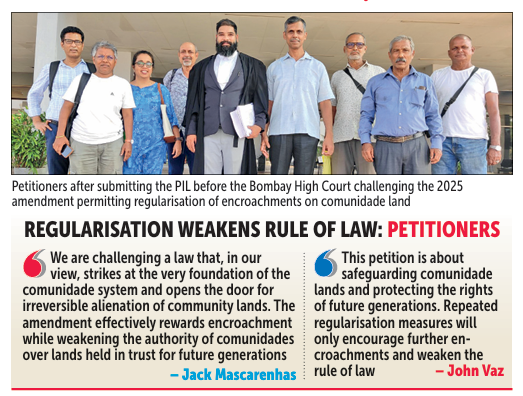
A Public Interest Litigation (PIL) challenging Goa’s controversial 2025 comunidade land regular isation law has been filed before the High Court of Bombay at Goa. The pe titioners allege that the amendment legitimises decades of encroachment on village community lands while weakening the tradi tional authority of comuni dades and gaunkars. The petition argues that the law threatens Goa’s centuries-old Gaunkari sys tem and sets a precedent for transferring valuable comunidade land to private occupants at nominal rates. The petition, filed on May 8 by registered organ isation Goyche Fudle Pilge Khatir (GFPK) through its president Jack Mascar enhas along with John Vaz, a gaunkar of the Comu nidade of Serula in Bar dez, seeks quashing of the amendment and an imme diate stay on all regularisa tion proceedings initiated under the law. The matter is presently awaiting admis sion before the High Court. Goa Act 16 of 2025 was introduced in the Legisla tive Assembly on August 4, 2025, passed on August 7 and published in the Offi cial Gazette on September 2, 2025 after receiving the Governor’s assent. The amendment inserts Article 372-B into the Code of Comunidades, allowing persons who built dwelling houses on comunidade land before February 28, 2014 to seek regularisation. Under the law, appli cants must qualify as “land less”—defined as persons not owning land or a house in Goa in the name of the applicant, spouse or minor children—besides proving residence in Goa for at least 15 years prior to 2014. Up to 300 square metres of land, including the struc ture and surrounding area, may be regularised. The law also stays dem olition of eligible struc tures for six months and allows “deemed consent” if a Comunidade General Body fails to decide an ap plication within 30 days, enabling a government-ap pointed officer to proceed with regularisation. In October 2025, the government notified regu larisation fee rates ranging from Rs 25 per square metre for older structures to a few hundred rupees per square metre for structures built between 2001 and 2014.
The petitioners argue that the amendment undermines the centuries-old comunidade system, a framework of col lective village ownership preserved under the Code of Co munidades after Goa’s integration into India. The PIL states that comunidades are autonomous village institutions historically managed by gaunkars and share holders who collectively hold rights over village lands and assets. The petition alleges that the amendment deprives comu nidades of property without fair compensation or legiti mate public purpose, violating Articles 14, 21 and 300-A of the Constitution. The petitioners have argued that the regularisation fees notified by the government bear no rational relationship to prevailing land values in Goa. The PIL states that under the notified rates, a 300-sqm plot could effectively be transferred for as little as Rs 7,500 despite significantly higher market values. The petition further alleges that the amendment creates an arbitrary classification by rewarding persons who en croached on comunidade land while offering no benefit to landless persons who did not violate the law. It also challenges the “deemed consent” provision, arguing that it strips comunidades of meaningful control over their own property and permits government-appointed authori ties to override objections raised by comunidade bodies. The petition additionally contends that the amendment was introduced while directions issued by the High Court in Suo Motu PIL No. 3 of 2024 concerning illegal construc tions were still under implementation. In its March 2025 judgment in that matter, the High Court had directed authorities to take action against ille gal constructions across Goa, including encroachments on comunidade land, while requiring periodic compliance re ports. According to the petitioners, the 2025 amendment effec tively shields encroachments from demolition proceedings and was introduced to neutralise the impact of the court’s directions. “We are challenging a law that, in our view, strikes at the very foundation of the comunidade system and opens the door for irreversible alienation of community lands,” said Jack Mascarenhas. “The amendment effectively rewards encroachment while weakening the authority of comunidades over lands held in trust for future generations,” he added. John Vaz said, “This petition is about safeguarding co munidade lands and protecting the rights of future genera tions. Repeated regularisation measures will only encour age further encroachments and weaken the rule of law.” The petition also alleges that the mandatory procedure under Article 652 of the Code of Comunidades—requiring the government to convene an assembly of Comunidade representatives to consider and forward their recommen dations before amendments to the Code—was bypassed before the Bill was introduced in the Assembly. The petitioners have sought declarations that both Arti cle 372-B and the Goa Regularisation of Grant/Allotment of Encroached Comunidade Land Rules, 2025 are uncon stitutional and ultra vires, besides interim relief restrain ing the government from processing, approving or regu larising encroachments under the amended provisions pending disposal of the PIL. The respondents named in the petition include the State of Goa through its Chief Secretary, the Revenue Secretary, the Law Secretary, the Director of Civil Administration, Administrators of Comunidades for the North, South and Central zones, and the North and South district Collectors.