Manohar Parrikar has always been a creature of circumstances. When he first came to power at the turn of the century, as a fallout of yet another toppling game that Goa used to play with effortless ease, he was the millennium man Goa had not see before. A metamorphosis of saffron and science, balancing ideology and intellect, dipped in arrogance and insolence, his trademark traits that have nestled against him like a soft pillow, he rests his head on after a eighteen hours work day.
Here was a politician in office who would go to office like a man possessed, running Goa like a hectic performance driven private enterprise. In the process, certain political niceties were given the go by, the Cabinet became a necessary but not a like able baggage he had to endure when he took decisions as crucial as dissolving the Assembly completely on his own and formalising the official Cabinet decision later, the opposition and unfriendly media treated with disdain and above all he, as a single entity became the party and the government. But even the biggest critics of the Parrikar project reluctantly agreed that the Parrikar administrative project made Goa better governed, at least where the eye could reach. The roads were a lift out of any western nation, Panjim became a gorgeous city with wide roads, tree lined avenues and with a spring in her step.
Yet again, the Parrikar ideological project disturbed many, and more so because it didn’t seem to bother him. It was the first time in Goa’s recent history, pre and post 1961 that the Catholics and even many Hindus felt that there was the “other” force bent upon negating history or wishing away a past culture which had the rubber stamp of history. While it wasn’t surprising that it got the communal label, it was more of an act of negation of history than any attempt to stamp a Hindu rashtra in Goa. But yes it did across as an attempt at extreme polarisation. Decisions that he now claims he took to improve efficiency like cutting down of public holidays which included Good Friday or the order the Education Department to show a CD of Goa’s history with the inquisition shown in disturbing detail, were seen an affront to catholic sensibilities.
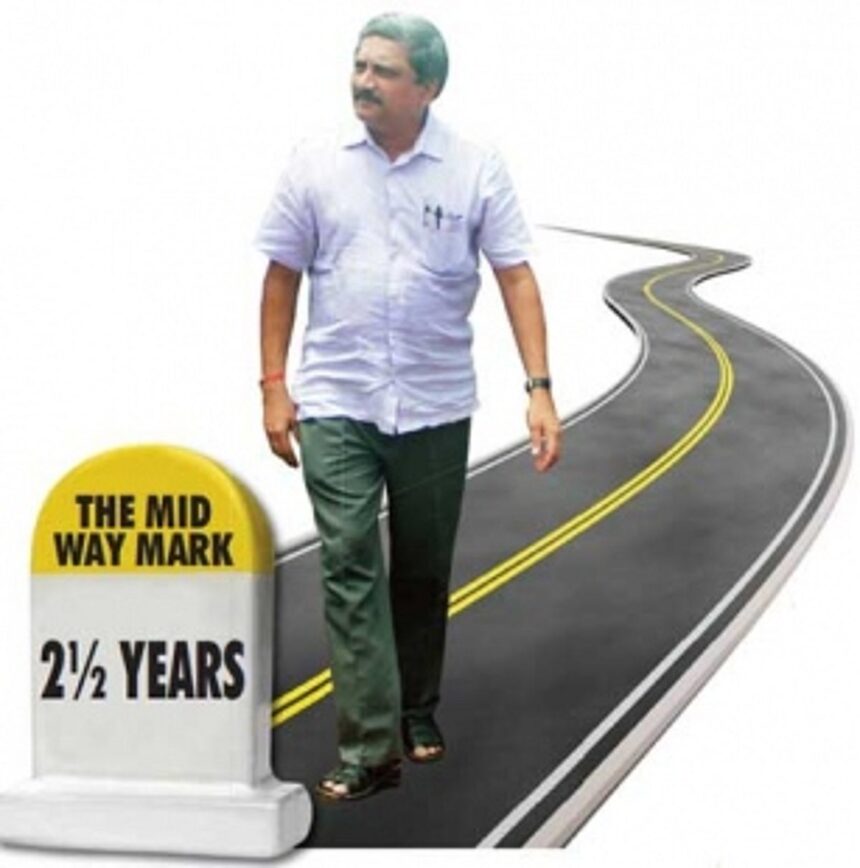
This back ground, though very much ingrained in every Goan who followed and were influenced and affected by his rule, is not just critical but imperative in understanding the Parrikar sequel of 2012 onwards which has reached the exact half way mark.
The circumstances that got him to power have been the subject of constant dispatches, and doesn’t really need a replay. But it does call for flagging the leitmotif of the Parrikar comeback, a four letter word called HOPE. Hope over history, solidity over suspicion, results over religion. It was an act of faith without the God being in a conventional place of worship. As he prepared to belt up for his roller coaster ride, knowing that at the end of it, he would ride not into the sunset but another sunrise, the watershed moment of the release of the Shah Commission report, the ban on mining and the suspension of all Environmental licenses taking the economy on a nose dive.
His carefully structured plans (hopefully) were jettisoned as he got into a crisis management mode, choosing to do it alone. And out of this process emerged shades of the old Parrikar, his new voters had thought he had buried for good. The Chief Minister has never embraced consensus in his politics, choosing to, at best, playfully flirt with it, to keep this politically correct. And while he allowed ministers some playtime at home and abroad, attending road shows, travel marts, motorsport and football matches, he got into something, and we say this with responsibility, he understands less than governance.
He spent far too much time sparring, with the Courts and the Congress government and then taking ownership for having backed Modi and then conveying to all in Goa that the Parrikar CMO and the Modi PMO were on first name terms with a “one call does it all” principle at work. He also became obsessed with fixing mining, leaving it hanging in a sea of confusion with the mining loan clearing policy and the larger mining policy, held. And with Goa Foundation about to move court any day challenging the renewal of licences, a longer delay is awaited.
Elsewhere, there lay the debris of indecision in the fields and villages, as construction carried on using three available loopholes. Section 17A, the joker card which allowed constriction if public interest was established and the sea of chaos between the two regional plans. But the biggest wall, which he allowed to personally build was between him and the people not meeting or planning with them. The man who held rallies with his people now faces rallies against him.
So is he then a creature of very unfortunate circumstances. But because he is Parrikar, Goa would have expected a Plan B which would involve non mining projects, fixing the Regional Plan and developing alternate economies as a priority and not as a fair accompli. Or is he just a changed man, more eager to put his personal political stamp as regional satrap and not necessarily the hope messenger.
And yet again, some things don’t change, the fundamental being that he knows best. He is capable of much more, but he is underperforming, and therefore showing shades of his early 2000 version. If Manohar Parrikar did all the things he is capable of he would literally astound himself, this last line borrowed from Thomas Edison “If we did all the things we are capable of, we would literally astound ourselves”