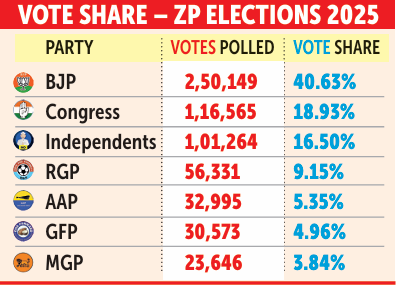
While the Zilla Panchayat (ZP) election results have already estab lished the seat outcomes, a break-up of the vote share from the December 20 polls offers a clearer picture of how voters were distrib uted across parties and in dependent candidates, and the extent of the ruling par ty’s dominance. The Bharatiya Janata Par ty (BJP) emerged as the sin gle largest force in terms of vote share, polling 2,50,149 votes to secure 40.63 per cent of the total votes cast. This scale of support trans lated into a sweeping out come on the ground, with the BJP winning 29 of the 50 ZP seats. The party will hold a clear majority in the North Goa ZP and is also ex pected to control the South Goa body with anticipated support from the Cortalim ZP independent member, Merciana Vas. The Indian National Congress (Congress) remained the principal Opposition party despite a wide gap with the BJP in vote share. It polled 1,16,565 votes, accounting for 18.93 per cent of the vote share, and went on to win 10 seats, with its support concentrated in select pockets, particularly in Salcete taluka. Independent candidates occupied a surprisingly large space in the overall vote share, collectively polling 1,01,264 votes, which accounted for 16.50 per cent of the total. This tally was drawn from 60 independent candidates who con tested across several ZP constituencies in both districts. In the end, independent candidates went on to win four ZP seats, causing an upset to some of the bigger parties in those contests. Among the other parties, the Revolutionary Goans Party (RGP) polled 56,331 votes, accounting for 9.15 per cent of the vote share, and won two seats. The AamAadmi Party (AAP) polled 32,995 votes, translating to 5.35 per cent, and secured one seat. The Goa Forward Party (GFP), which CONG ATTACKS MODI GOVT ON ARAVALLI ISSUE was part of the Congress-led Opposition alliance, polled 30,573 votes, amounting to 4.96 per cent of the total, and won one seat. The Maharashtrawadi Gomantak Party (MGP), which contested the elections as part of the BJP-led alliance, polled 23,646 votes, accounting for 3.84 per cent of the vote share, and won all three seats it contested, adding to the ruling alliance’s overall tally. Overall, the vote share analysis reinforces the BJP-led alliance’s dominance in the ZP elections, while also high lighting the sizeable space occupied by independent can didates and the fragmented nature of the Opposition vote. Former State Information Commissioner Juino De Sou za said, “The ZP election has clearly shown that the BJP is invincible and it cannot be defeated. More so the opposi tion parties will never unite, come what may. In Lok Sabha polls the opposition parties came together because it was only for one seat. The schemes launched by the govern ment have definitely helped the BJP.” Former Rachol Seminary Prof (Fr) Mousinho De Athaide said, “In politics even one night makes a difference and one cannot say what could be the outcome. We follow the British system where the party which polled the highest number of votes is declared the winner, unlike the propor tional representation system followed in many countries like Germany and Italy. If a party wins 40 per cent of the votes it gets 40 seats. They rationalise it and they consider the British system to be unjust. I believe that the ZP elec tion does not show the pulse of the people. It does not rep resent the will of the people. In the system of proportional representation nobody would have got absolute majority.” Progressive Front of Goa Co-convenor Adv Hrudaynath Shirodkar said, “This ZP election result has given a clear message to all Goans that if the opposition votes are unit ed, then there is no chance for the BJP to win the 2027 As sembly elections. As I had already said that the division of votes has been organised by BJP through their undeclared allies, we need to identify those allies. BJP on its own can not win any election as they don’t have issues to fight fair elections. It is high time people of Goa think about the fu ture of Goa. To save Goa, BJP needs to be defeated in the 2027 Assembly polls.”
A VICTORY FOR INCLUSIVITY

The recently concluded Zilla Panchayat elections have marked a no table moment for women’s participation in grassroots governance, with 20 out of 50 elected members being women, accounting for 40 per cent representation. This figure signals a steady shift toward more inclusive local leadership, even as it highlights the distance yet to be covered in achieving full gender parity A closer look at the results shows that women candi dates have succeeded across party lines and regions, indicating growing voter confidence in women leaders rather than isolated gains driven by reservation alone. The Bharatiya Janata Party (BJP) emerged with the high est number of elected women members, suggesting both organisational backing and effective mobilisation at the constituency level. The Congress, RGP, MGP, GFP and In dependent candidates also contributed to the overall tally, underlining that women’s electoral success is not confined to a single political ideology. Importantly, several women won from non-reserved or politically competitive constituencies, reinforcing the view that voters are increasingly prioritising local lead ership, accessibility, and performance over traditional gender biases. The presence of Independent women can didates among the winners further strengthens this nar rative, as it reflects individual credibility and grassroots support beyond party structures. Geographically, the elected women represent a mix of coastal, rural, and semi-urban areas, from Arambol and Calangute in the north to Curtorim, Navelim, and Cola in the south. This broad spread suggests that women’s politi cal participation is no longer limited to specific belts but is becoming more evenly distributed across the State. However, while the numbers are encouraging, political observers note that representation must translate into in fluence. Women members will need adequate institution al support, decision-making authority, and space within party hierarchies to shape policy outcomes meaningfully. Issues such as local infrastructure, health, sanitation, ed ucation, and social welfare—areas where women leaders often bring focused attention—are expected to gain great er prominence. Overall, the election of 20 women to the Zilla Panchayat reflects a gradual but important transfor mation in local politics. It points to changing voter attitudes and opens opportunities for stronger, more responsive governance at the grassroots level. The com ing term will be crucial in determining whether this nu merical presence evolves into sustained leadership and long-term empowerment. Expressing her opinion on the achievement, former Goa Pradesh Mahila Congress president Beena Naik said, “The representation should be 50 per cent, not just 40 per cent. Of course I am happy the way the ladies are emerging and coming into politics. I am very happy about that but at the same time I think more women should come forward. If there are more women there will be less corruption and a stable government. It should be replicated in the assem blies as well as Lok Sabha elections. If you see Lok Sabha, the ladies who are there are doing a very good job. Which ever party they belong to, they are vociferous. Ladies are the one who will not keep quiet if injustice is being done. And the whole credit goes to former Prime Minister Ra jiv Gandhi, former UPA Chairperson Sonia Gandhi and the congress party because they gave power to panchayati raj. Our leaders had foresight. That is why you see women coming out as leaders.” Social activist Cecille Rodrigues, said, “We welcome the 40% representation of women in the recently concluded Zilla Panchayat elections as a promising sign of progress towards inclusive local governance. This milestone re flects the growing recognition of women’s leadership po tential and their invaluable contributions to community development. It’s a testament to the efforts of individuals, organisations, and policymakers working tirelessly to cre ate a more equitable society.” “This achievement is a step in the right direction, and we’re optimistic about continued growth. With more women at the helm, we can expect more nuanced, em pathetic, and effective decision-making that addresses the needs of all community members. Let’s build on this momentum and strive for even greater representation and participation of women in local leadership roles,” she said. Former Goa Pradesh Mahila Congress president Prati maCoutinho said, “It is nice that women have started re alising and are coming forward. It is a good sign for a girl child or a woman. Women think by heart not by mind. It needs to be appreciated but then they should not become puppets to any leaders. They have to make their own de cisions. They should not be a rubber stamp to anybody. They have to stand firm on their ground and make deci sions. When women have reached everywhere, why not politics? But women have to be without any baggage. They have to be on their own.” Another social activist Dr Sabina Martins said, “ The res ervation of seats provided the opportunities for women and they have progressed. We hope they will work to im plement women’s rights just as others worked to get them reservation and into governance. In fact all the elected should work as that is their mandate too.”