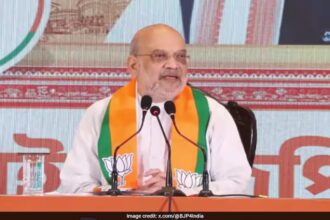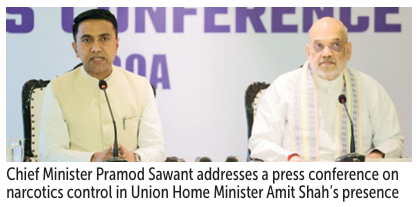
Union Home Minister Amit Shah unveiled a compre hensive three-year strategic roadmap running from July 2026 to July 2029 to dismantle countrywide drug networks and counter the growing threat of narco-terrorism. “We have prepared a 3-year roadmap from July 2026 to July 2029, which is based on four pillars:intelligence and operation-based enforce ment, control over precursors and synthetic drugs, demand and harm reduction, capacity building and coordination,” Shah said.
Shah claimed that due to the narcotics trafficking control measures taken by Centre, there has been a massive jump of over 357% in drugs seized between 2014 and July 2026, compared to 2004-2014. In Goa, the action increased nearly threefold during the same period. “From 2004 to 2014, during the Congress rule, the quan tity of drugs seized was 26 lakh kilograms. Today, that fig ure has increased from 26 lakh to over 1 crore 19 lakh kilo grams seized between 2014 and 2026,” Shah said. The value of seized drugs was Rs 40,000 crore during the Congress rule, whereas under the Modi government, that value has reached Rs 1,89,000 crore, a rise of 372%. Val ue of disposed drugs increased from Rs 8,150 crore from 2004-2014 to Rs 97,784 crore. “Between 2004 and 2014, 3.36 lakh kg of drugs were de stroyed, whereas from 2014 to 2026, the Narendra Modi government has destroyed 48.68 lakh kg of drugs (a rise of 1,348%). We all know that narcotics is a crime that de stroys our future generations, and the dirty money earned through narcotics is also used for terrorism. Thus, a ‘Nar co-Terror’ module has been formed in several countries, and the entire world is troubled by this issue today,” he said.

The Union Home Minister said that since 2019, the Cen tral government has established a mechanism to curb this. “We have altered systems, caught networks, broken financial chains, and provided hand-holding to victims to free them from addiction. Before 2014, this fight was fought piecemeal at the unit level and in silos. Satisfaction was drawn merely from small seizures and apprehending minor offenders,” he said. In 2019, a four-tier Narco-Coordination Centre (NCORD) mechanism was created. The Centre provided states with a model to form dedicated Anti-Narcotics Task Forces across all States and Union Territories. “For the rehabilitation of drug-addicted youth, we launched the 1933 MANAS Helpline, restructured the NCB cadre, and built a national database of narcotics offenders through the NIDAAN portal.
Through CCTNS data and in tegrated data fusion, we prepared a data-driven map cov ering hotspots, modus operandi, and seizures across the entire country,” Shah said. The Centre has also initiated a new method of reverse investigation for networks—following the chain from bot tom-to-top and top-to-bottom. “Whether a small pouch is seized, we trace where it orig inated in the country, or if a large consignment of drugs is seized at the country’s borders, we investigate how it trans forms into small pouches and reaches the youth,” he said