SHASHWAT GUPTA RAY
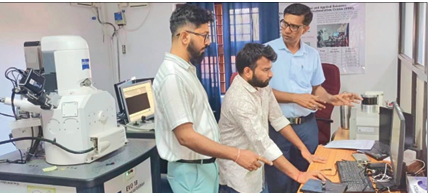
Amid grow ing concerns over food adulteration, the com mon people will soon be able to detect the quality of eatables in real time using a smart phone-based Artificial Intelligence (AI) system being developed by Goa University “We are all aware of the increasing cases of spurious food items. While the Food and Drug Administration (FDA) is continuously monitoring products in the market, we decid ed to widen the scope of detection by empowering citizens to verify quality on their own using their smartphones,” Dean of the School of Physical and Applied Sciences (SPAS), Goa University (GU), Professor Ramesh V Pai told O Her aldo. To make advanced testing accessible to all, SPAS is de veloping portable sensors and a dedicated smartphone application linked to a cloud-based AI platform. Users will be able to scan food items using their phone camera or an external sensor, after which the data will be uploaded to the cloud for analysis. “The system delivers easy-to-understand results within seconds, ensuring that sophisticated scientific testing be comes accessible to any consumer with a mobile device,” Pai said, adding that the technology has reached an ad vanced prototype stage, with successful demonstrations on various eatables. The upcoming mobile-based solution is an offshoot of the advanced, non-destructive food quality-checking tech nologies developed by SPAS scientists using spectroscopy, multispectral and hyperspectral imaging, colour imaging, artificial intelligence, and cloud-based computing. “These systems work by capturing the chemical, struc tural, and visual signatures of food items and analysing them through AI models to determine freshness, purity, and overall quality. Designed to be portable, rapid, and user-friendly, these technologies reduce dependency on traditional laboratory settings and eliminate the need for chemical-based testing,” Technical Officer, SPAS, GU, Dr Madhusudan G Lanjewar said. According to Lanjewar, most conventional laborato ry-based methods are slow, expensive, and require skilled personnel, making routine testing impractical for the pub lic. “Conventional food-testing techniques are hindered by lengthy processing times, high operational costs, the re quirement for chemical reagents, and the inability to con duct on-site testing. These limitations make them unsuita ble for quick decision-making or field-level assessments,” he said. “Our technology addresses these issues through rapid, non-destructive, and highly accurate tools that use spectral and imaging data, combined with robust AI algorithms, to instantly detect spoilage, adulteration, chemical contami nation, or hidden structural defects not visible to the na ked eye,” Professor Jivan S Parab of SPAS, Goa University, said.