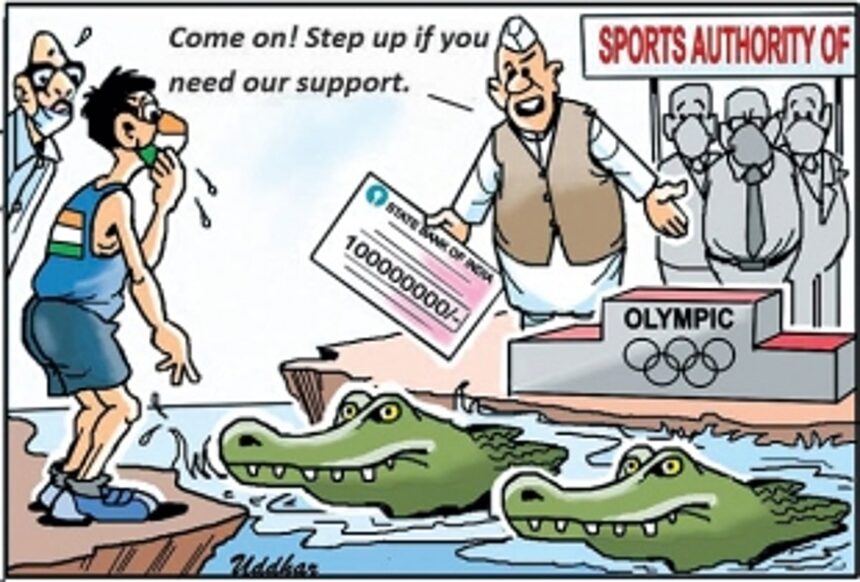
. Businessmen running five-star sporting clubs in Goa leave genuine sporting talent out
. Our sporting stars need help, training infrastructure as they grow up more than cash awards after they win medals
. Goa, a proud sporting State lacks basic infrastructure and facilities even after building new stadiums
The celebrations of India winning 7 medals including gold are not ending. Awards are being announced, cash prizes are being given and brands are rushing to endorse our Olympic champions. But our athletes are not a product of a system. They win medals and do well for the country in spite of the system.
Throughout the country and Goa is no different, top-class sporting facilities are in private hands, not quite accessible by those who cannot afford it.
Take the Panjim Gymkhana for instance. The inspiration for building a stadium to develop sports, especially cricket talent was Bhausaheb Bandodkar’s. The idea was to use the space purely to train and develop sporting talent, mainly cricket. The new avatar of the club as it stands today is that of a restaurant, hotel, and bar with sports, not on the forefront. It is a private club with an exorbitant entry fee. Let us ask, will an ordinary sportsperson’s family be able to able to afford the “world-class” facilities advertised by the club?
The same goes for Clube Tennis de Gaspar Dias’ “erected on a piece of land at Gaspar Dias ceded by the Camotim Mamai family”. These are the most prime properties in and off the riverfront. It is perhaps time to introspect when we look at the larger issue of sports and why we do not produce winners, that a part of the reason is that sports has become a business. It is for-profit only and controlled not by sportsmen and women but by businessmen, many of whom are common to both these premier five-star clubs and other bodies like the GCCI. It is almost the same set of people who make the same set of rules, in a manner that they remain at the helm of affairs forever. It is not just by chance that some high-profile member of GCCI is on the committee of Panjim Gymkhana or Clube Gaspar Dias and manage to retain control. Is this for the good of sports? Let us all think.
A sporting facility and alcohol do not mix
Mind you, setting up a restaurant and a bar with a swimming pool is a legitimate business. But in this case, does it go with the spirit of having a facility to develop sporting talent for those whose families cannot afford to pay for a five-star facility? A facility for developing sporting talent and alcohol do not mix.
A sporting facility has become more about saloons, restaurants, bars, and pools. And the premises are used for weddings, parties, conferences, and politicking. A cosy relationship between those who control all these places and their relationship with political power ensures that there are no questions, no debates, or even a call for introspection.
We are sure all of them have genuine interests and are well-meaning people but does this help Goa get a better talent pool of sportsmen and women who can do Goa, and India proud? That is the context, and these two clubs are just examples of a mismatch between what the intentions were and what has turned out.
Sports is not a business. So, this game should not be played. Instead, the game of helping our sportsmen and women should be played honestly
Well-meaning businessmen are blessed with enough to create infrastructure and allow access and raining for sheer sporting talent that cannot be valued with money. If they are blessed before tournaments like the Olympics, it will go a long way.
Do we have sportsmen and women who have played for India and taken part in the nationals, or the Asian games, or even the Olympics as members of these clubs? Are there memberships open for free for reputed sportspeople including coaches?
And sports and business do not mix. Across India, there are stories of the struggle of India’s athletes and how they managed to pay for their sports training due to their families and sacrifices. It has nothing to do with the state. While some succeed and carry on, others go back to their days of poverty even after representing India. At the same the majority of the Indian players have hard stories of struggle
– Pinky Karmakar carried the Olympic torch for India at the London Games in 2012. She now works as a daily wage labourer at a tea garden in her village in Assam
– Another athlete’s family sold a watch to pay for training fees
– The current captain of the Indian women’s hockey team mixed water in her milk as the family couldn’t afford it and practiced with a broken hockey stick
– Another hockey player from Manipur has told us a story of how her father had to spend his entire day’s earnings just to travel to a camp she was, to sign a document to allow her to play in a tournament
These stories bring us tears of pride but also pain for those who have lived through it. Are governments who announce so many awards and prizes at the end of their winning journey, with them through their journey? Do they get the support they need when they are young so that they don’t have to struggle for a glass of milk or a father having to spend all his daily wage earnings to fill a form for his daughter?
Sports budgets are spent on salaries and not infrastructure
While sports budgets are being cut, there is always money for sports administrators for their worldwide travel, luxurious stays when funds should be allocated for sports development and grassroots training. These figures will shock you for a country which is now promising jobs and cash awards to medal winners AFTER the Tokyo Olympics.
In this year’s budget Rs 2,596.14 crore was allocated to sports in an Olympic year which was less by over Rs 230 crore or an 8 per cent drop from the previous year. Of this 90 per cent is for salaries and basic expenses with just Rs 46 crore for new facilities training stadiums etc.
Australia’s four-year budget for Olympic sports planning is $198 million compared to UK’s $334 million and Germany’s $275 million. India spends one-fourth of UK’s budget annually, according to indiaspend.com – that’s about Rs 8 per capita.
That is why countries with a lower GDP than India have done better. By focussing on sports and allocating fewer resources in a better way. Countries like Brazil, Cuba, Kenya, Jamaica, Iran, and Uganda were higher in the medal standings than India in the Tokyo Olympics.
Does Goa have stadiums and facilities of a standard that can be used?
Let’s look at the situation in Goa. The state supposedly upgraded its infrastructure for the Lusofonia Games held in Goa but the new facilities are not being fully utilised regularly for the purpose for which they were built. It is here that the associations need to be told that it is their duty to make use of these for the sake of their sportspersons around the year.
Do we have good swimming pools and athletic tracks? Look at the state of walking track along the Fatorda stadium, the Shyama Prasad indoor stadium is used for political rallies and concerts. Do we have astro-turf pitches to practice and train for our hockey players? For long some private educational institutions have provided good sporting facilities but does the Sports Authority of Goa (SAG) have similar facilities?
The SAG needs to be revamped as well as the Directorate of Sports and Youth Affairs (DSYA). The biggest missing link in sports now is the lack of strong support at the base as children who display an aptitude for a certain sport must get a special type of treatment.
Finally, let us ask a simple question. Is Sports a priority?
Can individuals get medals through their own efforts? Yes, they can provide their families; their teachers and their coaches make supreme sacrifices, often making the children stay at their own homes like their own children. Yes, we need medals but they should come due to a good system. There was no Goan from the state playing for any of the Indian teams or individual disciplines in Tokyo. This is because of sports becoming a business. Because of businessmen who rule sporting clubs and organisations who perhaps do not see the budding sporting talent as a real jewel and turns that jewel into something valuable for Indian sport. This needs something money can’t buy. A passionate heart. When that happens rooms in sporting clubs will be for sportspeople, training facilities and a great kitchen with nutritious food will be given priority rather than bars and restaurants. And parents will not have to spend their hard-earned earnings to fulfill the sporting dreams of their children. The same governments, companies and others who offer so much after winning medals should come forward when this talent is first noticed and supported till they are ready for the state and country and supported throughout.
We say it again. Sport is not a business or a power game. And should be run by those who do not treat it as one. Since everyone, including businessmen, love sport and would want our sportspeople to do really well, we hope that this realisation will be there for us.