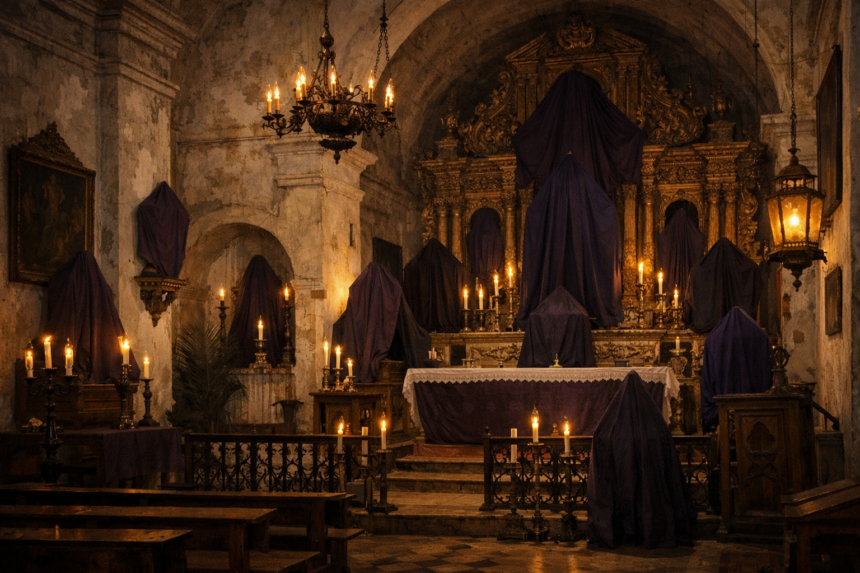
Lent marks a 40-day season of prayer, fasting, and almsgiving, starting on Ash Wednesday and concluding at sundown on Good Friday. This time prepares Christians to celebrate the Lord’s Resurrection during Easter.
It’s the most solemn observance in the Christian liturgical calendar, honoring the 40 days Jesus spent fasting in the Garden of Gethsemane on the Mount of Olives, where he faced temptation from Satan, as recounted in the Gospels of Matthew, Mark, and Luke, before his crucifixion on Calvary. In Konkani, spoken by Goans, the season is called “Korezm,” derived from the Portuguese “Quaresma,” which simply means “40,” symbolizing the 40 days of imitating Christ’s desert journey. Fewer people today are aware of the traditional practice of veiling altars and statues of God and saints (while leaving the Stations of the Cross and stained-glass windows uncovered) in every Catholic church.

This veiling signals that something profound is shifting; it might feel jarring at first, but the final two weeks of Lent build intense preparation for the Sacred Triduum. The veils draw our focus to the proclaimed words at Mass, especially during the Passion narrative, allowing our senses to immerse fully in the Gospel’s powerful scenes. The Church employs these veils to heighten anticipation for Easter Sunday, they’re temporary, after all. Typically, covering crosses, statues, and images with plain violet opaque cloths starts on the Saturday before the 5th Sunday of Lent. Yet, dating back to the Middle Ages, some churches began veiling as early as Ash Wednesday. Though its precise origins are uncertain, the custom evolved from the medieval “hunger cloth” (Hungertuch), a massive violet or black cloth draped before the altar to block the congregation’s view.
These images must eventually be unveiled; leaving them covered feels unnatural. The dramatic reveal before the Easter Vigil mirrors our earthly existence: we dwell in a “veiled” world, exiled from our true home, with salvation alone lifting the veil to reveal life’s full beauty. Older liturgical manuals note a papal dispensation from 1878 allowing St. Joseph to remain uncovered during March, his feast month. Following Good Friday rites, all crosses are unveiled. In the Ordinary Form of the Mass, coverings are removed quietly before the Easter Vigil. In the Extraordinary Form, images sometimes stay veiled until the Gloria at the Easter Vigil.
The core symbolism of veiling Christ’s images reflects his absence from society during Lent, he was isolated on the Mount of Olives, invisible to the public. But why veil the saints too? As ultimate followers of Christ, their presence depends on his; without him, they cannot shine.
Basically, crucifixes are veiled because Christ during this time no longer walked openly in public, but rather hid himself. Therefore, in the papal chapel the veiling formerly took place at the words of the Gospel: “Jesus autem abscondebat se.” Another reason is added by Durandus, namely that Christ’s divinity was hidden when He arrived at the time of His suffering and death. The images of saints are also covered because it would seem improper for folllowers to appear when the Master himself is hidden.
It is important to note as well that this ritual of veiling also has the effect of making the Easter Vigil much more dramatic when the veils are finally lifted at that time (Liturgical Arts Journal).
This tradition is a wonderful one to share with children, sparking their curiosity and making the season unforgettable. We lavish effort on Easter home decorations, so why not use veils to heighten readiness for the greatest feast? Notably, at the Andrade house in Ambajim, Margão, veiling their private oratory with a black veil dates to around 1730 and persisted until the 1960s, when candles ignited it. The practice resumed in 2013. The 18th Century oratory which is being veiled annually in a black veil bearing a silver cross comprised of 15 flowers (The meaning of the number 15 in the Bible is rest. This rest comes after deliverance that is represented by fourteen. The 15th day of the first Hebrew month (Nisan) is the first day of the Feast of Unleavened Bread, a day of rest for the children of Israel and for Christians) , on ash Wednesday and unveiled on Easter after the Vigil mass. Rooted in the Middle Ages, these veils are typically lightweight purple cloths, undecorated.
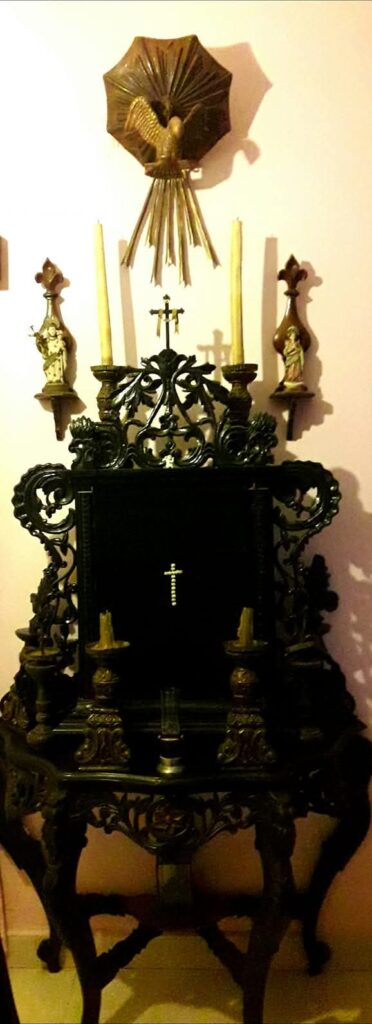
The veiled oratory at the Andrade’s in Ambajim
Additional Insights and Historical References
To enrich understanding, veiling underscores Lent’s theme of spiritual “hiding” to foster deeper contemplation, as noted in the Caeremoniale Episcoporum (1600), which permits the practice from Passiontide (the 5th Sunday of Lent) onward (Book II, Chapter 23). The “hunger cloth” or Hungertuch is documented in 9th-century German sources, such as the Pontificale Romanum adaptations, where it concealed the altar until the Passion reading on Spy Wednesday, evoking the temple veil tearing at Christ’s death (Matthew 27:51). Pope Innocent III (d. 1216) referenced similar customs in De Sacro Altaris Mysterio, linking it to penance and Easter joy.
Modern revival efforts, like the Andrade oratory, align with post-Vatican II options in the Roman Missal (Ordinary Form, 1970), which allows veiling “to signify the absence of the Lord” (General Instruction, n. 305). For families, the U.S. Conference of Catholic Bishops’ Lent and Easter guide (2020) recommends it for home altars to engage youth, echoing your point on passing it down.
This custom, though fading, revives Lent’s sensory drama, much like Advent wreaths build Christmas anticipation, reminding us that revelation follows restraint.
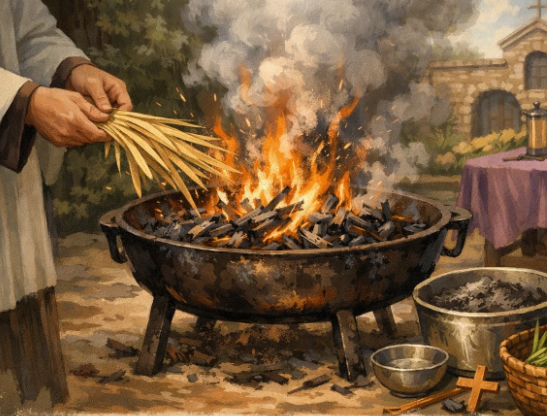
An illustration depicting the burning of blessed palm leaves from the previous year’s Palm Sunday celebrations to prepare the ash used in the Ash Wednesday ritual.