VITHALDAS HEGDE
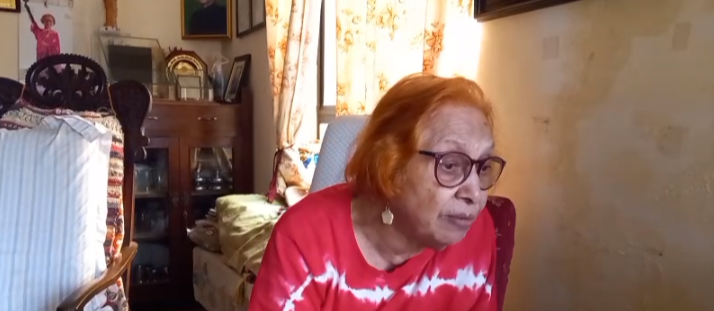
Veteran freedom fighter and Padma Shri awardee Libia Lobo Sardesai rued that Goa was no longer a civilised state. “Goa was ruled by foreigners, but people were civilised. Today we cannot think that we are civilised. Because we don’t… we don’t,” she said.

“If the Portuguese did not consider us because they were foreigners, today our own people do not consider us the same. Why? They… they… they [politicians] have divided us. The Portuguese never divided us; they united us. We were united during the Portuguese rule. Today we are divided. If only these rulers had learned something from Portugal and Portuguese rule, even the whole of India would have benefited.
“We did not want to remain under the Portuguese. But all those things—the destruction and the nonsense that is going on—we would have had better rulers, everything. Today we have uneducated people who do not know or understand. They go abroad; they may be going as suitcases and coming as suitcases. There are lots of suitcases going abroad, no?”
Sardesai, who worked for All India Radio (Bombay) as a librarian, recalled that her husband, late Vaman Sardesai, was doing news in AIR’s Konkani section. “Ami shen khalem,” she said.
Reminiscing about her participation in the freedom struggle, she said, “We had no quarrel with the Portuguese, and we rejected their colonial rule. They were colonialists, though not democrats. Hostilities against the people started only when people joined the Satyagraha movement in 1954. They had issued Bilhete de Identidade (identity cards) to Goans. Everybody was treated equally. There was Uniform Civil Law in the State. Also, one murder was reported in 25 years. But today, you cannot count burglaries and robberies reported in the State.
“Look at Puducherry, a part of India. It was under French rule. But the Government of France made an agreement with the Government of India, and Puducherry continues what was being done during the French regime. That would have happened in Goa, but we forced the issue. And having forced the issue, we changed everything. Immediately, Maharashtra wanted to merge Goa and make it part of Maharashtra.”
Recalling her decision to operate an underground radio to counter Portuguese propaganda, Sardesai said, “Myself, Vaman Sardesai and Nicolau Menezes set up an underground radio just outside Goa’s border on November 25, 1955. We chose November 25 because it was the day the Portuguese conquered Goa. We operated for six months at Amboli near Sawantawadi and later shifted to an almost uninhabited place at Castlerock, but Menezes dropped out.
“It was five years in the forests with a single mission—doing Konkani broadcasts, and I did it in Portuguese, continuing the mission until Goa’s liberation by the Indian Army. Operating the radio played a great role because, though the government did not help us, they eventually made use of our radio. For the last three days, the ultimatum sent by the Government of India through the Defence Minister told the then Governor that the time was up and he should surrender. The government asked the Governor to reply on our frequency, and we sent the message. Every two hours, we broadcast to the Governor that the time was up.
“We did not know what was happening, but the Indian Army was preparing Operation Vijay. So the Government of India made use of our radio. We became the vehicle of the government.
“Sensing trouble, the Portuguese Governor contacted Salazar, a dictator who told him to burn Goa. Some people then rushed to the Archbishop, who was the next authority in the Church as per the Concordat.”