ANIL KUMAR MISHRA & SHYAM ZAMBAULIKER
In 2023, Goa recorded 97 rape cases. By 2024, that number had climbed to 109. Last year brought a marginal dip to 102 — a figure that cannot be interpreted as progress, but a plateau of failure. So far in 2026, the record ed rape cases has already reached 40. Alongside rape, police stations across South Goa have been registering two to three kidnapping cas es involving minors every single month since January 2026. Cases of child sexual assault, outraging of mod esty and exploitation under the false promise of mar riage have spread across Vasco, Verna, Maina-Cur torim, Colva, Fatorda and Ponda. Investigators themselves acknowledge that several kidnapping cases concealed sexual abuse of minor girls. These are not isolated in cidents. In one case, Verna police booked a 23-year old man from Vasco for repeated ly sexually assaulting a minor girl over a period spanning April 2024 to March 2026 — nearly two years. In another, a 48-year-old man from Bicholim allegedly assaulted a wom an across multiple hotels in Mapu sa, Miramar and Margao between 2021 and 2025, claiming to offer her a job.

In March, two men befriended a woman at Siridao beach and alleg edly gang-raped her at an isolated spot near the Cortalim bridge. In Fatorda, a 62-year-old was arrested for exposing himself to two minor children. What connects these cases is not geography or the age of the accused. It is the pattern – perpetrators known to victims, abuse sustained over months or years, discovery only after repeated harm. Every one of these cases passed through a system supposedly designed to catch them, but none of it worked. Goa has the Goa Children’s Act. It has the POCSO Act, the Goa State Commission for Women, a dedicated women’s police station, and a one-stop crisis centre. On paper, it is among the better-equipped Indian States on children’s and women’s protection. In practice, however there is much to be done. “Laws alone cannot protect children unless there is sustained investment in prevention, safeguarding systems and institutional preparedness. Prevention has remained one of the most neglect ed aspects of child protection for years,” Peter F Borges, former Chairperson, Goa State Commission for Protection of Child Rights asserted.
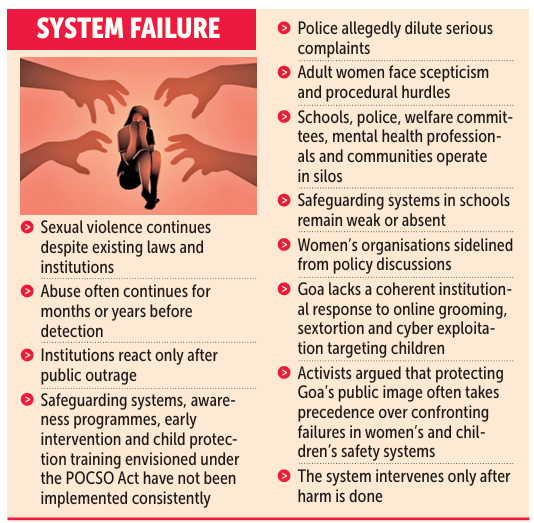
The POCSO Act, Borges points out, was never merely punitive in intent. It envisaged awareness programmes, early intervention, child-friendly systems and capacity-building — none of which have materialised with any consistency. Instead, the system jolts awake only when a scandal breaks through to public consciousness, issues some statements and goes back to sleep. “What we often see is systems waking up only after a shocking inci dent, followed by temporary outrage, cosmetic measures and then si lence again,” said Borges. For women who gather the courage to walk into a police station after a sexual assault, the ordeal frequently does not end there. It accelerates in a different direction. “When women approach police stations after experiencing sexual as sault, they are often pressured to remove certain words from their com plaints, and cognisable offences are diluted into non-cognisable ones,” said Sabina Martins, a women’s rights activist.
The distinction matters enormously. A cognisable offence permits immediate arrest without a magistrate’s warrant. Downgrade it to a non-cognisable offence and the accused walks free while due process grinds on. This is not a bureaucratic accident, it is institutional discour agement, and it is happening routinely. Martins points out that when the victim is a minor, cases tend to be registered promptly. When the victim is an adult woman, she faces scepticism, procedural friction and pressure to soften her own account. “In the name of protecting Goa’s image, we cannot undermine the safety and dignity of women,” argues Sabina Martins. Child protection, Borges argues, cannot function in silos — and in Goa, silos are precisely what exist. Schools, police, child welfare com mittees, mental health professionals, communities – each operates in dependently and reactively, with no sustained coordination. “The result is a system that is fragmented, inconsistent and heavily reactive,” Borg es added. “Are safeguarding committees active in Goa’s schools? Are teachers and hostel staff regularly trained on POCSO? Do children even know where to report abuse? These questions remain, by every measure, un answered,” Borges points out.
The collapse in governance is visible in plain sight. Women’s organ isations were promised quarterly meetings with police. Last year, one meeting was held. The Department of Women and Child Welfare has not convened stakeholder meetings in years. Organisations that raised concerns found themselves sidelined from programmes — not consult ed but excluded. “Unless women’s organisations actively push for these discussions, they simply do not happen. If we truly want to address sexual violence in the state, it must be a collective and sustained effort,” argues Sabina Martins While institutional attention has been slow even on physical abuse, a new front has opened entirely unguarded. Children today face online grooming, sextortion, emotional manipulation and cyber exploitation — abuse that requires no physical proximity and leaves no visible mark until it is far too late. “Abuse no longer requires physical proximity. It enters through screens. Yet digital safety and safeguarding remain among the weakest conversations across institutions and communities.
This is not a niche concern. It is the dominant vector of child vulnerability in 2026, and Goa has no coherent institutional response to it,” warns Peter Borges. Meanwhile, citizens and advocates are not short on demands on what actually needs to happen. They want faster trials, stronger investigations and the use of tech nology in evidence collection. Sanjit Dessai of the Quepem Bar Associ ation has called for strengthened preventive measures — active wom en’s helplines, mapping of vulnerable areas and greater deployment of women officers at police stations. But the more fundamental demand is structural – stop treating each incident as a crisis to be managed and start treating child and women’s safety as a system to be built. That means mandatory, functional safe guarding committees in every school. It means quarterly police-com munity meetings that actually happen. It means digital safety curricula. It means a Department of Women and Child Welfare that does not need to be chased to do its job. “Goa now needs to move beyond image management, reactive re sponses and statistical debates. The focus must shift towards preven tion, preparedness, institutional accountability and building systems that children can actually trust,” says Peter Borges. The police however played down the numbers saying “all com plaints are examined strictly under legal provisions.” “A large percent age of the cases originate from interpersonal disputes and consensual relationships that later turn into criminal complaints. Cases involving promises of marriage, failed romantic relationships, and family or neighbour-related disputes form a substantial portion of the regis tered offences. All this adds to the reported rape cases number, thus inflating the number to appear bigger than the reality,” contended a police official.
Higher reporting of crimes can, in one reading, signal progress — greater awareness, diminishing stigma, more women willing to come forward. But each reported case is also a child or a woman who was failed before they reached the police station. The systems that should have caught the abuse earlier — the school, the welfare committee, the helpline, the neighbour who knew — but did not. Goa has the laws. It has allocated the funds. It built the institutions. What it has chosen not to do is make any of them work. That is not a law-and-order problem. It is a choice — and the people paying for it are the ones who can least afford to.