What is at the root of the farm crisis leading to massive protests and agitation by the farmers, particularly in Madhya Pradesh and Maharashtra, has been summed up to a great extent by the Reserve Bank of India in its Second Bi-monthly Monetary Policy Statement, 2017-18 -Resolution of the Monetary Policy Committee (MPC), Reserve Bank of India.
The RBI report says:
“Propelled by significantly higher arrivals in mandis relative to the seasonal pattern, prices of vegetables also fell markedly from July and bottomed out in January 2017, with fire sales during the demonetisation period accentuating the fall. The seasonal uptick that typically occurs in the pre-monsoon months has been muted so far. In the fuel group by contrast, inflation surged across the board. Prices of liquefied petroleum gas (LPG) and kerosene rose in sympathy with international prices even as the subsidy was set on a path of calibrated reduction. Fuel used by rural households rose for the third month in succession, narrowing the wedge between fuel inflation facing rural and urban households.”
The RBI takes into consideration higher arrival in mandis and fire sales during the demonetisation period as two major factors leading to falling prices. On a similar count, the prices of vegetables also fell sharply.
In Madhya Pradesh, the Government has been in the overdrive mode over last few years to keep the agriculture production rising. In the process, the State BJP Government has continued to bask in the glory of the “Krishi Karman Award” it has been receiving year-after-year from Government of India for leading in agriculture growth. The glory of this award notwithstanding, what beats imagination is that the “sarkari babus” (bureaucrats) and advisers to the government and the chief minister in agriculture related matters failed to appreciate a simple economic principle that agricultural output or productivity, recognised as total factor productivity (TFP), is supposed to be measured not in terms of weight but should be calculated by comparing an index of agricultural inputs to an index of outputs.
Unfortunately, the mandarins in the corridors of power in Madhya Pradesh have failed to do justice when it comes to projecting agricultural output figures and what has compounded the problem is that even the Government of India has not bothered to demand more pragmatic projections by the State Government.
It beats imagination when some officers, at times, keep previous year’s figures as a reference point and even resort to fabricating figures for the successive year’s performance. This exercise gets completed in a jiffy especially when bureaucrats receive instructions from the Chief Minister’s secretariat to provide figures with a special tagline that the figures are needed immediately as the Chief Minister has to fly to New Delhi for an important meeting.
The Government has continued to pat its back for the Krishi Karman Award but ignored the plight of the farmers who are now finding themselves against the wall and have been forced to agitate to force the government to accept their demands.
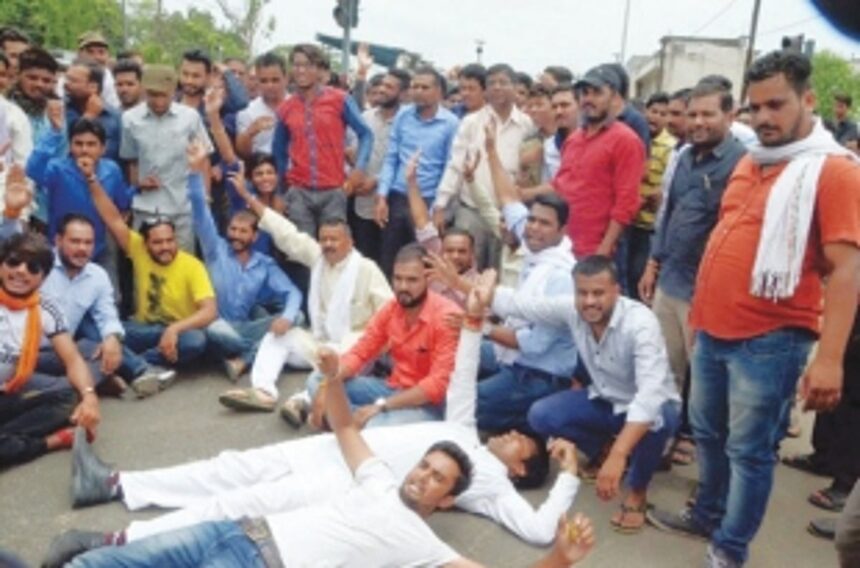
Madhya Pradesh is witnessing a farmers’ agitation that has gone violent. What came as most shocking were unconfirmed reports stating that six persons were killed in police firing during the farmer’s agitation in Mandsaur district of Madhya Pradesh on 6 June. After the authorities had kept asserting that the Police had not opened fire, came the state Home minister Bhupendra Singh’s admission that 5 farmers had died in police firing.
The State farmers are pressing for rural loan waiver and a hike in support prices to ensure they do not succumb to economic pressure due to rising input prices. Everyone knows that farmers, finding themselves trapped in debt, were even committing suicide.
Madhya Pradesh is on the boil, especially after the police firing at Pipalia Mandi in Mandsaur district. The agitated farmers are not in a relenting mood. The ruling Bharatiya Janata Party and the main Opposition Congress, both have tried to politicse the farmers’ strike that went out of control after the State chief Minister Shivraj Singh Chouhan had entered into a pact and accepted most of the demands of the RSS frontal organisation – Bharatiya Kisan Sangh – which was also quick in announcing that the farmers’ agitation was being called off . The other farmers organisations, including Rashtriya Kisan Majdoor Sangh refused to fall in line and declared that the strike would continue.
Chief Minister Chouhan has asserted that it is not the farmers but anti-social elements who were indulging in violence, loot and arson. He also issued a firm warning saying that the criminals will not be spared. Even State BJP leaders went in the attack mode and accused the Congress of inciting violence. With battle lines clearly drawn, the Congress Vice President Rahul Gandhi tried to visit the families of those killed in police firing on 8 June but was stopped by the police and taken into preventive detention when he was crossing the Rajasthan border and entering Mandsaur district where prohibitive orders were in force. Later in the day, after his release and just before his departure, Gandhi could manage to meet members of the bereaved families. He told media-persons that Prime Minister Narendra Modi can waive Rs. 1,50,000 crore loans of the rich but he was neither waiving the farmers’ loans nor giving them bonus. Instead, the farmers were being given bullets, he said.
There has been massive damage to properrty across many districts in Madhya Pradesh. Mandsaur–Neemuch and Bhopal-Indore highways were badly affected as a large number of vehicles, including heavy duty trucks were torched by rioting mobs after the Mandsaur firing. On Thursday, there were incidents of arson in Dhar district and at Shajapur, where a number of vehicles, including a government truck were set aflame.
Looking closely at the farm crisis, what also needs serious attention is that with population growing in geometric proportion in the countryside, agricultural land is getting progressively fragmented. Consequently agricultural land holdings are becoming uneconomical and can barely sustain the family of a marginal or poor farmer.
There has been plenty of talk of skill development. But the goal on this front would remain a mirage until the education system, at least at the primary and higher secondary level, gets revamped with total political commitment to prepare hands that could be channelised into different streams under the skill development plan that has to be backed with infrastructure and put in place keeping in view the region-wise objective requirements.
Another big problem, also associated with population bursting at its seams, is that we have too many people trying to make a living out of agriculture and as a result we are confronted with disguised employment. It is a catch 22 situation because the politicians will neither talk of reducing population nor will they address the issue of skill development by addressing it on a war mode. To achieve any worthwhile result in this direction would require absolute transparency and a corruption-free administration.