The great Nelson Mandela wrote ‘A long walk to freedom’ in 1994. In a unique coastal strip of India, Goans played out the significance of those lines; telling the ruling powers, that it is not just in the freedom struggle against racism in South Africa, but in every corner where there is a fight for democracy, it needs to be fought for freedom as well.
What freedoms did the thousands of people, the young, the middle aged and the old seek, as some woke up at 4 in the morning to walk for anywhere up to five and going up to 74 kilometres?
The freedom that they sought was simple, the freedom of knowing that decisions involving their lives, their futures intrinsically linked to the land they love and protect, would, not be taken without their knowledge and most importantly their consent. They also wanted freedom from their fates being signed off on the table of a bureaucrat, a servant of the ruling politician, as they stood as silent spectators.
That changed on October 2 in Goa. From East to West. From Mollem to Vasco.
Yes, they were silent, but they weren’t spectators. And no they did not stand. They walked. And even as each drop built this ocean of a people’s movement through the route they walked. Some took the lead, others followed and in turn became leaders of others who then followed, each step strengthening their resolve to turn their hopes into reality.
A reality of a Goa, which can register its voice and send a strong message in their silence, especially to their own Government, whose Chief Minister only recently said, “Sometimes I don’t understand why people who do not know where Mollem is, express their views from foreign countries. Residents of Mollem feel that double-tracking of railway and widening of the road will benefit them.” (Aug 14,2020).
For this story, we found a narrator, a leader whose team actually planned this and then in a spirit of collaboration joined hands with organisations like Goencho Ekvott and Goencho Avaaz, which broadened the horizon and the participation of this movement.
THE PLAN SET IN MOTION
Kennedy D’Silva, the spirit behind the John Paul II Foundation for Sports Goa is from a family of sportspeople who wear their fitness on their sleeves. His wife is an international volleyball player, the elder son is playing cricket is with BCCI and in the core team managing the IPL broadcast from Abu Dhabi, while his younger son, a footballer plays for FC Goa.
His wife walked 25 kilometres on October 2,
Having walked from South to North Goa earlier, they planned an East to West Goa ‘Walk for Peace’ on Gandhi Jayanti from Mollem to Vasco. “I shared this idea with Fr Bolmax Pereira and others to organise a peace walk with people’s participation allowing them to join at their willingness. The main motto was to promote peace and wellbeing of the people all over the world and to our state”.
Incidentally, the Mollem National Park is also the nerve centre of the people’s movement against railway double racking, the highway expansion and the power transmission line, which will lead to the felling of trees and disturbing habitats and homes. So when Father Bolmax shared the idea with groups opposing these projects, there was an obvious synergy with peace as the underlining theme.
D DAY. OCTOBER 2. At every turn more feet were added to the cause
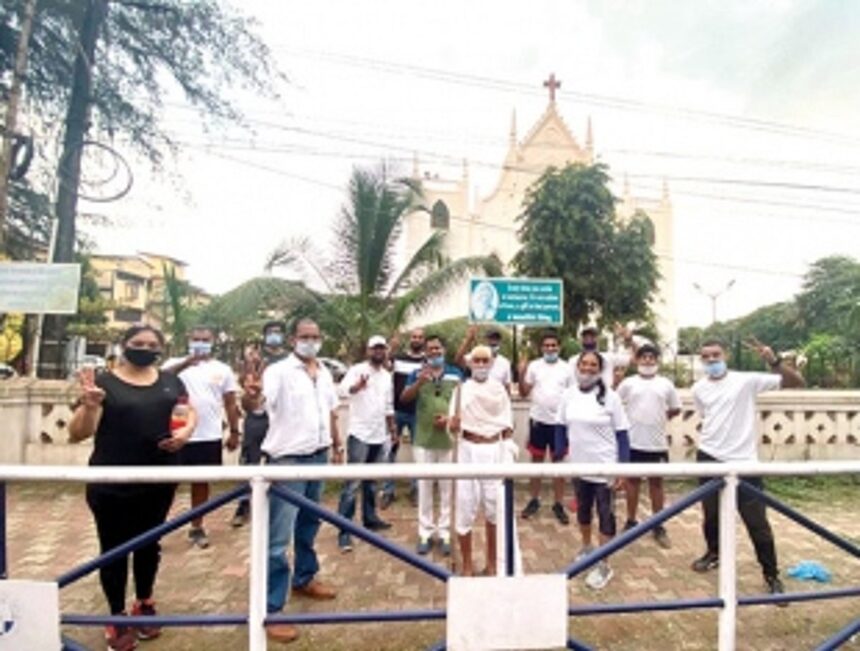
D’Silva narrates, “At 4.30 am, twelve of our members gathered near the fuel station at Mollem. We prayed and set out. Personally speaking, at 57, walking 74 kilometres is no easy task but everyone in my family has been training.
“Initially, 3 people from Collem and twelve of us members started the walk. Around 7 am, we were at Dharbandora. Then we reached Usagaon, where many others joined. People from Keri, Opa, Khandepar joined us till Ponda”
He continued, “At Ponda, I took a break of one hour to have a shower at home. At 10.30 am, we started again to walk from Sapna Park, heading towards Borim via Top Cola. At Borim people also showered flower petals. Fr. Bolmax and his team also joined us from Borim church. We turned right at Loutolim where we were joined by more and when we reached Cortalim the number of people had swelled to over 200.
And then they were those who gave fuel to the peace engines
D, Silva added, “It was really nice to see that people, especially senior citizens were offering water, juices to the walkers. There were some people in various places who were encouraging walkers by saying good things about the initiative. People were also saying that they are praying for the walkers. The ‘Peace Walk’ and the prayers, which we did silently was to pray to God to give good wisdom to our administrators who are ruling the people, how, why, when to do things. And can there be development only at the cost of nature?
Meanwhile, some of the people, who were the part of this walk, were also happy about the movement getting an overwhelming response from all walks of the state.
So many waves make a tide
It was like a tide. And many waves, big and small gave it strength. Chalton Furtado, a teacher from Chinchinim said, “I am in favour of a green Goa, which I saw in my early days, which is slowly becoming difficult to see now and I wanted to support our team during the ‘Peace Walk’ because the distance of over 70 kms would not be possible without teamwork.
Francisco Nunes of Chicalim, “In the years gone whenever a railway wagon was opened out at the railway station, we would see wheat, sugar or rice gunny bags but now we what we see is only coal and coal. Initially, people of the older generation, used to clean their houses dotting the railway track and remove the accumulated coal dust but now their children are educated and know what is affecting the environment and our health. Our younger generation opposes the double-tracking of the railway line, which will lead to more goods trains in the State, more dust and more people getting pulmonary diseases.
And in the evening glow of the setting sun as the walk culminated in Vasco, rose a new dawn and a new reality of Goans well and truly embracing the cause of protecting their land, a cause that will now be led by the young.
Over to the younger generation. Hear their voices in our accompanying story.