Karsten Miranda
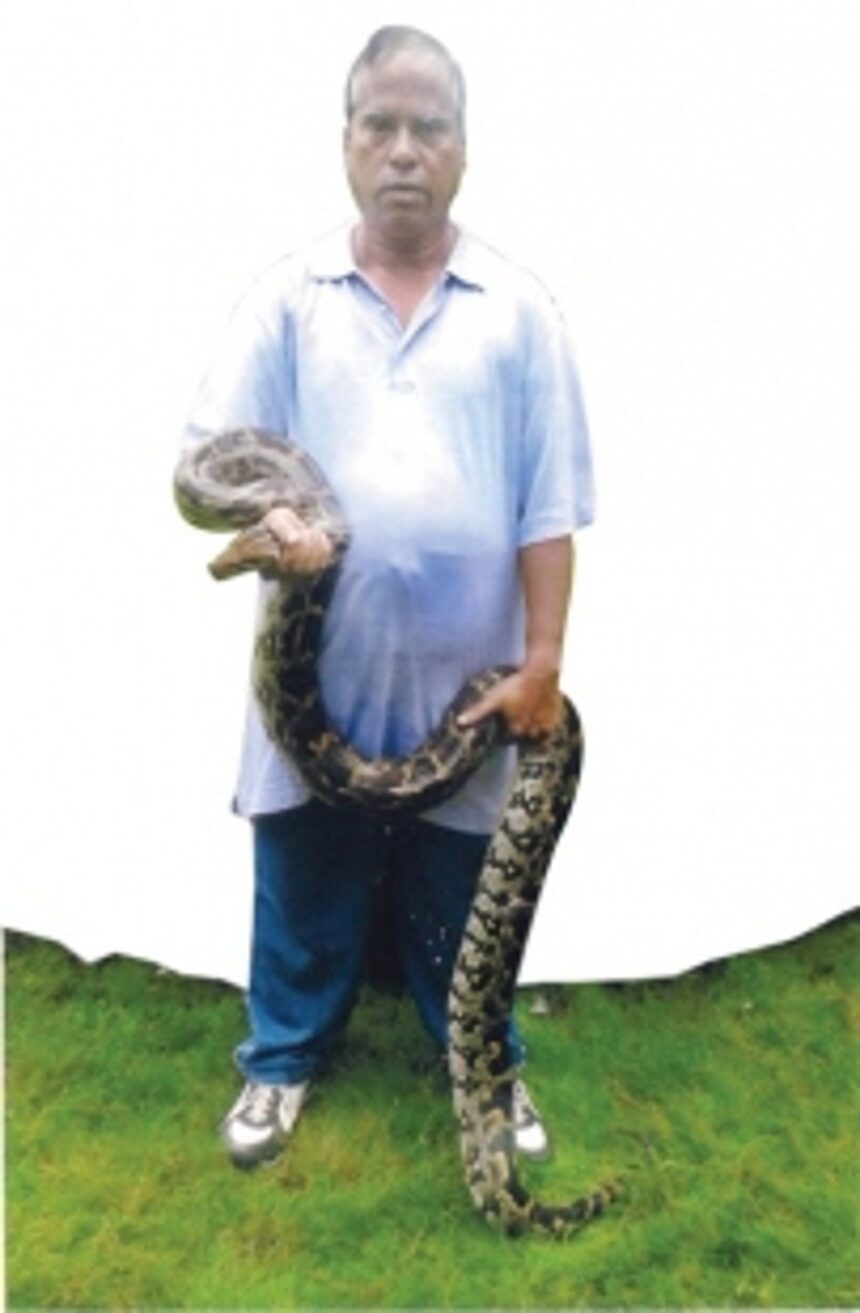
Margao: If you ask anyone in Salcete if they have heard of a priest who catches snakes, you will be told about the tales of a priest who has rescued snakes across Goa over the last 27 years. Thus, it came as no big surprise to the local parishioners of St. Alex Church, Curtorim when the assistant parish priest announced at the Friday morning mass that he had successfully caught the 100th python and offered a prayer on the occasion. The python was seen in Colva and the priest was called to capture the animal. Within a short time, he had done the needful.
Fr. Luis Pinto Lourenco, who also hails from Colva, has caught cobras, rattlesnakes and Russell’s vipers as well in addition to the 100 pythons.
The youth of Curtorim in particular were excited to hear about this development and watched Fr. Lourenco wash the live python’s body and mouth – a ritual he follows after catching any python after which he hands it over to the forest department. “I have been blessed with this gift of catching snakes. We must always save these animals as they are all God’s creation,” he said while recalling that he had caught the first python way back in 1988 when he was posted at Cortalim.
Reminiscing about his first encounter with reptiles that began this long journey, Fr Lourenco remembers reading a message from the Bible, Matthew ’16 :15-18 and how he was approached by the local ‘poder’ (baker) that morning about a python in the vicinity.
“I remember the poder came to me and told me that he had been asked to locate a hunter to capture the python that had gone near a residential area. I told him we should go and nab the snake and that I had read this passage from the Bible. I assuaged his fears and told him that God was with us, “said Fr Lourenco.
He said that they ended up waiting a long time before eventually nabbing the python using a net and ever since, the art of catching snakes has become second nature to him. “Pythons are strong and they can curl around you and squeeze you so you need to be fully aware of their movements and how to hold them,” he added.
He usually travels with three objects – a v-shaped stick, a net and a sack to capture the reptiles. “You have to be very careful because if anything gets caught in the snake’s mouth, you can consider it gone. The snake’s grip is very powerful,” warned Fr Lourenco, stating that only trained people like him or the forest department should be called in case of python sighting.
The priest stressed that he enjoys a good rapport with the forest department and that they were always prompt in rescuing animals.
Incidentally, Fr. Lourenco was given an award after he handed over his 50th python to the forest department in recognition of his efforts in protecting wildlife. “I don’t do this for any incentive. This is God’s work and I do this to help people who are scared and the python/snake that needs to be rescued,” he said. “I get calls often and I go whenever I can to help out as this doesn’t take much time.”
Fr. Lourenco has caught pythons from across Goa especially Salcete and Bardez and at far away places like Chaudi and Morjem.
When asked if he was never afraid of catching snakes, he spoke about his childhood when he had a deep fear for snakes in particular. “I remember I was flying a kite with my friends at Colva and we heard that there was a snake nearby. I left my kite and was so scared that I ran home and was sweating due to anxiety,” said the priest.
“Later when the neighbourhood boys told my mother what had happened, she told me that there was no reason to get scared of these snakes and perhaps one day I would catch them,” he went on to say while stating that his mother’s words turned out to be true in the end.
Speaking about the presence of snakes in residential areas, Fr. Lourenco gave the example of Loutolim, Verna and Rassaim where he spotted a lot of snakes and reasoned that the destruction of their nesting spots such as the Kesarval jungle was the reason for them moving to residential areas in search of shelter. “When the trees and jungle is cut, what happens to the home of these animals? Naturally they move out and we need to protect these animals and reptiles,” said Fr Lourenco while offering a sympathetic viewpoint.
He added that this was a sign that the snakes had lost their nesting spots and that it was important to hand over the animals to the forest department who would ensure that the animals were not harmed.