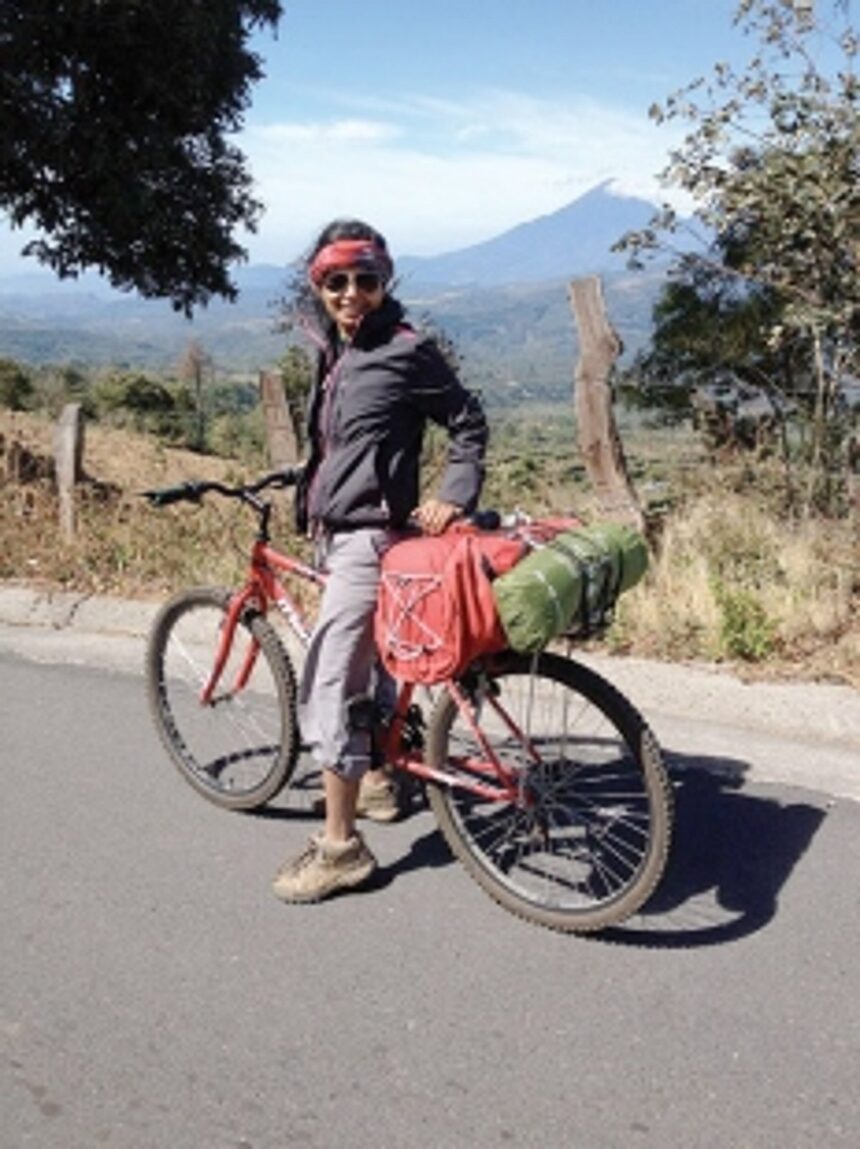
Across the length and breadth of the state, it is common to spot a group of Goan cycling enthusiasts riding on roads in a synchronised fashion and the song ‘Ain’t no mountain high enough’ fits them perfectly as they take on the toughest terrains.
In the first week of December, several of these cyclists who are part of various clubs across Goa were raving about the feats accomplished by a lady doctor. Given that there are several Goans who have covered impressive distances, for them to get so excited about one cyclist meant that it was truly inspiring.
“We cycled with Dr. Sarojini Monteiro. She is cycling from Kashmir to Kanyakumari for women’s health and the environment. Hats off to this woman!” exclaimed Vinayak Gaonkar, a Margao resident, who along with fellow riders accompanied Dr Monteiro to the Karwar border.
Dr Monteiro, hailing from Nachinola travelled from Margao to Karwar and all Goan cycling groups welcomed her and some of them joined her till Karwar.
“This is truly commendable. What is interesting is the routes she is taking – internal roads where she connects with the people, women in particular as part of her cause,” added Gaonkar.
‘Dare to Dream’ is an apt name for this project. Dr Monteiro began her journey on a cycle from Kashmir on October 18, 2015 and plans to cycle all the way to Kerala by December 24, 2015. She recently crossed her home state in the first week of December.
Dr Monteiro is on a quest to educate the community on the health and environmental benefits of cycling in the prevention of diabetes and non-communicable diseases and climate change. Through her pan India cycling mission, she is advocating for ‘women to cycle for transport’ and for ‘cycling infrastructure in India’. The other two objectives of the project are to conduct an observational and qualitative study to identify the barriers and facilitators to women cycling in India and to identify sustainable women’s cycling projects to increase the number of women who cycle in India.
The strategy involved in achieving the goals of the self funded group is to provide presentations in schools and the community and to conduct 20 interviews with women to identify the barriers and facilitators to cycling in India and to identify potential sustainable solutions to increase cycling in India with a target group women aged 18 to 45 years. She also aims at raising funds for women’s cycling research and sustainable projects to increase the number of women who cycle.
Explaining why she decided to start cycling across India, she said it was due to her passion for public health which has its roots in her Indian upbringing and her interest in health and environmental issues.
“I spent the first 23 years of my life in this wild and vibrant culture, experiencing the strength and humanity of its people, but also the extreme human suffering from preventable diseases caused by a lack of public health services amidst the confluence of industrialisation, westernisation and globalisation. My bold and vivacious Indian mother, the principal of a local government school, advocated bravely for disease prevention information and skills within the limited resources available,” said Dr Monteiro.
Inspired, she went on to talk about her move to Australia and the decision to commit her career to building skills, knowledge and experiences in international public health, in order to become a resource for international low-to middle income communities to prevent suffering and improve the health of people.
She obtained a Doctorate in Public Health with the focus on women’s health.
She has a decade of experience in Public Health and has held a number of positions including chief epidemiologist, public health policy, health promotion practice, and as a senior researcher.
“I love cycling and have travelled across countries using a cycle and other forms of public transport: Mexico, Guatemala, Belize, Costa Rica, El Salvador, Nicaragua, Panama, Colombia and New Zealand,” added Dr Monteiro.
India has intrigued her enough to take up this cause and she speaks about non-communicable diseases such as diabetes, cardiovascular diseases and cancers that are a public health concern in the country.
“The World Health Organisation identified the lack of physical activity as one of the five main risk factors for non-communicable diseases. Scientific evidence demonstrates that cycling has many health benefits including the prevention of diabetes and cardiovascular diseases. It is a form of physical activity that can be incorporated into daily living by using it as a form of transport,” she added.
She observed that women in most villages of India do not do a lot of physical activity for exercise apart from attending to household functions.
“In India, the harmful effects of environmental pollutants are felt by all communities as it affects the health and the livelihoods of people as India is predominantly an agricultural economy. Women can be encouraged to cycle to commute to work and school and thereby reduce carbon emissions,” explained Dr Monteiro.
Even as she points out that there is a small proportion of women in India who cycle, predominantly young girls, she laments that there is a lack of data on the barriers and facilitators to promote cycling among adult women in India. She takes relief from the fact that there is an increase in cycling groups across India which women are joining.
This project aims to understand the issues associated with cycling among women, to advocate for women to ride cycles in India to prevent diabetes and non-communicable diseases and for the environment, and to identify local solutions to increase cycling among women in India.