A deserted village with the men and women busy with terraced farming near the foothills of Guddi in Canacona is what we encountered during a trek through the village just off the NH17. Women were busy ploughing the fields while the men built bunds to hold water and kids helped with the transporting of small baskets of grains. Besides them, the oxen were grazing at the foothills.
As we climbed further using some makeshift stairs to enter the village, Draupadi Velip, an elder told us, “You shouldn’t come here in the morning as we go to the fields. Come after 3 in the afternoon. The entire village will sit and chat with you. We love guests and love to share about our dance, songs and stories of the past.”
We, however, proceeded to wait in one of the houses in the village with Bhagirathi and her family. She was soon joined by Sita, the senior-most Gaonkar and together they began to tell us with pride about their tribe.
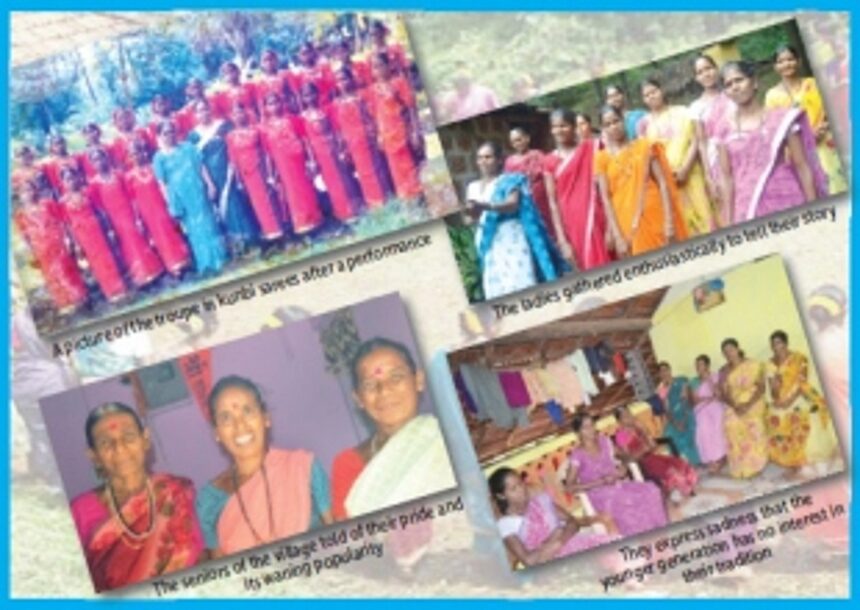
The women of this region belong to Malikarjun Self Help group and are proud of their traditional ‘Dalo’ dance. This is a dance form wherein they dance with necklaces of coins made by them, flowers entwined beautifully in their hair, their own ‘kunbi’ sarees and payals on their feet. The uniqueness about this 200-year old culture which has been passed down from generation to generation over time is that they do their ‘kalsi fugdi’ (dancing in circles) with no musical accompaniment. “The ganne (the lyrics) is what we have learned as kids listening to our mothers dance. We would recite and slowly they would initiate us to dance at Diwali or the zatra and that’s how we kept this folk tradition alive. We feel empowered to perform for the village,” explains Anjali Phundu Velip. But Anjali who gathered around eight women from the fields to meet us tells us how this tradition of theirs is slowly dying.
“Our daughters in-law and daughters don’t want to dance like us. It filled us with such pride to perform on the village stage which is a makeshift stage on the top of the hill. At Diwali, till date our women dance the fugdi for fifteen days in a row, but our younger women are unwilling to learn this tradition of ours,” stated Bhagirathi who holds a photo frame with pride of them doing the dalo in New Delhi.
The women explain what it means to them. They practice for about 8 days between their farming and managing homes and kids and perform from February to March at the local temple and various zatras they get invited to.
Now, the younger generation take their kids to a nearby primary school. Some of them take up jobs at shops or offices 8km away in Canacona town and stay away from farming and dancing. “All this was a celebration of our harvest, festivals, dancing for our Gods and interacting with the villagers. It’s not the priority for the women of today as they consider wealth and earning money more important,” explains Bhagwati Gaonkar.
Sri Srikanth Velip lit up when she spoke about how they performed in Delhi and travelled around with a 200 plus contingent. “We went for almost 20 days and performed in auditoriums. We performed at Goa Sadan, Goa Bhawan, at art and culture programmes etc. We performed for a huge audience and it was our pride to represent our tribe, our state and our culture,” she said.
Similarly, Draupadi told us how they were invited to perform in their Kunbi sarees and turo at the temple near the Panchayat hall in Guddi. Slowly they went many places and performed for small amounts of Rs 500 each. “We’ve even performed at the auditorium at Kala Academy. It’s a big feat for us to take our dance and act there in front of many Goans,” she explained.
Laxman Phondu, Anjali’s husband tells us that the men of the village known as the vadils or heads, perform at the Shigmo. They are only ten of them but for all other occasions, it’s the women who showcase their beauty, clothing and dance. “Even we went in a group of 12 along with the women and performed in our dhotor (loin cloths), colorful shirts and bandanas is Delhi and elsewhere, watching the women perform was a different aspect of culture, especially in the way they recite their music, the simplicity in their clothing and yet the responsibility they carry with them and yet perform so well,” he averred.
Laxawathi Gaonkar tells us that the entire tribe is of Gaonkars and that they have now become many families but for the sake of their dalo and traditional fugdi they would abandon their crop, farming or any activity and go for a performance if invited to perform anywhere in Goa. “We cook in the morning and go to the fields. But the fields, the crop, cashew picking in the summer or any other work can wait another day. Our dance comes first for us always. Money is not our priority. Tradition is!” she concluded as she got one of the ladies to make us tea while she spoke to us and fed the oxen simultaneously.