“We will be kickstarting it anywhere between the next two weeks to a month. The planning component is stretched over 38 months, so we are building these modules for different sectors within tourism. KPMG (India) will then have 60 months to implement it. Earlier, tourism did not have a perspective. That will come in now,” he says. The department is also considering developing an application, based on a peer review mechanism. We want to create a public platform. The idea is to build circuits for tourists, detailing beaches, hinterland, national parks, backwaters, riverine forts, etc.
This has to be provided on an easy platform,” states Abhyankar, a 2007 batch IAS officer of the Union Territories (UT) cadre. Speaking about his list of priorities for the sector he says, policies rank high. Referring to the registration of different types of trades under the Tourist Trade
Act, the director wants to streamline the system and make it web-based. “We want transparency and timebound service delivery. We are also looking at getting an ISO certification for this, so that there are standards and credibility associated with processes,” he says. While beach cleaning has already taken off, Abhyankar wants to build a public movement. “Changing behaviour is difficult. So we now want to focus on the awareness part. We are studying successful programmes carried out in the UK, Australia, even Hawaii, where there is a thrust on involving communities,” he says.
Part of this plan involves staging skits
and other socio-cultural programmes
on the beach over the weekend for
locals, fisherfolk and students.
In addition to regular inspections to
ensure contractors are also doing their
job, the department is also dabbling
with the idea of roping in litter patrols,
such as boy scouts or NSS.
For the much-awaited Exposition of
the relics of St Francis Xavier, the tourism
department is trying to compile a more
intensive collection of information about
Goa, which will help those visiting from
all over the world.
When asked about the evident tilt in
ratio of domestic versus international
tourists visiting Goa, the director insists
that their concerted effort will change
these figures.
In 2013, Goa saw 26,29,151 domestic
tourists, while the number of foreign
tourists stood at 4,92,322.
“There are many familiarisation (FAM)
trips happening. We had a delegation
from Armenia and Kazakhstan recently.
We want to become a competitive destination
that provides a diverse array of
experiences,” he says.
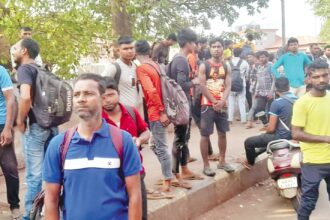
A direct effect of the increasing domestic
tourists, many of whom are allmale
groups, is unruly public behaviour
that locals have to tolerate.
But Abhyankar believes that encouraging
Goa as a family destination will
help curtail the menace.
“There is an act for regulation of nuisances
in tourist places, but these come
under the purview of the police department.
To address this issue, we are
planning to introduce a concept like
Delhi’s Raahgiri Day on the beaches
here. This will bring in a large number
of families. Public movement is what is
required for responsible tourism,” he
believes.