Goa ranks among the frontrunners on the Human Development Index for the country, fourth after Kerala, Delhi and Himachal Pradesh. While this speaks well for the state’s high literacy rate, a better standard of living and comparatively less unemployment, the employment statistics do not make a distinction between the jobs doled out in the government and those available in the private sector.
The Government of Goa in fact employs a substantial 58,008 people, to be precise.
For a state with a population of 14, 58,544 (as per 2011 census), this figure signifies that 1:25 persons in Goa have a government job—or to put it in another way, there is a government servant for every 25 citizens in this state, something that should raise eyebrows, because it is the highest figure in the country.
Governments have for years talked of decreasing paper work, cutting down red tape and making governance more tech connected to increase efficiency and cut down on the number of employees. Ironically, none of this has had any effect. On the contrary, the number of government employees has only been increasing.
The 2013 Census of Employees released by the Directorate of Planning, Statistics and Evaluation shows the Goa Government employs a total of 58,008 people across 76 government departments, 20 grant-in–aid institutions and 19 state public sector undertakings. The highest number of government appointments—6,172—are in the police department, accounting for 15.66 per cent of the total number of employees in the government. The recruitment for the police department, which is more than understandable, is also perhaps lower than it should be.
Just four years ago in 2010, there were 53, 069 government employees, making for a ratio of 1:28, and in 2007 the ratio stood at 1:32. But the government has been bloating with each passing year, and the much publicized claim that technology would help reduce the burden is surely not reflected in the employment figures. All the more surprising, since Goa’s burgeoning population should have actually brought the ratio down.
Lawyer Aires Rodrigues says the money being spent on e-governance has clearly had no significant impact on the reduction of manpower within the system. “Ironically with crores of rupees being spent on e-governance, the size of the bureaucracy should have been actually halved. But it has been bulging by the day and has almost reached 60,000 which is extremely steep for a small state like Goa,” he says.
Weighing the costs
So how much does it cost the state to keep such an over bloated workforce? The government’s salary bill touches Rs. 150 crore a month currently. As per the Economic Survey 2013- 14, salaries paid to the increase in the number of posts accounted for 38 per cent of the Non Planned Expenditure.
“The salaries are expected to go up by Rs. 136.93 crore during 2013 –14, marking an increase of 10.30 per cent over 2012 – 13. This increase in expenditure on salaries is mostly due to filling up vacant posts,” says the survey.
Government pensions too have taken the state expenditure up. A reply to a question in the July-August session of the legislative assembly, indicated that the government shelled out Rs. 417.11 crore for the year 2013-14 as pension and family pension including gratuity and commutation of pension. On an average Rs. 34.76 crore is paid out each month to government pensioners or the family of pensioners through notified banks.
The promise of a safe and secure government job seems to entice even fresh, young graduates in Goa who prefer a steady income from a boring 9 to 5 government job than pursuing other serious careers or venturing into business.
Fatorda MLA Vijay Sardessai points out that some people are even willing to give up their careers in engineering and commerce to pursue the easy going secure jobs with the government.
“There is this notion in people’s minds that a government servant’s job is the easiest and reaps a lot of benefits in the long run with an assured flow of money even after retirement. Graduates are known to give up their promising careers to land these government jobs. The way I see it, it is actually a problem. If everyone goes in for government jobs, who will open businesses in the state? Who will help build the infrastructure?” he asks.
But most significantly, does the government need so much staff? And is it justified in creating more and more posts and claiming that there is a shortage of manpower to run things more efficiently?
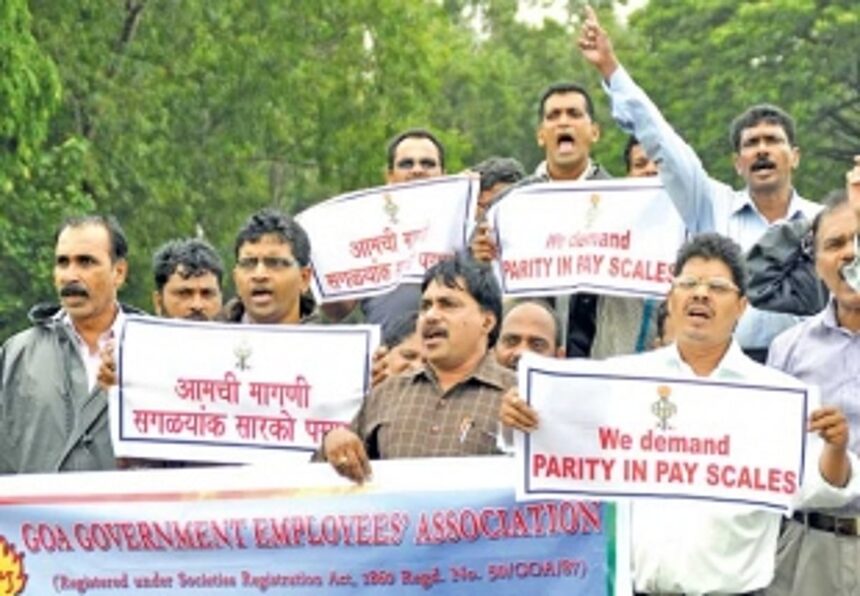
President of the Goa Government Employees Association (GGEA) M L Shetkar has a clear and firm No to all these questions.
“There are many departments that have unwanted staff or extra staff who do nothing but sit in the office all day. There are however many departments that are in urgent need of more work force,” he says, pointing to the PWD and water departments as a examples.
The reason consumers get their electricity and water bills after a period of two to three months instead of every month is because of lack of meter readers. Instead of investing in manpower in this department, the government instead hired an agency to handle a job that surplus staff in other departments could easily handle, says Shetkar.
“It is insulting for us as the employees of the state to face up to the general public’s view that we are happily drawing our salaries for which they contribute, only to be receiving late bills and not getting their work done,” he says, adding that it is the government, at the end of the day, that decides who to employ and why.
GGEA has never demanded for more staff than is necessary for a department, he explains, but points out that a proper assessment of departments needs to be done.
He recalls the time when ex finance secretary Ramesh Negi sent a circular to all departments banning any recruitment of staff unless an assessment report was first made. This was in 2007. There is an urgent need to bring this rule back, says Shetkar.
Political motivation, many believe, is often the primary reason why the government doles out jobs, putting more pressure on the state exchequer and probably also hampering efficiency.
Speaking at a Gomantak Maratha Samaj meeting last Friday, Chief Minister Manohar Parrikar openly admitted to giving BJP party workers first priority for government posts. “Majority of the total number of government posts advertised are given to BJP workers. If one BJP worker is denied a job, there are at least other 10 BJP workers appointed,” the CM said in response to a complaint by several saffron party members who said they had been denied government jobs despite their loyalty to the party.
“The Constitution of India envisages that the bureaucracy has to be absolutely nonpartisan. Government offices should never have been places to unload party cadres,” says Rodrigues. Sardessai points out that the bloated BJP party work force that is now currently finding its way into government jobs is only eating into the state’s budget
Review Bureau