‘Say! Take this impossible thing back! We don’t want it over here!’ A visibly angry Uncle Sam tells the Viceroy to India whilst lifting up a Sikh man with his fingertips. ‘Ha! Ha! not me’ the Viceroy replies. This racist political cartoon titled ‘A New Problem for Uncle Sam’ was published in the San Francisco Call on August 13, 1910 and was certainly a reflection of the times. The Indian in the cartoon is tagged ‘Hindu’, and ‘indolence’ and ‘incompetence’ are qualities attributed to him.
Fast forward to 2014 and it would seem nothing much has changed. Stereotypes continue to linger on in the imagination of the western world. Last month The New York Times was forced to apologize after carrying a cartoon on India’s Mars Mission when it depicted a farmer with a cow knocking on the door of the Elite Space Club.
The San Francisco Call cartoon along with other newspaper clippings, photographs and artifacts form part of a groundbreaking ongoing exhibition ‘Beyond Bollywood: Indian Americans Shape the Nation’ at the National Museum of Natural History administered by the Smithsonian Institution in Washington DC.
Indian Americans approached the staff of the Smithsonian when they found that their community wasn’t receiving the representation it rightly deserved. Of the 137 million objects at the Smithsonian National Collection, not a single one represented the Indian American community.
The 3.34 million Indian Americans are the third largest Asian community in the US after Chinese Americans and Filipino Americans. The exhibition that kicked off in February will continue till August 2015 and seeks to focus on the community’s contribution in the USA and to remove stereotypes (Bollywood movies, saris, elephants, gods, turbans and temples) associated with Indians.
Dr Masum Momaya curator of the exhibition who visited the State last week said one of the major challenges in putting the exhibition together was that there wasn’t any single definitive book or single source which highlighted the contribution of Indian Americans. “The available material was either restricted to a particular era or one demographic. We drew upon various sources over the years so that we could have a fairly broad story. In addition to archives and organisations there were various individuals who shared stories and valuable photographs from their private collections.
Indian immigrants went to the US as early as the late 1800s and early 1900s. Mostly farmers from Punjab, they were escaping oppression by the British. They worked in lumber mills, on railway construction and in iron factories but weren’t oblivious to the struggle for independence in India. They campaigned for the rights of their fellow Indians back home, forming the Gadar Party in 1913 and even returning to India to render their support. A photograph on display shows members of the party in San Francisco in 1924 getting ready for a trip back to India.
Another photograph on display dates back to 1910 when Kanta Chandra arrived in the US. She applied for citizenship as an unmarried woman but was denied. She pursued and continued petitioning for her rights finally obtaining her citizenship in 1969 at the age of 73.
Indian immigrants began to fight for citizenship in the 1920s. Credit for passing of the landmark 1946 Luce-Cellar Act went to the Indian Lobby. The Act allowed Indians rights to citizenship and land ownership. The Indian Lobby ad on The Washington Post shows the support the Indian Americans received from prominent writers Pearl Buck, Upton Sinclair and John Dewey among others.
Information at the exhibition states that many Indians start out as taxi drivers as these are one of the few jobs open to new immigrants who often find other jobs closed to them because of their accents and limited English skills. Many start their day in debt and work tirelessly without insurance for them and their families.
The exhibition also features Dalip Singh Saund, a farmer, mathematician and judge from California who entered American politics as early as 1957 and became the first Asian to be elected to Congress. He is seen with Senators John F Kennedy and Lyndon B Johnson.
Other photographs on display show the achievements of Hargobind Khorana the first Indian American to win the Nobel Prize in 1968. Zubin Mehta, the first person of Indian origin to become principal conductor of a major American orchestra. He served as music director of the Los Angeles Philharmonic and New York Philharmonic. Darsh Singh, the first turbaned Indian to play NCAA basketball. Balu Natrajan the first Indian American to win the National Spelling Bee in 1985.
In a section devoted to yoga, religion and spirituality, a photograph also shows Swami Satchidananda opening the Woodstock Music and Art Fair in 1969.
The H-1B visa welcomed Indian scientists and engineers in the 1960s and The exhibition goes on to credit Indian American inventors for Hotmail, The Pentium chip, Fiber optics and noise-canceling headphones.
The exhibition’s many artifacts include the dress, designed by Indian American Naeem Khan worn by First Lady Michelle Obama to a Governor’s party, the first doctor bag of Abraham Verghese author of My Own Country, campaign material of Congressman Dalip Singh Saund.
Discrimination against American Indians particularly Sikhs worsened post 9/11. Assumed to be terrorists because of their beards and turbans, the Sikhs were targeted. Four days after the attacks, Balbir Singh Sodhi a Sikh gas station owner was shot to death in Arizona becoming the first casualty of the racial backlash that followed. His family donated his turban and his diary to the collection. Empathising with the community, a cartoon in August 2012 shows Uncle Sam hugging a Sikh man.
The exhibition has well been received in the US, Momaya says. “We had hoped that it would be visited not just by Indian Americans and this has been happening with large numbers of the broad American public visiting too.” The only representation of Americans of Goan origin she says can be seen in a few family photographs.
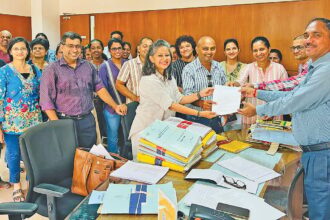
The exhibition at the National Museum of Natural History in Washington DC will continue till August 2015 and will then travel throughout the US till 2020. A travelling version of the exhibition is on display at BITS Pilani at Zuarinagar and will be travelling to Chennai and Kolkata in the next few weeks.
Review Bureau