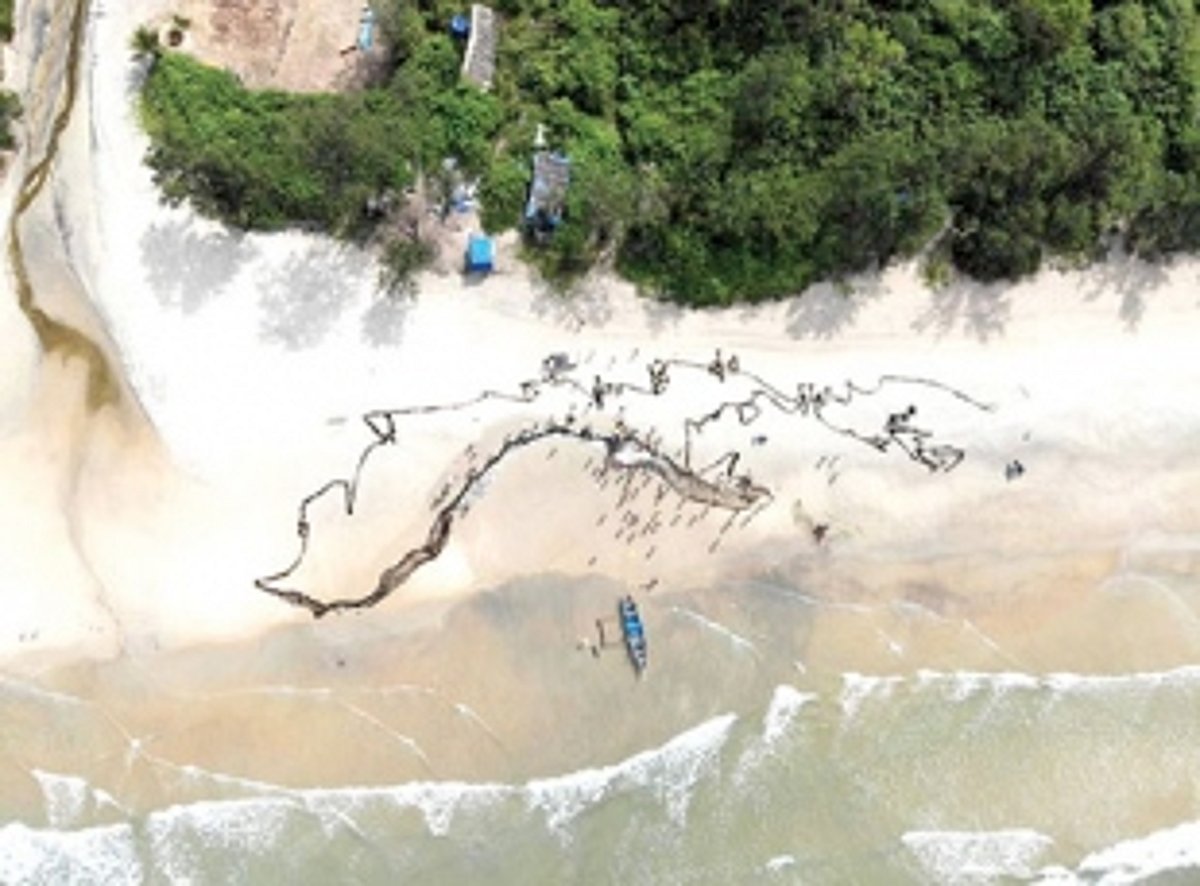
This was a life of a traditional fisherman in Goa. Rivers full of fish for enough food on the table and life in the lap of nature. From a way of life, fishing in Goa has become a cut throat business with numbers and profits, killing the traditional occupation and most of the fish. The State is rudderless and complicit in backing big trawler owners who blatantly use banned LED lights and carry out other methods of fishing, which are banned. DHIRAJ HARMALKAR & SUJAY GUPTA, drive through Goa’s southern coasts to net conversations and bring back a catch of information which, tells a sad tale.
Sea of sadness at the mouth of the Sal
he ironies are strikingly similar. And hard to bear. The seventeenth-century Betul Fort built by the Hawaldar of Balli, an administrator of Shivaji is a signpost of decay overlooking a sea of breathtaking panoramic beauty where the mouth of the River Sal bends and empties itself into the sea.
The decrepit fort with weeds weaving in and out of the ancient walls, pieces of debris; all fragments of history, strewn and the edifice of this grand Fort, perhaps the last Shivaji built, when he held sway over the territory before the Portuguese arrived.
The traditional fishermen of Betul on this Southern bank of the Sal, like the fort, look back on a dignified simple and happy past- words that resonate with a period that has been and probably will never return.
The stories of Betul’s traditional fishermen, whose unused traditional boats are kept outside their homes, are a cesspool of lament, of a beautiful life and its living assisted by nature, which had laid its bounty of the sea and the river at the doorstep of their village.
They lived by the sea, and of the sea, acknowledging with every breath their gratitude to God for giving them the ocean and its treasures, its fish.
On a clear afternoon last week, Team Herald wove its way through the narrowest of roads with homes on one side and the rocky path up to the Betul Fort on the other. The road was bursting at its seams, not with people but with fishing boats, parked and reached high. Why were they not on the water? Because there’s no fish in the water.
If you box this image in a freeze-frame and out sepia filters, it speaks not just a thousand words. It is a story of a lifeline that has snapped. It’s the story of a farmer whose fields have turned barren, or a writer who has lost his words or for that matter even a politician who has lost his people.
It is mid-afternoon. Sudhakar Vithal Joshi a veteran traditional fisherman, and Vice President of the Assolna, Velim, Chinchinim, Betul traditional fishermen association, responds to our knock on his door, weaving through his unused bits, he walks with us to the Betul Fort, about 500 metres away. Standing next to the Old Canon installed on Shivaji’s orders, overlooking the panorama of the Sal meeting the ocean, Joshi’s current life too is at the crossroads. But there is no confluence. He and his brethren have the Sal on their right of vision and then the bend towards the ocean and the vast expense on the other. He says softly, “We have no fish.”
The words took time to sink in, “Big trawlers with LED lights line up on the edge of their ocean pointing to the Sal. The beam of their lights pierces through the waters and all the fish get drawn towards the lights. And fish of all sizes and shapes gets dragged in. From newborns to eggs every gets sucked in like a vacuum cleaner”
The scourge of big trawlers has cleaned out livelihoods and tradition. A traditional occupation has been sucked out. And filled by hard business where each fish is a percentage point of profit. And for a short term, quick future of fishing is doomed because much of the sucked in fish is destroyed and then lives are nipped in the bud with eggs getting destroyed.
Pandari Kerker, lives in Betul too. From the height of the Betul Fort, his traditional fishing boats with a small motor can be seen bobbing in the waters but it has been that way for days.
“What is the point of even starting the boat? What will we get? Fishing was never our business. It still is our life. We caught fish to eat, to share and to get by. It was God’s gift to us served in the expanse of the river or ocean,” he explains further.
His eyes swelled up when he recalled, “There were times in the past when there was not much to eat at home. We used to cast our net and get enough fish, which we would quickly sell, buy some rice and have it with the curry of the small portion of fish we didn’t sell. They were such hearty meals.”
The relationship between the river and the communities who live by them are symbiotic.
“It is something that a fish trader will never know. They are just sharks of a different kind. They will push in more trawlers, with big nets and LED lights. Led fishing is banned but no one stops them” says Joshi.
“And do you know most of them are from Goa and not traditional fishermen. It’s just another business and when this doesn’t give them returns, they will move to something else,” Kerker adds.
It’s a stormy battle. For the control of the waters. A battle they are losing or have lost because power is clearly on the other side. Kerker is blunt when he says, “Who do we talk to? Ministers and MLAs have big fishing boats. They are in the business. Some have been ramponnkars before. Otherwise, why has the government not managed to enforce their own ban on LED fishing?”
In the villages of Assolna, Chinchinim, Velim and Betul, hugging the Sal as it bends to the sea, en route to Agonda and Palolem, traditional fishing families wonder why a way of life, their way of life has been taken away by sheer stealth and deceit.
Their shrill cry that can be heard above these still waters- “TURN OFF THOSE LIGHTS”.