World Blood Donor Day is celebrated annually on June 14 to raise awareness about the importance of donating blood and to express gratitude for the invaluable contributions of all blood donors. This also includes raising awareness about the need for rare donor types because some blood types are uncommon. It was initiated by the World Health Organisation (WHO) in 2004, in collaboration with various health organisations and governments worldwide.
Every year, blood donation by frequent and willing donors saves millions of lives. In India, the National Blood Transfusion Council, under the Ministry of Health and Family Welfare, has laid down blood donation guidelines that must be followed. As per the guidelines, men can donate safely once every three months, while women can donate every four months. Donating blood is of paramount importance for several reasons. Firstly, it saves lives by providing transfusions to patients undergoing surgeries, cancer treatments, traumatic injuries, and managing chronic illnesses. Secondly, regular donations help maintain a stable and sufficient blood supply, ensuring immediate availability during emergencies where time is of the essence. Additionally, blood donations support various medical treatments, as blood and its components like red cells, platelets, and plasma are essential for addressing conditions such as liver disorders, clotting issues, and severe burns. Furthermore, in times of natural disasters, accidents, or terrorist attacks, a robust blood supply is crucial for an effective healthcare response.

Due to the spread of misinformation, some people also believe that frequent blood donations can be harmful. World Blood Donor Day serves as a forum for raising awareness and educating people about blood donation and transfusion safety through advocacy and educational campaigns. Organisations aim to debunk stereotypes about blood donation, highlight its significance, and motivate individuals to partake in blood drives and outreach programs. Regular blood donation can actually protect the body against cardiovascular diseases and minimise heart attack risks. Blood donation helps with the early detection of certain health conditions, such as anaemia or infectious diseases. After donating blood, the body produces new cells to enhance overall health and works towards replacing the volume of blood lost within 48 hours of the donation. Another advantage of donating blood is that the donor receives a card, which can be used if they ever need blood in the future.
There are several ways in which one can contribute to make a positive impact on World Blood Donor Day. Firstly, one can make an appointment to donate blood if the eligibility criteria are met. Secondly, lend your support to blood donation campaigns by donating your time and expertise to plan blood drives, assist with logistics, or spread awareness about blood donation. Furthermore, one must make the effort to educate oneself about blood donation, transfusion safety, and its public health implications, keeping up with the latest developments in these fields.
Dr Siddharth Naik, a physician, says, “In order to become a donor, the person has to be between the ages of 18 and 65, above 45 kg and have a normal pulse and blood pressure. They should also get adequate sleep and not overexert before donating blood. They should not consume alcohol or drugs just before donating and they should not have any recent tattoos. A person with STDs, such as HIV or other such diseases, cannot donate blood. If the person has recently undergone surgery or is currently on medication, he will be deemed unfit to donate blood. In one sitting, 350-450 ml is drawn from each donor depending on their weight, after which they should drink a lot of fluids so that they do not feel drained out.”
Shashikant Naik, who has donated blood 51 times, says, “I have been donating blood for more than ten years and I donate blood every three months without ever having any negative side effects. I exercise regularly, eat well and avoid bad habits such as smoking, which helps me to be healthy enough to donate blood regularly. When I was in Class 8, my father met with an accident and it was a struggle for us to find him a blood donor. That was when I decided that as soon as I become a major, I will donate blood regularly to help save lives.”
Sagun Gawade, who has been donating blood for the past 10 years, says, “Every year, I donate blood on my birthday. To keep myself fit to be a donor, I exercise and cycle, eat whatever the doctor recommends and get adequate sleep. In the past 10 years, I have seen that awareness about donating blood has increased and my friends like to join me when I go to donate blood. Since I have been a donor for many years, people immediately call me when they are in need of O+ blood and I try to help out in whatever way I can.”
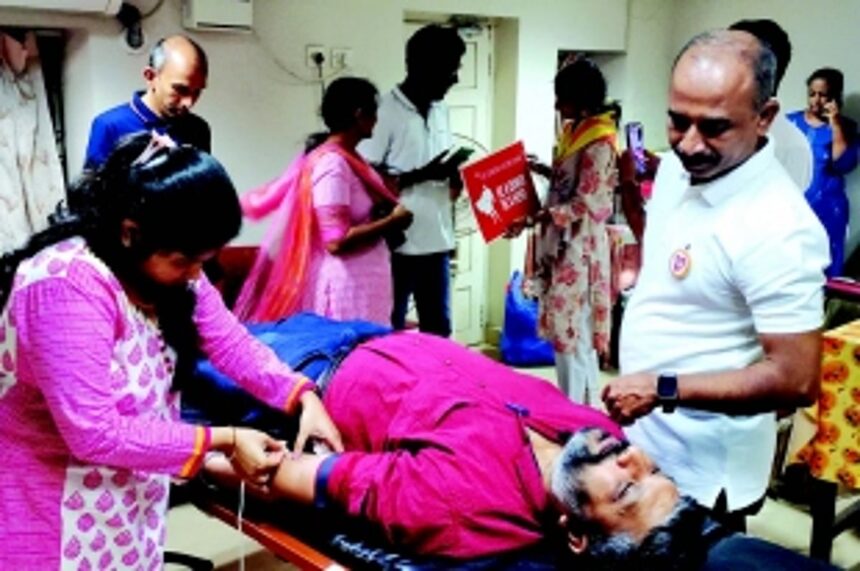
Devansh Cholera, a member of the NGO, Caring Souls, says, “Since the age of 18, I have been donating blood around four times a year. I was inspired by my lecturer in GEC, who came to our class just after donating blood, which dispelled my misperception that blood donation leaves you completely weak. That day itself, I went to the same blood donation camp and began my journey of donating blood. I eat a lot of vegetables and dates, especially after donating blood and have experienced no side effects so far. During Covid, I also donated plasma 10 times for Covid patients and currently I donate platelets every month for cancer patients. In honour of Blood Donor Day, our NGO will be conducting a blood donation camp on June 16.”
World Blood Donor Day therefore serves as a reminder of the effectiveness of collective efforts and compassion in tackling issues related to global health. One must recommit to saving lives through blood donation on this significant day.