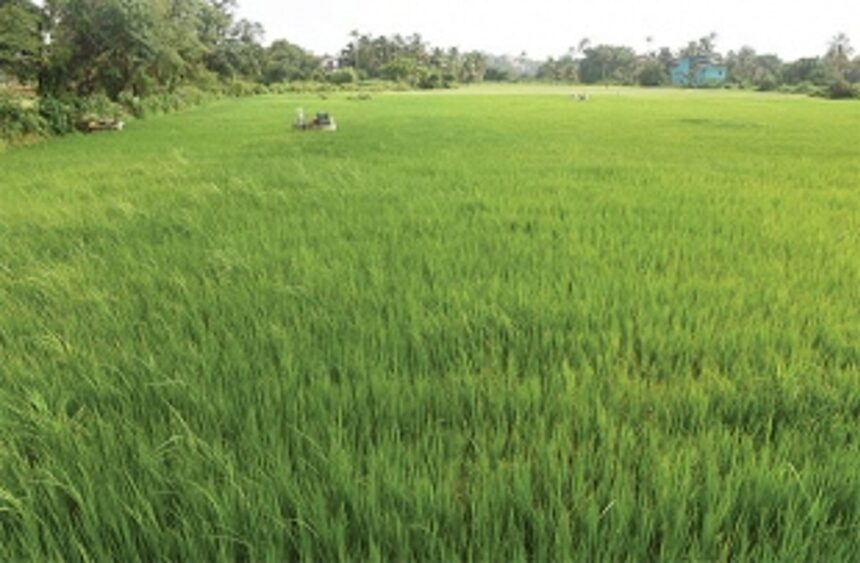
The lush, green fields in Goa have a calming effect on our eyes. But for a farmer, that same
piece of land earns him his bread and butter. Unfortunately, the farmers who
support us with a regular flow of crops are the ones who are less supported by
those who live around them
Taleigao was known for the tastiest brinjals in Goa, which have
their own Geographical Indication (GI) mark. In the vast tracts of land, rice
is cultivated during monsoon and various local vegetables are grown during
summer. Progressive Farmers’ Club of Taleigao has been working on motivating
the existing farmers to continue farming even as they stare down at the ugly
face of rapid development. The President of the Club, Xavier Almeida, has been
protecting the land from real estate sharks and fighting against all odds.
“There are 60 members in Taleigao with nearly 20 members owning fields in high
areas. There are many who have stopped farming because of manpower issues and
cost of labour but there are some like Vito Gomes who continue farming. This is
the season for growing paddy and once it is harvested, we will immediately
start growing vegetables like sweet potatoes, lady finger, maize, chillies,
snake gourd, pumpkins and onions,” says Xavier, who will be cultivating string
beans, pumpkins and snake gourd.

Taleigao native Vito Gomes owns and operates a global aviation
services company, and was ranked 50 in a 2019 Forbes list of Top 100 Indian
Leaders, has made a big impact in the Middle East. However, he can still be
seen on his ancestral family land, growing vegetables and fruits and fighting
against the trend of real estate expansion in his village. Down in Goa for the
Harvest Festival that was celebrated on August 21, Vito says, “The Taleigao
Gaunkars comprise nine families as of today, namely Mendonca, Viegas, Martins,
Luis, Gomes, Faria, Almeida, Falcao and Abreu. These nine families in rotation
every year take turns to solemnise the feast of St Michael. This year, my
family, the Gomes family, is the main celebrant of the feast”
Most of the families were cultivating the fields and managing
plantations of cashew and mangoes with the help of cattle. Farm land over a
period of time has been damaged due to illegal structures that have mushroomed
in the fields as well as the concrete jungle that has come up around it. It is
difficult to cultivate as the canals and drainage systems are blocked by
construction waste, which is let out into the fields.” Vito won the first place
for being the highest supplier of locally grown vegetables to the Goa State
Horticulture Corporation for three consecutive years between 2014 and 17.
The club is not only involved in farming but also fighting to
save the existing traditional fields from being converted from agricultural
land to settlement areas for real estate. Vito was instrumental in challenging
in court the Taleigao ODP finalised by the Greater Panaji Planning and
Development Authority after it refused to consider his objections to several
roads proposed in it cutting across paddy fields including his farm. “The
criss-cross roads were drawn across the fields to sustain the builders. The
plans were passed without any meetings in the Gram Sabha with the local
farmers. There is a lot of pressure on the land and Taleigao itself has very
little resources. There are already problems over traffic management, water
supply and sewage in the village,” says Xavier.
Pundalik Raikar has been with the Progressive Farmers’ Club of
Taleigao since its formative years and is looking out for a farm to cultivate
with all earnestness. “Farming as an occupation against real estate is peanuts.
However, if a family continues farming for 100 years, they will still derive an
income and sustain on those fields for generations to come. I have seen
families that have sold their fields for huge amounts of money and in the end
have destroyed their own family and life. It is absolutely worth it to grow
your own fields and the joy of seeing the produce is priceless.
However, in Taleigao, fields and especially low lying field
areas have notoriously been destroyed and converted. Land filling is happening
and politicians play a role in this. We are fighting a defeated cause and the
farmers are feeling de-incentivised,” says Pundalik.
As the village is still in the spirit of the four-day long
Harvest Festival, Pundalik points out that the village is known for its
flourishing green fields and what will they reap for their harvest festival in
a few years if the land is not cultivated. “We might have to bless the harvest
grown in a small pot. We can earn billions on land but once nature is gone,
it’s gone forever. The most recent example was the water supply to Taleigao.
Since the wells are not maintained any longer, the taps were running dry in the
village,” he says.
While
Taleigao is gradually turning into a city of its own with large gated
communities and complexes, it is still a village at heart that doesn’t want to
part with its roots.