The harvest festivities date back to pagan times, and the name harvest is derived from the old English word ‘Haerfest’, meaning ‘Autumn’. The Romans had their LudiCereales, or feasts, in honour of Ceres, a goddess of agriculture, grain crops, and fertility. In the 16th century, a wheat harvest festival called Lammas Day/Loaf Mass Day was celebrated in England on August 1 with mass gatherings where individuals thanked God for the season’s first harvest. Farmers made loaves of bread from the first wheat crop and offered them to the local church as Communion bread during a special thanks service.
Harvest festivals are held in September or October, depending on local tradition. Today’s church celebrations only began sometime in 1837, when the Reverend Robert Stephen Hawker invited his parishioners to a unique harvest thanksgiving service at the church in Morwenstow, Cornwall, UK, in 1843.

Fish-curry-rice has been the staple diet of Goans since time immemorial. Harvest feast has been celebrated in the villages for centuries as a thanksgiving ritual to the Almighty, anticipating a rich crop. The scriptures remind us always to be thankful to the creator. In the Old Testament reading from the Book of the Prophet Joel (2:26), we are reminded of how much we are blessed – “You shall eat in plenty and be satisfied and praise the name of the Lord your God who has treated you so wonderfully”.
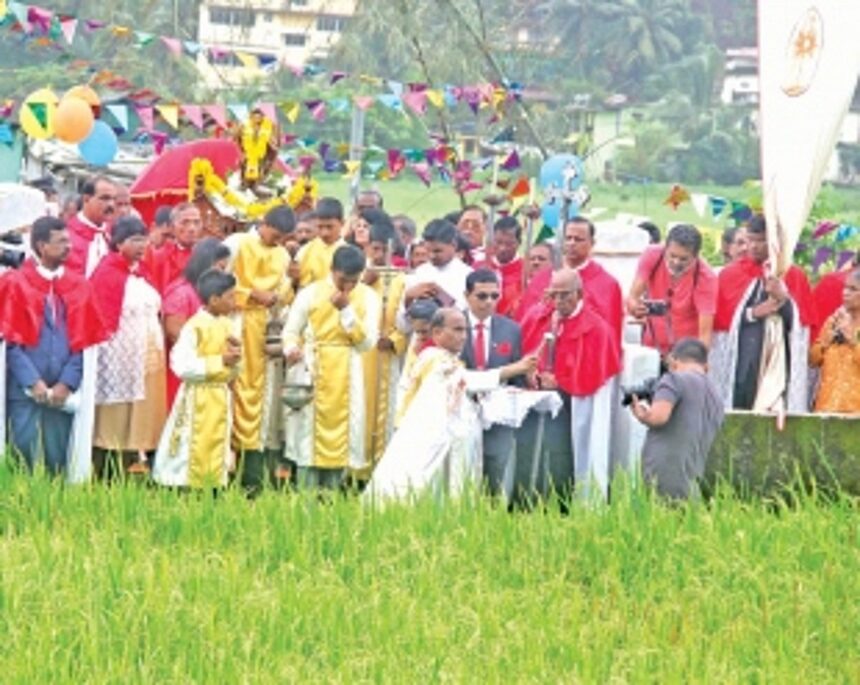
Taleigão Comunidade’s privilege for celebrating Novidade on August 21
The King Manuel-I of Portugal was keen to establish sea routes to Asia for the spice trade, so he deputed Admiral Afonso de Albuquerque. In Europe, exotic spices were in demand in those days for preparing food dishes, adding flavour to sauces and wines, and for use in medicines. The Ottoman Turks monopolized the traditional route through the Red Sea and the Gulf. Adm Albuquerque planned to assume active control over all the main maritime trade routes of the East and establish colonies. At that time, Ismail Adil Shah of Bijapur’s rule was oppressive to the Hindu population; he doubled the taxes and made their life miserable. So Hindu chiefs of Goa complained to Timoja/Timaya Nayak, a powerful and influential Hindu exiled from Goa, about how the Muslims exploited them. They pledged their support to Timoja if he agreed to assist them in changing the situation. Timoja invited Albuquerque and his captains to conquer Goa. The King sent Adm Albuquerque to capture Ormus, Aden and Malacca. Albuquerque’s fleet launched an attack from the River Mandovi on the Adil Shah palace in March 1510 but was repulsed by 60,000 Muslim troops. Albuquerque immediately left to get more soldiers, leaving behind his fleet. Soon the monsoon arrived, and the Portuguese forces were stranded at Penha-de-França because the navigational channel was blocked by a sand bar at Aguada.
The troops ran out of food and had to survive on mice. The fishermen of Taleigão saw their plight and informed the ganvkars, who quickly arranged food grains, as large tracts of Comunidade land were under agriculture. Taleigão was a prospering with agricultural produce that it was known as the granary of Tiswadi. They loaded food into canoes at Caranzalem and sailed into the night toward the Mandovi river, risking their lives from Muslim soldiers and bad weather. Albuquerque returned with a larger fleet and captured Ilhas on November 25, 1510. Good deeds are rewarded. When Albuquerque was elevated to Governor of Portuguese India, he granted the ganvkars of Taleigão three privileges at their request. (1) To cut paddy sheaves on August 21, three days before the rest of the Tiswadi villages. (2) To carry the Portuguese flag during the harvest celebration. (3) To present the first sheaves to the Governor. To this date, the ganvkars are following (1) and (3) and other regulations inscribed in the Code of Comunidade through the intersession of village patron St Michael.