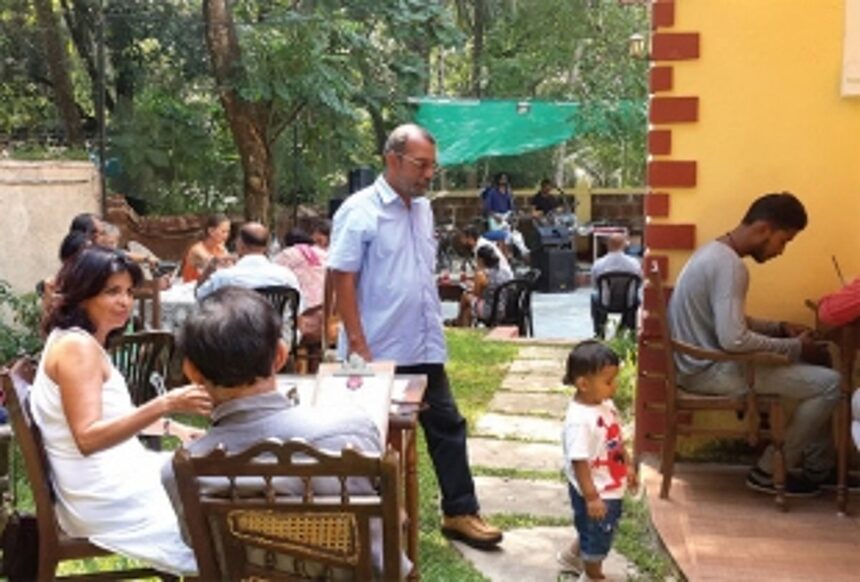
Goa’s old homes never fail to evoke a series of emotions. From angst at those that are
dilapidated due to reasons such as litigation amongst family members fighting
over it, or immigration, a general state of disinterest, and greed at the
prospect of selling to the inflated rates offered by the real estate lobby for
the purpose of demolition, to elation at those that are well-maintained by the
members of the family that reside within their stately spaces, there are myriad
emotions that accompany the sheer sight of these structures.
Fortunately, in more recent times, it is the latter aspect that
has truly stood out, with many of these spaces being given a new lease on life,
largely because they have been able to monetise their own upkeep through
ventures that have popped up from within their walls. Prime examples of some of
these include the likes of ‘Sunaparanta, Goa Centre for the Arts’ in Altinho,
where ‘Cantina Bodega’, simply known as ‘Bodega’, has now become a must-eat-at
place, when in Goa, or for that matter ‘Vivenda Dos Palhaços’, in Majorda,
where the charming hostess that is Charlotte Hayward, takes you on a journey
through time through the early twentieth century home. There’s also an
interesting new entrant in this sphere, courtesy Casa Menezes, a heritage homestay
tucked away in the quaint village of Batim.

The village of Loutolim, somehow, has been ever on this happy
camping trail of utilising the inherently vintage spaces as places of interest.
Let’s take for instance the home of the Figueiredo family, where the lady of
the house, Maria de Lourdes Figueiredo de Albuquerque, the current owner of the
home (also notably the first female member of Portuguese parliament) has been
running the house as a museum since 2010. In the same village, for over a
decade, Carole and Norman Steen have been running one of the finest homestays
in the state – one that emanates a true sense of warmth from the vibe of the
owners themselves, in the form of ‘Casa Susegad’. The Steens, who share the
home with their ever-growing menagerie of animals, have repeatedly stated that
at the end of their day, their venture is a labour of love, one that has
enabled ordinary people to lead extraordinary lives. In more recent times,
we’ve seen the rise of the village’s first proper sit-down restaurant, one that
merges the old with the new, and sees old-school dining find a way to meet the
feel of an ancestral home, in the form of ‘House No. 2’. A project started up
by Orson Dias and Lineker Furtado, ‘House No. 2’ is the ancestral home of the
Antao family that once resided in Ambora, and was only the second-ever to be
built in the village. Today, it serves as a dining spot that has people
constantly returning for more.
In the year 2012, one section of an old home belonging to the
Jacques Godinho family in Majorda was given a new lease of life, in an
interesting manner. One member of the family, Daegal Godinho, decided that it
would be best put to use as a space for the arts and crafts. The success of
‘Carpe Diem – Art and Learning Centre’ (as he would go on to name it) since
then is a clear indicator that there has been no looking back since then.
Speaking on the vibe that is imbued by these old structures, Daegal says,
“There’s an instant charm associated with a heritage home. And for art of all
kinds to be set in such an ambience makes for a feel so very different from the
modern contemporary bare faceted walls of new buildings.”
However, it is not without its downsides. Setting up such a
space involves time, labour and a sizeable investment, but it does not deter
those who choose to go down that path. “In my case, I had the space and the
desire to create an art centre, so the art gallery was a natural outcome. But
is it easy setting up a business or for that matter, maintaining the space? The
answer is a definite no. From the start, there were old mud walls to plaster
and paint, roof tiles, beams and odd angled ceilings to deal with, flooring
that needed to be upgraded with the old fashioned feel, tons of wiring,
lighting and plumbing too. It doesn’t end there either; every year roofing
needs to be reworked, every week cobwebs need to be dealt with, and one is
perpetually worrying about the rains and the effect of moisture in these old
houses. White ants can be trouble if not dealt with in time, and some old door
or shell window needs repairs sooner rather than later. But would I prefer a
modern building to this? No way! The odd shapes of spaces being re-used for new
purposes, the handmade feel to the flooring and uneven walls, and most
importantly, the sense of pride in looking after a structure that not only
withstood so many centuries but tells of history and culture and is made
accessible to everyone is more than reason enough to choose a space like this,”
Daegal adds.
In São Tomé, in Panjim, one little gem that has been standing
out in more recent times is Caravela. The space serves as a little café and
bistro, apart from being a notable bed and breakfast, all ensconced by three
levels of centuries-old Indo-Portuguese architecture along Rua 31 de Janeiro.
The little yellow building has been up and running for a couple of years now,
and has required its fair share of work, but it’s not without reward, shares
Carlos Noronha, the man behind its operations, barely into his twenties.
Carlos shares a little on the journey thus far, saying, “When we
took over the space, it was very sparse and needed a complete overhaul, which
we undertook over a period of time. To say that the investment was large would
be an understatement, but it is also a given that one needs to shell out in
order to own such kind of properties. The end result is well worth it though,
because it is a must to showcase our heritage. As Goans, hospitality is a large
part of who we are and how we conduct ourselves. So this, in many ways is a dual
showcase of ‘Goan-ness’ – one, through the place itself, and the second,
through what it is being used for.”
These
spaces may have taken on a different raison d’être or proverbial purpose
for existence than what they were originally designed to do. However, these
same purposes are the very reason why these places not only still stand today,
but rather, thrive. And that being said, whatever the reason may be, for
something being able to stand the test of time has certainly got to be
commendable in its own right.