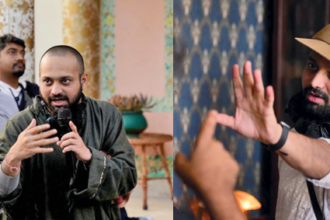
Fashion designer Anuj Sharma, who won the
Innovative Collection of the Year Award 2009 for his Button Masala Collection,
put his creativity to best use by teaching his unique Button Masala technique
to the members of the Tara Women’s Innovative Group (TWIG) recently in Goa. TWIG
works in the area of skill development and capacity building for women of
low-income background, migrants and the underprivileged women in Goa.
Shedding light on the mission of the TWIG,
Project Director Juhi Pandey says, “We always organise innovative workshops for
our group, and it’s with the thought of adding another skill to their regular
working style that we invited Anuj Sharma to Goa to teach them the Button
Masala concept. TWIG coordinator Shaily Dutt was also there throughout the
workshop project. The designed garments by this group were on display at a
fashion store in Panjim.”

Anuj entered the world of fashion with his
debut collection – Sunday Market – in 2007, after his post-graduation studies
in Apparel Design at the renowned design school National Institute of Design
(NID), India. Speaking about this technique, Anuj says, “So far, I have
introduced this technique to 10,000 people. It is a very simple, affordable and
quick technique. It’s sustainable and works well because there is no
wastage. It is a done manually; no
machines are needed. Buttons are wrapped in fabric using rubber bands; these
rubber bands hold the buttons. The concept is around 5 to 6 years old. I had
developed it for one of my shoots. I liked it so much that I continued doing
it. I have been working on it since then. Teaching and spreading the technique
has been the main area of my work.”
Clearing the misconception that only
fashion designers can use this technique, Anuj explains, “People are under the
impression that only designers can design. I disagree. They should not feel so.
It’s only fear that prevents them from learning. Those who take the trouble to
learn the technique can overcome this fear and become better at it. On my last
visit to Goa, I came across the craftsmanship of the place. The people here
embroider so well, they know how to convert fabric and make something better
out of it. If they acquired this technique, they could totally change the
structure and pattern of the dress.”
Speaking about the origin of the Button
Masala technique, Anuj says, “I saw somebody who was wearing an unbuttoned
shirt. At that time, I started visualising a different pattern of buttons
wrapped with fabric at every intersecting point and how it would appeal to the
eyes. As for the title of this technique, it was something interesting with
buttons; a play on ‘Mutton Masala’.”
Commenting on the fashion scene in Goa, he
says, “I like Goa. As far as Goa’s fashion point of view goes, it’s
interesting; Goa has its own culture. Over here, people are already used to
wearing western attire; things are different in the North. Western clothes are
very tough to sell in the rest of the country. I’ve also noticed that despite a
big market, people have reservations about spending, which is fair enough. It’s
not necessary to spend when you don’t want to buy.”