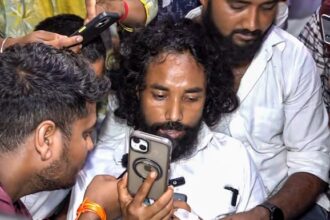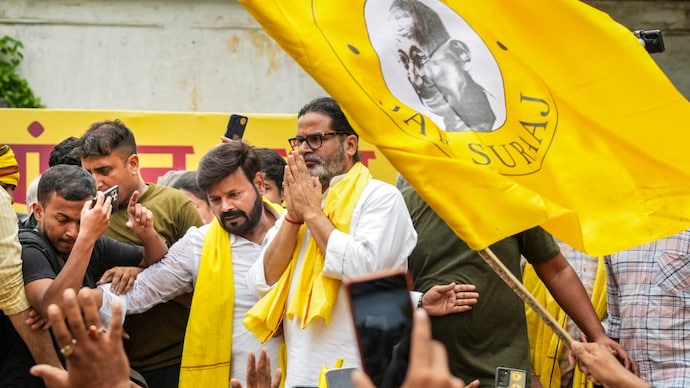
Prashant Kishor’s victory in the Bankipur Assembly bypoll has emerged as one of the biggest political upsets in Bihar in recent years. Contesting his first-ever election, the Jan Suraaj Party founder defeated BJP candidate Neeraj Kumar Sinha by over 19,000 votes, securing his party’s maiden electoral victory while ending the BJP’s uninterrupted hold over the constituency since 1995.
The defeat is particularly significant for the BJP because Bankipur was vacated by former MLA Nitin Nabin after he became the party’s national president. The constituency had long been considered one of the BJP’s safest seats, with the ruling party also enjoying the advantage that typically comes with contesting bypolls while in power.

Here are the five key factors that contributed to Prashant Kishor’s landmark victory.
1. The Election Turned Into a Test for Samrat Choudhary
The bypoll quickly evolved into the first major electoral test for Bihar Chief Minister Samrat Choudhary after he took office in April.
Prashant Kishor repeatedly portrayed the contest as a direct battle against Choudhary’s leadership rather than just the BJP candidate. Throughout the campaign, he questioned the chief minister’s leadership and projected the election as a referendum on the state government’s performance.
After his victory, Kishor claimed the verdict had sent a message to the BJP leadership to appoint a capable and upright chief minister for Bihar.
2. Three Decades of Anti-Incumbency Worked Against BJP
Bankipur had been represented by the same political family for nearly 30 years. Nitin Nabin held the seat for two decades after succeeding his father, Nabin Kishore Prasad Sinha.
Political observers believe voter fatigue and dissatisfaction over local development created strong anti-incumbency sentiment, allowing Kishor to position himself as a fresh alternative focused on governance, employment and infrastructure.
3. Fragmentation of RJD’s Traditional Vote Base
Another major factor was the apparent division of the Rashtriya Janata Dal’s traditional Muslim-Yadav (M-Y) support base.
Analysts believe many Muslim voters viewed Prashant Kishor as the strongest candidate capable of defeating the BJP and shifted their support to Jan Suraaj instead of the RJD. The result pushed the RJD into a distant third place, with its candidate securing only around 14,000 votes.
The outcome has also intensified questions over the RJD’s future as the principal opposition force in Bihar.
4. Shift in Upper-Caste Votes
Political analysts also pointed to changes in traditional upper-caste voting patterns.
Prashant Kishor, a Brahmin, is believed to have attracted a section of upper-caste voters, including Brahmins and Kayasthas, who have traditionally backed the BJP. Since Bankipur has a sizeable Kayastha electorate, even a limited shift proved significant in a closely watched contest.
5. Early Campaign and Strong Grassroots Organisation
Unlike his rivals, Kishor began campaigning nearly two months before the BJP and RJD launched their full-fledged election efforts.
He conducted extensive door-to-door outreach, held public meetings and built a booth-level organisational network across the constituency. His campaign centred on local issues such as employment, education and governance while particularly targeting first-time and Gen Z voters.
The BJP, despite deploying around 40 star campaigners—including Chief Minister Samrat Choudhary and senior Union ministers—was unable to overcome Jan Suraaj’s early momentum and grassroots mobilisation.
Prashant Kishor’s victory is being viewed as more than just a bypoll upset. It has established Jan Suraaj as a serious political player in Bihar, raised questions over the BJP’s ability to retain traditional strongholds and signalled that shifting voter preferences could reshape the state’s political landscape ahead of future elections.